Trump revealed real intentions. “Don't ignore his crazy statements”

Since he first took the office of the president, it was increasingly difficult to define the “Trump's doctrine” in foreign policy. The Republican undertook more and more conflicting actions, while gaining more and more confidence in his instinctive decisions.
Outstanding foreign policy experts have devoted many articles to attempt to explain the goals of a man who does not want to clearly determine. They had various theses – that he is a shallow transactions, a realist with principles, an imperialist with obsession with the western hemisphere. Trump himself once said about himself. – I am a nationalist and globalist. I am both.
His decision to bomb Iranian nuclear objects shows that he is located at the stage where is ready to take a huge risk without worrying about the consequences.
Trump without restrictions
He has already survived a lot – two impeachment proceedings, convicts, two attacks on their lives. He no longer has to apply for the office. And probably his advisers will no longer stop him from various actions, as they did during his first term.
Even when Trump withdraws from his resolutions (even a special term “Taco” was created for this – “Trump always withdraws”, in English: Trump Always Chickens Out), it still changes the framework of conversation.
“It's Trump without restrictions,” said Ilan Goldenberg, the Middle East specialist who worked in the team of Joe Biden, referring to the behavior of the Republican.
I never wanted to define presidential doctrines. I consider it unfair to try to draw leaders who face so many different crises. However, I feel sorry for people who want to find consistency in Trump's behavior, because as people we all need a sense of order and clarity.
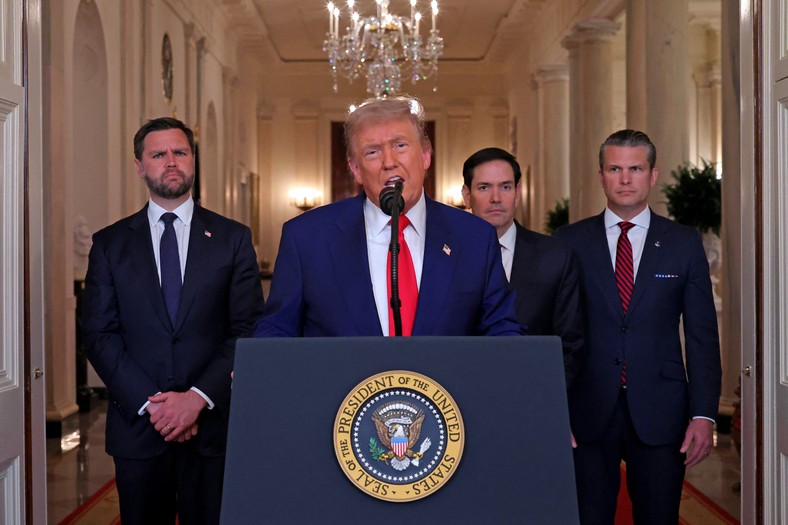
Donald Trump talking about the US attack on Iran, behind him from the left since: Vice President JD Vance, Secretary of State Marco Rubio and defense secretary Pete HegeSth, White House, June 21, 2025.
When I asked several former officials and analysts what Trump's attack on Iran means for his doctrine foreign policy, they could feel their fatigue attempts to understand the president's volatility.
– I have no idea what this doctrine is. Ask him – one of the analysts told me.
– Seriously? – asked the Bush II administration clerk. They both asked for anonymity.
Others attempted to define his foreign policy doctrine.
Trump “puts emphasis on diplomacy, but leaves no doubt that the diplomatic windows are not infinitely open,” said Bill Cortese, an activist of the Republican party close to the White House. – It always takes into account the use of force, but the use of US resources is limited, targeted and has the final purpose – End of conflicts with an indefinite ending. It must also answer the final question: does this bring direct benefits to the United States? He added.
Eddie Fishman, an expert on sanction who worked for Obama's administration, put it in a different way. – Trump seems to believe that a quick and decisive use of US force – whether economic or military – allows you to achieve maximum goals. According to Trump, the difference of forces between the US and other countries is so great that when we operate boldly, others give up – he said.
Poor resistance before using force
Trump's decision to hit Iran will be a test for these theories, as well as for his risk tolerance. He can also decide on the final shape of his “doctrine” – if it can be called that.
Trump called Iran not to take retaliation and use the US attack as an opportunity to negotiate a kind of room. However, he has already threatened revenge and Almost all American officials I talked to expect to keep this promise. On Sunday, there were reports that Iran could close the Strait of the Ormuz, which could cause a rapid increase in oil prices and turmoil on the markets. The United States also has about 40,000 Soldiers stationed in the Middle East, which gives Iran many potential goals.
If Trump's hope for a one -time attack turns into an endless war into mutual retaliationit will lead the United States to a war, which he has long promised to avoid. That would be enough when it comes to “insulationist”.
Countries observing the situation from the side from Trump's approach to the conflict, which intensified after Israel's starting attacks on Iranian purposes, can draw several conclusions.
First of all, Trump does not bluff when it comes to using force, even in an extreme form. Although during his first term he conducted military attacks (to Syria, on an Iranian general staying in Iraq), these activities were probably more balanced than the Iranian bombing of Iranian territory with bunkers destroying bunkers.
Limited diplomacy
The second lesson is that he believes in diplomacy, but there is not much patience with it. This applies especially to the opponents he considers much weaker than the United States.
Iranian officials tried to use their usual delay tactics during negotiations with Trump's envoys. When Israel decided to attack Iran two days before the planned meeting of Iranian and American officials, Trump, annoyed by the reluctance of Tehran to commit to completely cease to enrich uranium in Iran, did not make too much effort to stop the Israelis.
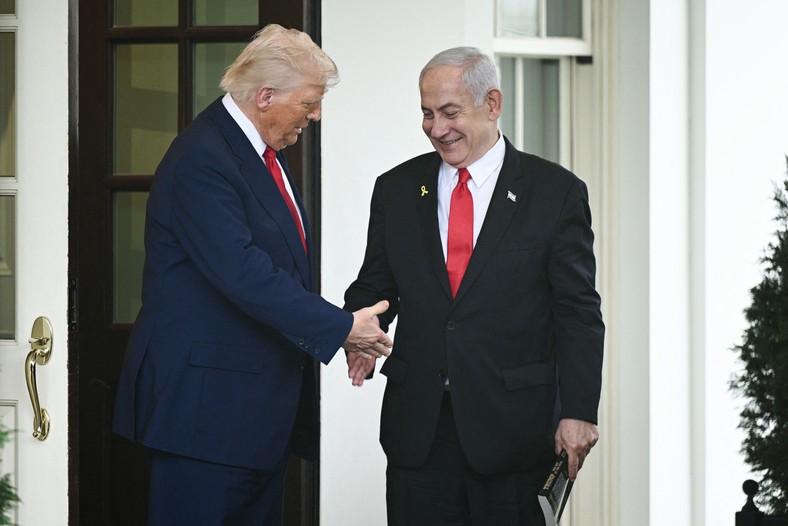
Donald Trump and Binjamin Netanyahu, Washington, April 7, 2025.
– They thought they were dealing with another type of leader, such as those with whom they have played for the last 30 or 40 years. It turned out that this is not the case – said on Sunday the secretary of state Marco Rubio in the CBS program “Face the Nation”.
Another lesson makes you prepare for the worst scenario in the case of Trump. He says that “within two weeks” will decide whether to bomb a given country? This probably means that it will be bombed.
“Don't underestimate or ignore his crazy statements.” They can actually come true, said Goldenberg.
As for Iran, you can adopt the “America First” principle as a reference point. Trump's opponents may argue that he abandoning this motto, engaging in a war that can lead to the loss of life and resources of the United States. His supporters can say – what could be more “America First” than eliminating the nuclear threat on the part of the United States's explicit enemy?
The biggest advantage of the “America First” principle is that it is plastic. Just like Trump himself.