When the Acatist of the Birth of Saint John the Baptist is read and why is it so strong: miracles and grace


Saint John the Baptist is the only saint of the Orthodox calendar – together with the Mother of God – whose feast does not only mark death, but also birth, a rarity that emphasizes its exceptional importance. Moreover, the church calendar dedicates no less than six holidays, a record of the deep respect and veneration they enjoy.

Frasinei, the monastery with an Athonite regime (without women access), the dedication of the old Schit-Nașterea St. John
In this article, you will discover not only these special moments of the year, but also the power of the Acatist of the Birth of Saint John, a prayer that brings soul relief and reinforcement, but also the discrete but significant miracles, which are attributed to them.
Birth of St. John the Baptist on June 24 in the Orthodox Christian Calendar
The birth of Saint John the Baptist is an occasion of holiday and gratitude in the Orthodox Church. This event is full of meanings, being proclaimed by an angel and understood as a blessing to the whole world.
Every year, on June 24, the believers participate in special services, read the aquatist dedicated to this feast and reflect on the unique role of Saint John in the preparation of the coming of Christ. It is a day when celebrating the light that has begun to shine in the darkness of the world, through the life and mission of the Lord's Forerunner.
On the territory of Romania, the Monastery of Frasina from Vâlcea (see opening photo) It is a special place dedicated to Saint John the Baptist, the Church of the Old Sketch bearing the dedication of his birth. This monastery is the only one in the country with an Athonite access regime, similar to that of Mount Athos, forbidding women's access and maintaining a centuries -old tradition. For this reason it is known and right “The Athos of Romania”.
Who was Saint John the Baptist
Saint John the Baptist was the son of the priest Zechariah and Elizabeth, being also relative to the Virgin Mary. From birth, he was chosen to announce the arrival of the Savior, baptizing Jesus in the waters of the Jordan and thus preparing the way for the salvation of the world.
He is considered a model of humility, courage and obedience to God's will.
When and for what is the Acatist of the Birth of Saint John the Baptist
Out of godliness towards this saint, the church inspired several aquatists, but the one dedicated to its birth remains among the most beloved. This aquatist is recited especially around the feast on June 24, but also when the soul needs courage, discernment and reinforcement. Many believers say it to ask for the intercession of Saint John in receiving God's grace, for help in temptations or in moments of suffering.
Prayer brings relief and inspiration, evoking the birth of a saint who has prepared the way for the coming of the Savior and giving hope to those who seek light in the dark.
Born from a prayer full of faith, in a tried family, Saint John becomes a symbol of hope in the trial moments. His aquatist is for many a discreet, but deep spiritual anchor, which does not promise visible wonders, but awakens consciousness, illuminates the mind and brings peace.
In a world that often seeks external signs, the Acatist of the Birth of Saint John offers an inner miracle: peace, meaning and power to move on.
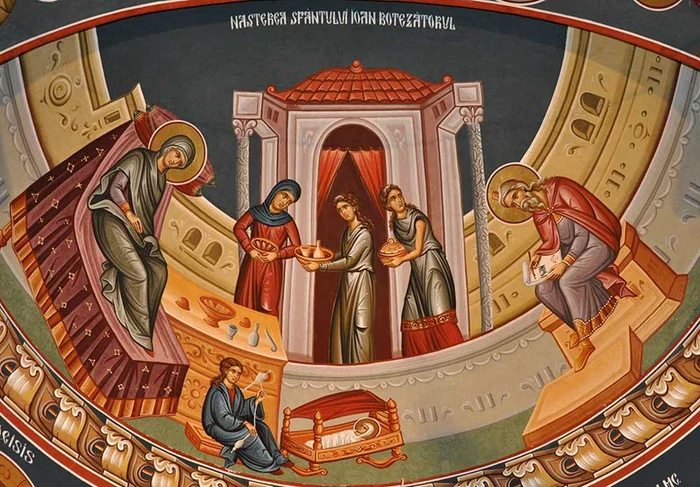
Painting representing the birth of Saint John the Baptist Photo source Mănasta Lipnița
Power of Prayer: The Little Acatist of the Birth of Saint John
The Acatist of the Birth of Saint John the Baptist, in its full liturgical form, contains 13 conds and 12 icons, according to the traditional order of the Orthodox Church. However, there is also a short variant, known as “small aquatist”, which is often found in brochures or prayer collections, being intended for those who have faith, but a limited time for prayer.
It preserves the basic liturgical structure, but with a small number of condyles and icons, being designed in a compact form, more accessible for personal or daily use.
Condac 1: Prophets and forwards of the coming of Christ, according to the dignity, praise you, we do not understand, those with love honor you; That the non -God of Elizabeth has discharged through your holy birth, and Zechariah's mourning was free from this secret. For this, we are glad to sing: Rejoice, the Great Birth of God-Prooroc!
Icos 1: When the Holy Prophet John came out of his mother's womb, joy and light shouted; That is why we sing: Rejoice, the fruit of promise and prayer! Rejoice, the forerunner of fulfilling the law and grace! Rejoice, the news of salvation that comes through Christ! Rejoice, the Lord's forward!
Condac 2: Your birth, Holy John, was a sign of salvation, the angel announced, and Zechariah enlightened. So, with everyone, with a voice of joy, we shout: Alleluia!
Icos 2: The prophets of the above, that you have announced the coming of Messiah and prepared the waters of baptism for him, mediate for us, to receive the mercy and grace of God. Rejoice, the foreshadow of the unseen light!
How many times is St. John the Baptist in the Orthodox Calendar
Saint John the Baptist is undoubtedly the most honest saint in the Orthodox calendar. No less than six holidays are worshiped throughout the church year-an absolute rarity among the saints. The only holy figure who enjoys such a liturgical privilege is the Virgin Mary, honest for birth and sleep.
This abundance of celebrations says everything about the exceptional role that John has in the history of salvation: The Lord's Forerunner, the voice that cried in the wilderness, the one who prepared the hearts of men for the coming of Christ.
Here are the six holidays that mark the Orthodox calendar:
- January 7 – Sobor of Saint John the Baptist
The next day after Boboteaza, this day is dedicated to the honor of the one who baptized the Savior in the waters of the Jordan. Saint John's Day is also the date when most Romanians celebrate their names.
- June 24 – The birth of Saint John the Baptist
One of the few births of saints celebrated by the Church, along with that of the Virgin and Savior. The birth of Saint John the Baptist or Sânzienei represents a day of light and joy.
- August 29 – Cutting the head of Saint John the Baptist
Day of fasting and retreat, reminiscent of the prophet's martyrdom. The Church urges to comply and pray on this day of holy pain.
- September 23 – The House of Saint John the Baptist
The celebration of the moment when, by the will of God, the prayer of the righteous Zechariah and Elisabeta was fulfilled: life has overcome old age and non -God.
- February 24 – the second out of the head of Saint John
A day marked by the rediscovery of one of the most revered relics of Orthodoxy.
- May 25 – The third finding of the head of Saint John
The last of the holidays dedicated to the saint, but not the least important. It ends an impressive calendar dedicated to one man – a witness of the truth.
This frequency shows how much veneration and respect the Church has towards its life and sacrifice. In a hurried world, in which prayer sometimes seems forgotten, these six moments of the year remind the believers the power of a simple, but full of grace, who has forever changed the path of the world. Saint John the Baptist was not only a prophet – but the divine echo of a fulfilled promise.
The miracles of Saint John the Baptist. What great facts is recognized for
In a thirsty world after spectacular miracles, Saint John the Baptist remains an exception: he did not make visible wonders, but was a living miracle through his courage and truth. Born from old and sterile parents, after a divine promise, was the baby who felt the presence of Christ from the womb.
Although he came to the world six months before Christ, John prepared the arrival of the Savior, calling people to repentance. Prophesied over 800 years before in the Old Testament (“The voice of the one who cries in the wilderness, cook the way of the Lord” – Isaiah 40: 3), he was born after the angel Gavriil announced to the priest Zechariah that his son will be “Great before the Lord”full of Holy Spirit from the womb.
Due to the unbelief, Zechariah lost his gift until the birth of the baby, when he regained his voice and confirmed the name of the child: John. Raised in the wilderness, after the death of the parents, in a harsh and ascetic life, feeding on locusts and wild honey, John attracted crowds of salvation, but rejected the title of Messiah, simply declaring: “I am the voice of the one who cries in the wilderness, smooth the ways of the Lord” (John 1:23).
Without world schools or teachings, it became the voice that woke up a nation, without compromises and without applause. The culminating moment was the baptism of Jesus, when the sky opened and the Holy Spirit descended over the water.
Although without spectacular miracles, John healed souls, broke the chains of fear and was the light that prepared the path of the Savior. According to his martyrdom, the believers attributed numerous wonders of protection and redemption, confirming their place in the hearts of those who believe.
Why is Saint John the Baptist before the Lord's
The title of “The Lord's forward” It is due to him because of his unique role in the history of salvation: he was the one who prepared the way for Christ, calling people to repentance and return to God.
Without his mission, the news of the coming of Christ would not have been transmitted with the same power, and the spiritual training of the believers would not have been as intense.
The spiritual inheritance of Saint John
The Acatist of the Birth of Saint John the Baptist is a deep prayer, full of spiritual meanings, which brings relief and support to the believers. Either on holidays or in the hard times of life, reading this aquatist strengthens faith and opens the way of divine grace.
The life and wonders of Saint John the Baptist remind us how important it is to be prepared for meeting with God, following the path of holiness and repentance.