Photo Ukrainian prisoner, mutilated with the symbols of the Russian invasion during captivity operations. “Beyond cynicism”

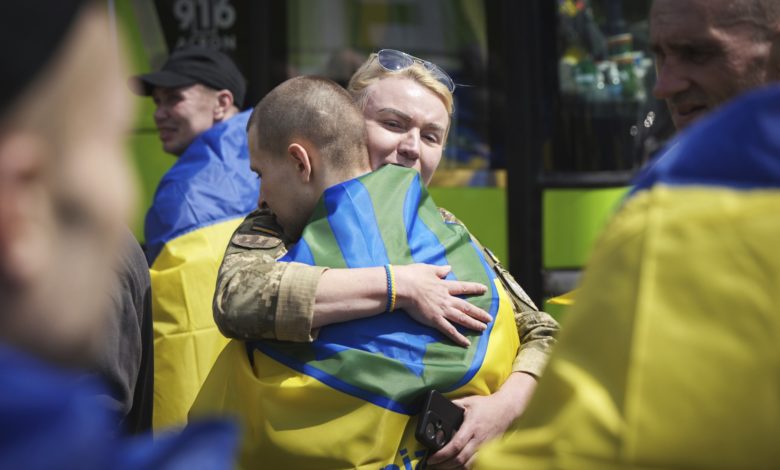
After more than three years since the beginning of the large -scale Russian invasion, each new disclosure about the cruel treatment to which Ukrainians are under captivity in Russia no longer surprises anyone. But recently, a photo that appeared online, which shows a scar with the inscription “Glorie Russia” on the body of a Ukrainian war prisoner, sent shock waves around the world, writes The Kyiv Independent.
The words, written in Russian, were engraved on the right side of the body, along with the letter “Z”, the symbol of the invasion that many Ukrainians and criticisms of war compare with the Nazi swastika.
This cynical act was publicly revealed after a Ukrainian doctor distributed a photo of the soldier's mutilated abdomen, taken in early June, shortly after his release from Russian captivity. The photo was subsequently verified by the Ukrainian military intelligence services (HUR).
Although the identity of the issued soldier remains unknown, it is known that his name is Andrii and that he is currently receiving medical care through the “Neopalymі” program, a national program that offers free treatment for injured during the war.
Maksym Turkevych, the general manager of Neopalymi, told the Ukrainian publication that the doctors are sure that the inscription on Andri's body was done by a surgeon, qualifying it as “more than cynical”.
“It was done under general anesthesia, which strongly suggests that it was not meant to be a torture. It was not to cause pain,” Turkevych said. “It was made with the intention of leaving a trace,” he added.
According to the spokesman of Hur, Andrii Yusov, a doctor from a Ukrainian rehabilitation center where Andrii was treated could not shut up, took the photo and distributed it online as proof of what the Ukrainian defenders endure in Russian captivity.
“The photo speaks for itself,” Yusov told national television on June 10. “It is essential that this be seen not only by the Ukrainians – they already know why the Russians are capable – but by the whole world,” said the spokesman for Ukrainian military espionage.
⚡️The Phrase “Glory to Russia” was burned onto the abdomen of Our🇺🇦 Wounded Soldier. After Surgery in Russian Captivity, He Woke up with this on his body. Thankfully, he is now. Our doctors has Removing the Physical Mark of Torture. But Who Will Erase IT from Memory?
90% of… pic.twitter.com/jitmhsfes
– партія «слуга народу» (@sluganarodu_pp) June 16, 2025
According to the United Nations (UN), over 95% of Ukrainian war prisoners said they were tortured during captivity. The survivors told about terrible treatments, including brutal beats, electroşocu and their obligation to stay in painful positions.
Many have been subjected to the simulation of executions, threats with rape or death and they were refused basic medical care. Some were left without food, imprisoned for isolation for weeks or remained with permanent burns or scars.
Although Ukraine has managed to repatriate 5,757 people in over 65 exchanges, according to the Coordination Center for the Treatment of War Prisoners, thousands of Ukrainian and civilian military remain captivity in Russia.
Yusov did not reveal details about the prisoner of war on which the message “Glorie Russia” was engraved in captivity, but mentioned that it was released in one of the previous exchanges, not within the latest.
A series of releases of prisoners followed the discussions between the Ukrainian and the Russian delegation, which took place in Istanbul at the beginning of May. Although the meeting did not lead to a political advance in negotiations, it marked the first direct negotiations between the two parties of 2022 and led to a series of prisoners of war and to the return of the fallen soldiers.
“A brutal, inhuman system”
For Maksym Turkevych and his team, the sight of scars left by Russian captivity on Ukrainian war prisoners has become an ordinary part of their work. Launched in August 2022, the project treated almost 400 patients with injuries, burns and scars, including former prisoners of war.
Although Turkevych and his team treated several liberated Ukrainian fighters who had swastika scars, some on the forehead, he describes the scar on Andri's body as extremely cynical.
Turkevych said that the sharp accuracy of Andrii's scar suggests that it was unconscious – otherwise, the wound would have looked very different. According to him, the sign was made with the help of an electrocautery device, which uses the heat to cut or coagulate the tissue, and not with something like a soldering iron or knife.
🔴 Russian Surgeon Burned “Z” and “Glory to Russia” onto Ukrainian Pow During Surgery.
A UKRAINIAN SOLDIER FREED FROM Russian Captivity WOKE FROM SURGERY to find “z” and “glory to Russia” burned into his body – allegedly by Russian Surgeon.
According to Maksym Turkevych,… pic.twitter.com/zpescnkzcv
– United24 Media (@United24media) June 16, 2025
Although Turkevych did not specify how long the andri was in captivity or where he was held, he said that the scar was probably caused about 15 months ago. The sign with the inscription was overlapping with other surgical scars, according to Turkevych, which suggests that it was done during one of the procedures to which Andrii was subjected.
“The operations, including the one who left the sign, were probably carried out during the same period,” he said.
According to Turkevych, Andrii had a wound caused by the shrapnel in the groin area and bladder injuries, which required surgery. In the photo distributed by a Ukrainian doctor you can see another catheter, next to a huge scar on the stomach.
Turkevych added that Andrii cannot be contacted today to make statements because they are under treatment.
He believes that Andrii was probably subjected to three to five procedures during captivity, which would explain the stratified and uneven aspect of the scarred tissue: “At one point, someone decided to be” creative “and left a signature behind,” he said.
Although it is not clear how long it will take the removal of the scar that writes “glory of Russia” from Andrii's body, Turkevych says it will definitely be removed.
“At this moment, we hope to see visible results on the inscription in about five to six months,” he said.
For Turkevych, this also reveals a deeper truth about Russia: “Their whole structure is built on cruelty, aggression, cynicism and the availability to commit deeply immoral acts just to demonstrate their loyalty and to ensure a place within it.”
What was shocked most was not only the cruelty of the system itself, but the fact that, even now, after more than three years of large -scale war, people still want to be part of it.
“In Russia there are too many who are informed about this brutal and inhuman system,” said Turkevych. “I am ready to do anything to belong (this system, no), no matter how much the fundamental human values violate,” he said.