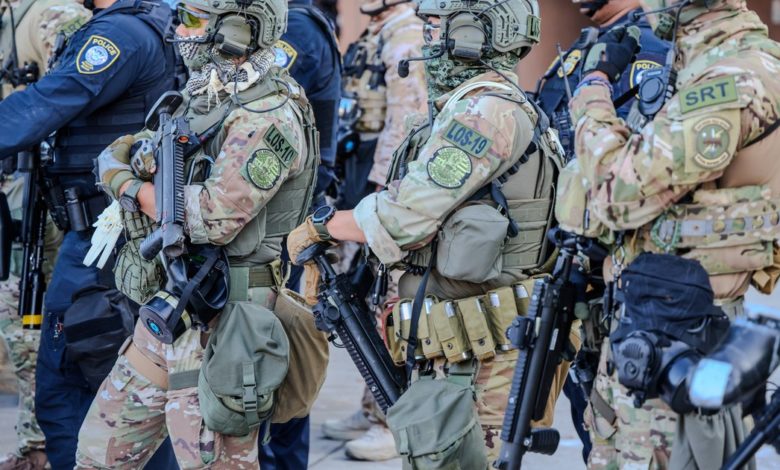
For the first time after decades, active troops of the United States Navy were mobilized on the streets of an American city. In a tense context, with protests out of federal raids against immigrants, hundreds of military were held in the Los Angeles metropolitan area on Tuesday, in an action that raises numerous question marks-legal, moral and institutional, writes Los Angeles Times.
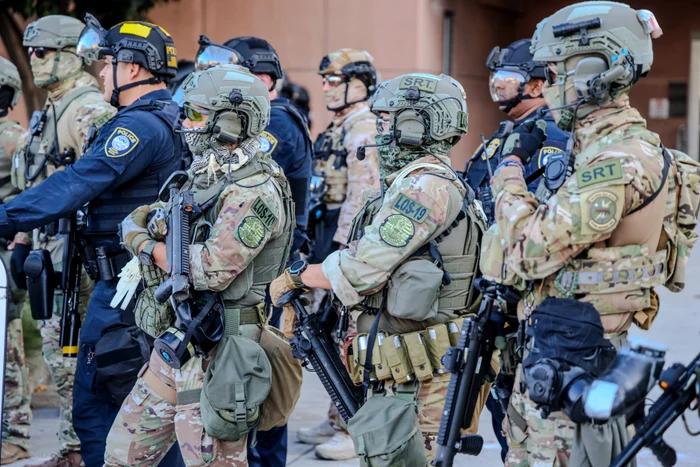
Anti-Ice protests in the center of Los Angeles Photo Profimedia
The officials of the White House justify the military presence through the need to protect the property and federal staff in front of what they called “violence and vandalism”. But the governor of California, the mayor of the city and a significant part of the civil society considers the deployment of forces as abusive and without legal basis. “We are part of an experiment that no one asked for,” said Mayor Karen Bass.
700 marini rifles without a clear and unprecedented mandate
The conduct of the approximately 700 soldiers of the Marine Corps Air Ground Combat Center in Twentynine Palms in Southern California, was confirmed by Northern Command, which supervises the troops on the US. According to General Gregory Guillot, the Marine kids do not have police duties, cannot make arrests and are in the field only to protect the federal objectives. “There are no public order officers and they have no arrest authority,” he said.
However, military and constitutional experts warn that the border between direct protection and intervention can be quickly diluted under crisis conditions. “Marine prisons are trained to fight. It is their first competence. They are not trained for the control of the crowd or the management of peaceful protests,” said Jennifer Kavanagh, analyst in the field of defense.
The absence of a legal basis
More serious is the fact that this active forces comes without an official request from the state authorities – an essential element according to the federal legislation. The governor of California, Gavin Newsom, qualified the action as “flagrant power abuse” and filed a trial against the federal administration, invoking Posse Comitatus act – an 1878 law prohibiting the use of federal armed forces in the application of civil law without a solid legal basis or without invoking Insurrection Act.
So far, President Trump has not officially appealed to this act, but the public transmitted signals suggest an intention to continue on an extremely risky line. “If the insurrection act will be invoked, we have passed a major red line,” warns Gregory Mary, a constitutional law professor at Washington University in St. Louis.
A confused mission, young soldiers and risk of climbing
According to a recent report of the Pentagon, almost three quarters of the active marine prisoners are under 25. The average age is 24 – a demographic profile that, say some analysts, increases vulnerability in tense situations. Although they are well trained, including in de-escalation tactics, the risk of a major incident remains real in a city living with the memory of the violent revolts in 1992.
“There is a clear break between the purpose for which these young people were trained – the defense of the country in theaters of external operations – and what is required now: to position themselves in front of their own fellow citizens,” Kavanagh noted.
On the evening of Monday, a column of military vehicles reached, under the escort, at the naval base in Seal Beach, in Orange County, south of Los Angeles. The troops are part of the Battalion 2, the 7th Marine Infantry Regiment, but Northern Command refused to provide details about the exact locations where they will be held.
Previous historical and anxiety of the present
The last similar mobilization took place in 1992, during the riots after the payment of the four policemen involved in the aggression of Rodney King. Then, however, the intervention of the troops was made with the express request of the governor and the mayor of Los Angeles. Today, the context is radically different: the action comes unilateral from Washington, without supporting the local authorities.
“I see no legal justification for this development,” says Abigail Hall, a defense specialist. “We are not in a state of war, Insurrection Act has not been invoked. This is not the role of marine prisons.”
Kori Schake, an expert in defense policies, warns that the real danger is not the violence in the street, but slowly, but surely, the “slip to authoritarianism”: “The messages from the White House, from the Pentagon and the Department for Internal Security are inflammatory, almost contemptible to their own people.
What follows after California?
In a gesture that reconfigures the relationship of the executive power with the citizen, the Trump administration opens the possibility of the largest military forces on the American soil in recent history. According to statements made on Wednesday by White House officials, President Donald Trump is ready to send troops of the National Guard in several American cities, if the protests triggered by anti-immigration raids exceed the Los Angeles borders, writes The Washington Post.
The Secretary of Defense, Pete Hegseth, told Congress that the army is ready to act “in other cities where local law enforcement are threatened”, thus indicating an availability for unprecedented internal intervention in recent decades.
In the same tone, the spokesman of the White House, Karoline Leavitt, transmitted an unequivocal warning: “More anarchy will only strengthen the president's determination.
The force show as a state policy
The message of the administration comes at a time when the presidential rhetoric acquires more and more authoritarian accents. On Saturday, Trump is about to participate in a great military parade in Washington, occasioned by the 250th anniversary of the founding of the American army. The event, long desired by the president, will include tanks, helicopters and parachutes-a demonstration of force in a context of internal escalation.
“The enemies of America have learned, throughout history, that if you threaten the American people, the American soldier will follow you, crush you and throw you into forgetfulness,” Trump proclaimed in a recent speech at Fort Bragg, in North Carolina.
In the official statements, there is no clear distinction between violent protesters and peaceful ones – an aspect that alarms the analysts. Asked about the right to peaceful protest, Leavitt replied dryly: “Of course the president supports this right”, adding that the question is “stupid”.
Democratic skids or firmness in front of anarchy?
The administration justifies these actions by calls for “law and order”, a formulation familiar to the American public since the Nixon era. But some commentators sound an alarm: the more frequent use of the army against their own citizens is a feature of authoritarian regimes, not consolidated democracies, notes WP.
“This type of reaction is not compatible with the principles of a democratic society. In an authoritarian regime, the citizen has to think twice before protesting. Here are we?”, Professor Steven Levitsky, a democratic government expert, asks rhetorically.
“Democracy is under siege”
The open conflict between Trump and the governor of California, Gavin Newsom, has become symbolic. The president ordered the sending of the National Guard to Los Angeles without the consent of the local authorities, and Newsom reacted harshly: “This is just the beginning. Other states follow. It follows democracy. It is under attack, even under our eyes.”
California has already opened an action in court to block the conduct of troops, in a new episode of the legal-political battle between the progressive state and the federal administration.
In the meantime, other states are preparing for massive protests. Philadelphia, Chicago and San Francisco are on the map of the planned demonstrations for the weekend, in a national campaign called “No Kings Day” – a clear allusion to what the activists perceive as the authoritarian driver of the White House.
Nation, again divided
A survey conducted by Washington Post and George Mason University indicates accentuated polarization. Republican voters overwhelm the president's decision to send the National Guard to Los Angeles. Democrats oppose the majority, while the independents and most of the Californians show or disapprove the measure.
Senator Dick Durbin, Democrat in Illinois, warned of the risks of such a decision taken “as a mere formality”: “The use of the army to apply civil laws is not a common thing in a functional democracy.”
Trump does not exclude the invocation of insurrection act, a rarely used law that allows the president to conduct troops in American territory in exceptional cases. The fact that there is an open talk about this scenario is, in itself, an alarm signal for civil society, warns the specialists.