“The loop is tightening.” Haiti falls. Gangs take over power. “We are in the middle of it all”

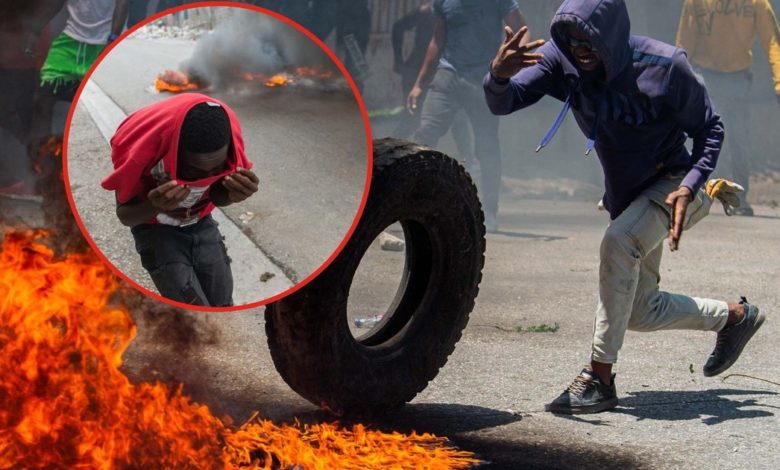
“They come at night to steal everything they can. They set fire to buildings to maintain their positions,” says the owner of the company, preparing to take his family and 15 employees from the capital of Port-au-Prince. “We're in the middle of it all.”
Almost the whole capital is currently under the destructive control of gangs, while the Provisional Presidential Council is torn with internal struggle and rooted in a wealthy Petion-Ville enclave on the hill. But the loop gradually tightens
According to representatives of humanitarian organizations, the only barrier between the presidential council and the total fall of the government is the group of self -defense groups commanded by a policeman known as Samuel.
Gangs have strengthened control over Haiti since the assassination of President Jovenel Moise in 2021. After years of mutual fights in February last year, they joined forces to overthrow the government of the acting of Prime Minister Ariel Henry.
Since then, they began a brutal offensive that turned the capital into hell.
The entire PORT-AU-Prince districts, where over 2.5 million people live, are closed zones. Gangsters guard the borders of districts, governing the areas covered with debris and charred remains of houses and vehicles.
Resistance fighters fight with gang members in the streets, and the police and private mercenaries began to use kamikaze drones unloaded with explosives. To avoid detection, gangs move through the disputed districts, blowing up the walls of the houses.
Finance Minister Alfred Metellus said that drones can help reverse the fate of the battle, but only with the support of 2000 or 3000 additional security officers.
“The use of drones is necessary, but not enough,” he said. “They must be accompanied by security forces on Earth, which will take control of areas mastered by gangs.”
The UN mission led by Kenya sent about 1000 foreign officers to support Haiti's overloaded police. However, during a four -day visit to the capital, the Financial Times reporter did not meet a single Patrol of the United Nations.
“Safety situation is a nightmare,” said Claude Joseph, who was the minister of foreign affairs and the prime minister acting during Moise's rule. “You never know when a place will be mastered.”
“Currently, it seems that gangs are aimed at more than just overthrowing the government,” said Diego da Rin, an analyst at the International Crisis Group NGO. He added that gangs want a “open channel” of communication with a government that would be willing to give up international support.
Jimmy Cherizier's gang leader, known as Barbecue, said that the government must cooperate with criminal groups to put an end to violence. “We demand participation in negotiations,” he said in February. “If not, we will continue to fight.”
Gangs were created several dozen years ago, receiving money from political and business elites to harass opponents and control the poorer districts of the country. As the gangs became richer, they gained autonomy. The murder of President Moise created a vacuum of power, which was quickly fulfilled by criminal groups.
“It's not safe anywhere”
The temporary government, harassed by allegations of corruption and paralyzed by internal disputes, is hardly trying to stop the wave of violence. In November, he moved his leader away from power and shows no signs of progress in preparations for the first elections in the country since 2016.
The scale of the humanitarian disaster in Haiti is stunning. In the whole country, 1 million people – almost one tenth of the population – were displaced from their homes. According to the UN, over 5,600 people were murdered last year, and this month 5.7 million people may face a serious lack of food safety. Over a third of Haitans live for less than $ 2.15. (just over PLN 8, counting at the current exchange rate) per day.
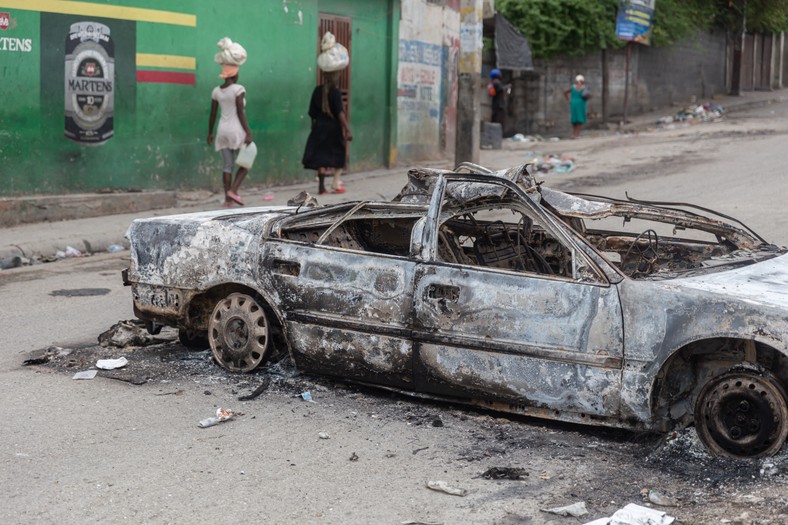
Destroyed street in Port-au-Prince
The public service sector collapsed in Port-Au-Prince. Two -thirds of the main hospitals were forced to close. Gangs control the roads around the ports and force tribute from food importers, basic goods and fuel, overstating their prices. Those who could, escaped from the capital to Cap-Haitien, the second largest city of Haiti.
In addition to the capital, gangs expanded their activities in Artibonite, the agricultural heart of the country, and in Mirebalais, a city located on the road to the border with the Dominican Republic and being an important transit point for imported goods. In May, the United States recognized two large criminal groups as foreign terrorist organizations.
Anxiety is on the streets of Petion-Ville, the last fortress of the government. Exclusive houses and hotels are hidden behind steel and concrete walls. Armed guards protect them. Garbage mountains – some of them are burning – there are pavements, and police cars and armored vehicles stuck in a traffic jam on narrow, bumpy roads.
When gangsters armed with AK-47 rifles and machetes approached the home of Nadine Anee in the capital, the woman grabbed three of her small children and escaped, hiding behind buildings to avoid bloodshed.
“They just appeared and started shooting,” she said. “We have nothing else to do but run to save lives.”
Ultimately, about 8,000 people found shelter in a government building in Port-au-Prince, which was transformed into a refugee camp. The shelter spilled into the surrounding streets. The air fills the stench of droppings, urine and rotting rubbish. The heat is suffocating, and during heavy rains the camp is flooded with water.
Over 15 people sleep in a dry roof pool, covered with recycled tarpaulin. Orienne Hector, an elderly woman sleeping in this place, was forced several times to escape from gangs and now there is no one close. “It's not safe anywhere,” she said.
A nurse from the Ministry of Health announced that she had recorded cases of cholera and tuberculosis in a camp that rarely visit international non -governmental organizations.
The government claims that it needs full involvement of UN forces in blue berets to defeat gangs, but China and Russia have already vetoed such proposals. Washington is considering a potential mission under the leadership of the organization of American countries, the Regional Diplomatic Forum, which, however, has little experience in such operations.
James Boyard, a security analyst at Port-au-Prince, said that although international support is needed to immediately fight gangs, every long-term solution to Haiti's crisis must include the construction of their own security forces and improving the living conditions of the population.
However, despite the chaos and the destruction of many Haitians, they are determined to remain in the country.
“Most of us do not see our future outside Haiti. Everything I have, I owe this country,” said the owner of the company preparing for evacuation from Port-Au-Prince. “Haiti is the only place that Haitans will be able to call their home.”
© The Financial Times Limited 2025. All rights reserved. It is not allowed to spread, copy or modify in any way. Onet bears the sole responsibility for the translation, the Financial Times Limited does not bear any responsibility for its accuracy or quality.