
One of the oldest non -governmental organizations, proposals for the Constitutional Court Reform

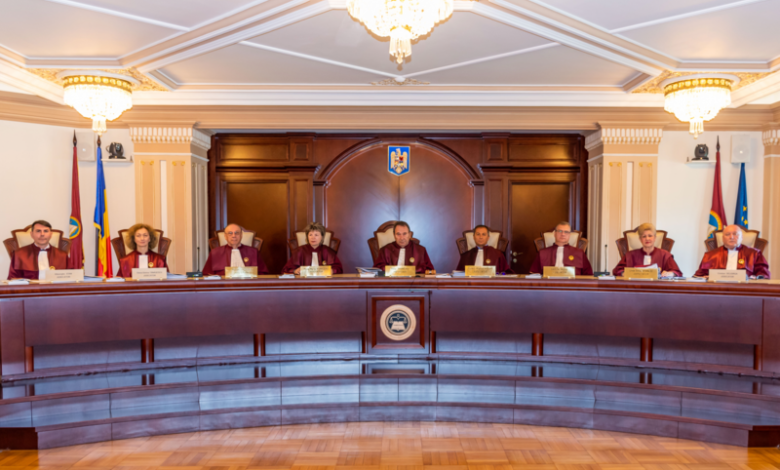
“The elections are over, what do we do with the Constitutional Court?”, The Association for the Defense of Human Rights in Romania asks the Helsinki (APADOR-CH). The NGO makes some proposals for the reorganization of the RCC, which says that, in the last year, it has made “controversial and unprecedented decisions”.
“From the arbitrary prohibition of some candidates until the election cancellation, it would be honest not to pretend that everything has returned to normal and only discussing new members in the RCC, as if nothing had happened,” writes Wednesday.
The NGO also says that the institution that “now is neither a court of justice nor political structure chosen by citizens”, has “a decision-making power over the Parliament, uncensored by anyone”.
“It is also our right as a company to discuss whether the functioning of this institution serves or not democracy,” the quoted source reports, specifying that “the CCR should have gathered in the building that hosts the best of Romanians, above any suspicion or non -professionalism.”
“And yet, history shows us that it was not so. We had CCR members accused of corruption, members of which they planned various suspicions, and the apolitical status of some of the current members was not enough to increase the professionalism of the court and its decisions as a whole,” accusing Apador-CH.
Thus, the non-profit non-governmental organization, established in 1990, which acts for human rights protection and for establishing balance when they are in danger or are violated, says that the only solution to straightening the courts of the Court is still a change of constitution.
“One by which we can recover, if possible, from too much power accumulated in the hands of the nine members of the RCC and thus restore the balance of powers in the state,” reports APADOR-CH.
The NGO believes that it is a good time to discuss the need to reform the Constitutional Court and make several proposals to re-organize the RCC.
CCR to be divided into two distinct sections
The NGO proposals concern an organization of the RCC in two distinct sections. One of constitutional litigation, consisting only of judges within the ICCJ, who will have in the attributions the previous and posterior constitutionality of the normative acts.
The other, a section of constitutional procedures, of which to belong: lawyers, politicians, persons from civil society, etc., a section that would solve the other, mainly political issues.
“The APADOR-CH proposal is based on the finding that the attributions of the Constitutional Court can be divided into two categories:
- strictly legal/technical attributions (in general, those regarding the constitutionality control of laws and ordinances);
- predominantly political attributions (conflicts between public authorities, suspension of the president, constitutionality of a political party, etc.) ”.
According to the NGO, a reorganization/restructuring of the Constitutional Court can be reached by dividing it into two entities with distinct competences.
Changing some articles in the Constitution
Also, the NGO proposes to modify articles 142 and 147 of the Constitution, which refers to the CCR structure.
“By the proposed changes in Art. 147 of the Constitution, the aim is to establish a clear difference between the CCR decisions and the CCR decisions, indicating who can pronounce them, whether or not they can be challenged (only the decisions) and to what court (at ICCJ),” APADOR-CH said.
Also, according to APADOR-CH, by introducing a provision in the sense that the pronouncement regarding the constitutionality of a law can only be done by “yes” or “no”, without the use of expressions such as “to the extent that …”, it is aimed that the CCR does not turn into a legislator, substituting the Parliament, as it does today.
According to the NGO, “the possibility that the Constitutional Court has, in the current regulation, to rule on the constitutionality not only by” yes “or” no “, but also by” insofar as … “unjustifiably transfers attributions strictly by the Parliament and transforms it into a legislator”.


