Our brain works like this: when we say “I do not want to see blood spill”, the message first reaches us in its positive form, that is “I wish” – the warning of a researcher about the risks of increasing violence in Romania

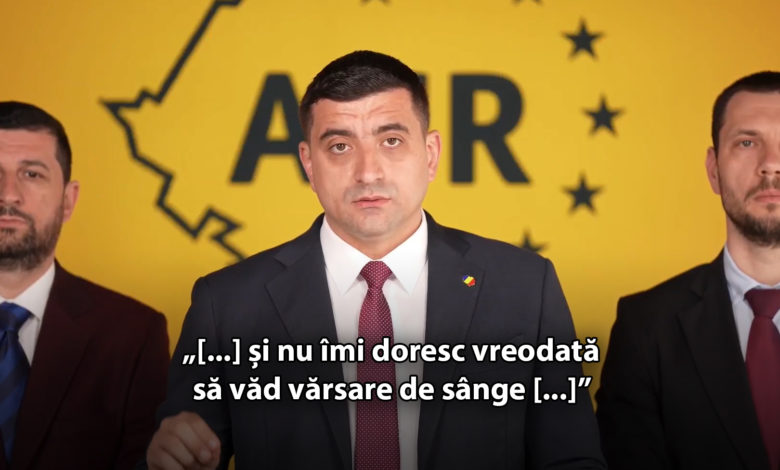
A recent statement by George Simion, who said he did not challenge the choices in their night, but later, because he did not want to spill blood, he joins the line of increased violence, which does not remain verbal. “The result can be a tragic one,” explains a researcher from Iasi, because our brain has a proper way to process the information.
“Just because we avoided a bloodshed does not mean that we can be taken by fools,” said George Simion, on Tuesday, May 20th. He added that he did not want to see “bloodshed in our country, justifying the chaos and taking over by some.”
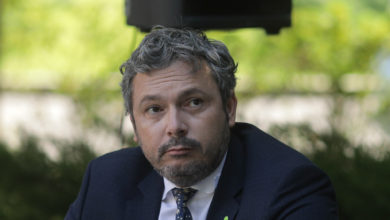
“There is an aspect that is not discussed in the speech of Mr. Simion. I refer to the processing of denial,” says Alexandru Cohal, a scientific researcher at the Romanian Philology Institute “A. Philippide” in Iasi.
What a child understands when you tell him “you broke the cup, but I will not beat you”
Neaging processing is a theory that explains how the human brain understands the information. “Psychologists observed in the 1960s that the brain processes negative statements Starting from the positive version of the respective statements, which he then overturns, ”explains Alexandru Cohal in an article in Contributors.
“It can be seen, for example, that if you tell a child” you broke the cup, but it will not beat you “, there is a great probability that the information with which the child remains to be” beat you “. Communicators tell those who are preparing to speak in front of crowds to use as few negative verbs as possible, because there is evidence that positive information is easier to process and has more chances to be fixed in people's minds. “
“At the same time, it seems that, to reach denial, our mind first builds the affirmative variant of the action, the concept.” The way we learn the words has an effect on our minds ”, according to the researcher.
“According to this interpretative model, when Simion says” I do not want to see blood spill “, the message reaches a first instance in its positive form, that is” I want “. Later the brain creates the negative version: “I do not want”, “added Cohal, doctor in linguistics, Università di Pavia, Dipartimento di Humanistic Studies.
“Also according to the same model, it seems that the positive variant of the message tends to be fixed in our mind, because the production of the negative formula of communication requires a greater cognitive effort than the production of the positive one.”
Alexandru Cohal: Let's not underestimate the effects of speech violence in real life
“A conclusion of the stage would be that symbolic violence, including or especially that of words has increased greatly in the context of these presidential elections, and that it should not be underestimated. Any reasonable person, especially a politician, should abstain in public from such a speech, and is not late as Mr. Simion or other political personalities,”
“The danger is that, by repeated presentation in the public space of words and gestures, the audience will be called to feel, to think and to position itself very clearly to the message, and the result can be a tragic one.”
“Language has, besides the function of describing reality, a practical result, to determine the interlocutor to go to action. If important discourse creators will fill the public space with violent phrases, it is a matter of time until symbolic violence will turn into physical violence.”
“Obviously, there are many shades here, a certain aggression in language exists in all the layers of our society, the problem is who propagates and in what communication situations. We see, and in the speech of Simion, that instead of setting moderation and sobriety in language, the rhetoric of violence is progressively escalated, risking to bring the public, in which the public, in an area Relevance, ”said Alexandru Cohal.