Presidential elections in Poland. Which candidate would be better for the zloty, stock exchange and bonds?

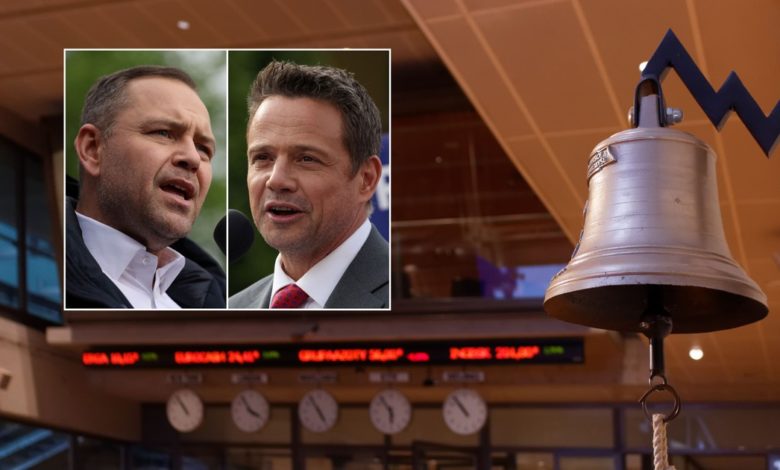
On Monday before noon, the National Electoral Commission reportedthat Rafał Trzaskowski and Karol Nawrocki went to the second round of presidential elections (after counting the data from all circuits), who won 31.36 percent respectively. and 29.54 percent votes. The promotion of these two is not a surprise, but at least two results are surprising that can change the perception of investors in the final decision, which is scheduled for June 1.
Before Sunday voting, a fairly clear favorite in the race to the Governor's Palace was the Citizens' Coalition candidate and the investors considered such a scenario to be basic. The market reaction was visible from the very morning on Monday, when the survey data was already known Late Pollsindicating the little advantage of Trzaskowski.
The zloty weakened slightly to the euro, but to the dollar in the afternoon he even gained (which can be associated rather with a decrease in the US rating), and the Warsaw Stock Exchange recorded clear declineswhich during the session deepened and in the afternoon WIG20 fell by almost 3 percent, which made our dance floor one of the weakest in the world. At the end of the session there was a relaxation and WIG20 lost “only” 0.84 percent, closing the day at 2786.7 points.
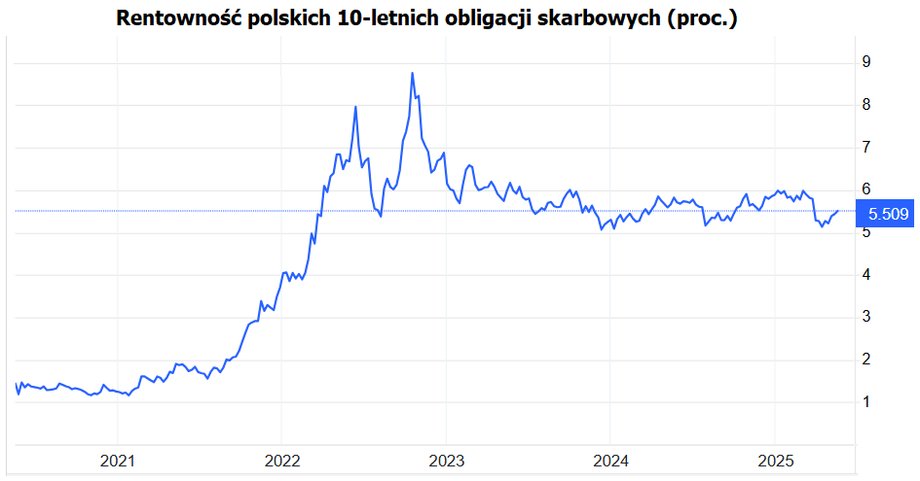
The profitability of 10-year Polish bonds increased (which means a decrease in prices), reaching 5.58 percent, the highest level from the beginning of April), but this is primarily the result of similar movements on American debt. At the end of the session, following the events in the USA, the pressure decreased and the profitability was 5.49 percent.
Kamil Cisowski, director of the DI XELION Investment Analysis and Advisory Team, points out that when before noon on Monday WIG20 fell by 2 percent, he would only attribute to the election about half of this movement (then contracts for American indexes would lower by 1-1.5 percent, European stock exchanges lost-depending on the floor from 0.1 % to 2 %.
-The profitability of 10-year bonds was higher by 0.12 percentage points. than on Friday, but again only about half of this growth can be combined with politics, the debt is sold all over the world after a reduction in the US rating by Moody's. Changing the EUR/PLN exchange rate was only minimal – adds Xelion's expert.
Change of favorites to the presidency?
A surprise for the market, next to the smaller than the forecast in the first round of Trzaskowski over Nawrocki (some polls gave up to 7-8 percentage points of advantage at the average around 4 percentage points), there is also a high result of right-wing candidates who won 14.8 percent in the first round. votes (Sławomir Mentzen) and 6.3 percent (Grzegorz Braun). There is a great probability that most of their voters – as long as they go to the Urns in two weeks – will pass their votes to a candidate supported by PiS. Trzaskowski may not be enough support that he can get “inheritance” from Szymon Hołownia (5 percent), Adrian Zandberg (4.9 percent) and Magdalena Biejat (4.2 percent).
For the order, let us add that the leftist Joanna Senyszyn won 1.1 percent, and right -wing Krzysztof Stanowski, Marek Jakubiak and Artur Bartoszewicz, respectively, 1.2 percent, 0.8 percent and 0.5 percent
The economists of Bank Millennium pointed out, however, that the flow of voters from voters whose candidates dropped out of the race are not obvious and difficult to estimate. “The more that these candidates during the campaign were against the dominance of two parties: PO and PiS. In addition to the flow of support, the turnout and mobilization of electorates will be crucial for the second round result” – they added.
– The results of the presidential election showed a large scale of underestimation of two candidates. A small difference in support for the two who entered the second round means that The probability of victory is equal to both candidates. Market valuations from last Friday did not assume such a development of events – comments Dariusz Świniarski, managing in the TFI treasury.
Limited (for now) impact of elections on quotations
– From a market perspective, there is no major doubt that Rafał Trzaskowski's winning would be better in a short term. However, the impact of anyone's presidency on the WSE, our currency or profitability of debt is negligible – says Cisowski.
The president's rights in the area of the economy are small, but exercising the right of veto has the opportunity to influence economic policy, as well as other issues relevant to investors, including the rule of law, judiciary, or relations with the European Union.
“A system in which the president and government are from other political camps could potentially influence the institutional assessment of the country, and thus increase the risk bonus (which can negatively affect the records of Polish assets – ed.). However, we do not think that this has a strong impact, because the inflow of funds from the EU should be continued from the point of view of the economy. We also do not think that there are radical changes in fiscal policy, due to the restrictions resulting from the excessive EU deficit procedure, “wrote Bank Millennium economists.
In the first statements after the results Trzaskowski announced the pursuit of increasing the amount of PIT free, and Nawrocki zero PIT for two or more children. Both factors are actions contrary to the goal that should be guided by fiscal policy, i.e. reduction of a deficit of about 6.5 percent. GDP.
|
Tradingconomics
“The results of the first round show that the ruling coalition loses social support, which may cause inside the coalition. In the extreme scenario it could lead to early parliamentary elections, but in our opinion it is unlikely regardless of the result of the second round” – added experts by Bank Millennium.
– Monday increases in the profitability of Polish treasury securities and the discount on the WSE are a response to an increase in uncertainty that markets do not like. The potential win of a candidate supported by the current opposition can start the discount process of PiS win in the next parliamentary elections or even be a catalyst for accelerated elections to the Sejm and Senate. The potential change of government in the next election affects the increase in the risk of transfers from the EU, which in the current budget situation and the perspective of future arms expenses, exerts pressure on the profitability of national bonds – says Świniarski.
Possible increased variability. Market opportunity?
How can the market behave for the final decision of the presidential race? – The question about the preservation of Polish assets to the second round is so tricky for us that In recent months, they have become very bought out and before Sunday we also expected a correction, which, however, will have a limited extent to our policy. When she occurs, we will increase allocation in Polish actions regardless of who will become president – says Cisowski.
Let us remind you that the Polish stock exchange is one of the strongest in the world this year. WIG has set new records of all time and exceeded 100,000 Point, and WIG20, gaining from the beginning of the year at some point over 30 percent, climbed the highest ceiling since August 2011 (interestingly, then the US for the first time lost the highest rating agencies and caused a large discount on the markets).
-in the case of winning Karol Nawrocki in the second round, and I assume that after Sunday results, the market values the likelihood of such a scenario at 55-60 percent, The market reaction would probably be similar to Monday or up to two times larger and I would use it as an opportunity to buy, both Polish shares and bonds – says Cisowski. He points out that parliamentary elections are more important for the market, and although Rafał Trzaskowski's defeat would be a very clear signal of the loss of support by the parties of the current coalition, there was still a lot of time to them.
According to Świniarski, Nawrocki's win could mean from the WSE perspective the risk of a risk of worsening corporate governance in companies with the participation of the State Treasury in the shareholding and greater interference in individual industries, i.e. energy and fuel companies. – The lack of a president supported by the Civic Coalition is a risk of not implementing election promises that enabled the victory of the opposition parties in 2023 and the change of the then ruling team. The impact of election results on national assets is evident – convinces the TFI treasury expert.
According to economists, Credit Agricole Bank Polska, the first round results are similar to earlier polls and in their opinion remain neutral for the gold rate and the profitability of bonds. “Only the results of the second round can have a noticeable impact on financial markets,” they said.
– The other two weeks to the second round will be a period of increased variability. Questions may be influenced by the changing results of support for the candidates' presidencies fighting for the Palace. The upward trend on the WSE, lasting from the second half of 2023, clearly showed which investors in the Vistula River on the Vistula are more trusting – says Świniarski, referring to the election rally at the WSE from autumn 2023.
According to XTB analysts, Trzaskowski's victory can be positively perceived by the market, because it would allow the government of Donald Tusk to implement reforms and unlock EU funds, which could bring moderate strengthening of the zloty.
In their analysis, they stated that in Poland the presidential election caused a short -term increased volatility on the WSE. “Studies indicate a tendency to fall in the index within five days after voting, especially with an uncertain result. It is worth paying attention to the win of Andrzej Duda in the first round in 2020. Then WIG20 did their losses after the first hit of the pandemic and Duda's win was seen as a continuation of the power of the ruling party, i.e. PiS,” they wrote.
See also: Half a trillion of electoral costs of promises. Szymon Hołownia distances the rest of the rate
They stated that if Trzaskowski came out victorious from the clash for the presidency, and the political scenario would remain predictable, WIG20 may still be an opportunity for foreign investors, taking into account the valuation that still encourages them. However, they emphasized that To a large extent, global factors, such as customs uncertainty and uncertainty about war, have a large extent on the stock exchange. “If these factors are solved positively, WIG20 has a lot of further growth potential. On the other hand, the escalation of the trade war or war in Ukraine may negatively affect the index, taking into account very strong increases from the beginning of this year,” XTB analysts assessed. They added that a possible opposition win or a surprising result can potentially cause correction on the stock exchange and the outflow of a part of foreign capital.
Global key factors for the zloty
What next with the Złoty, who has clearly strengthened the dollar and the euro in recent months? The impact of presidential elections on the records of our currency may be limited. XTB experts pointed out that the behavior of the zloty in the long run depends mainly on factors such as monetary policy, government actions, or (above all) global moods and flow flow.
“However, by examining the influence of zloty behavior after most of the elections in Poland in the last 30 years, we cannot observe any major dependence. The zloty lost rather than strengthened after the election, but it was primarily associated with global factors” – they wrote in Friday's analysis.
“The zloty can experience re -variability in the coming week,” said Commerzbank experts. They indicated that the possible win of Karol Nawrocki would again introduce an impasse in economic policy and strengthened the influence of PiS supporters at the NBP.
Note: information posted in the text is only information and does not constitute a recommendation for the purchase or sale of financial products. This text does not constitute an investment recommendation or investment consulting activities within the meaning of §3 of the Regulation of the Minister of Finance of 19 October 2005 on information constituting recommendations regarding financial instruments, their issuers or exhibitors (Journal of Laws 2005 No. 206 item 1715)
Author: Maciej Rudke, Business Insider Polska journalist