
The average salaries differ greatly in Europe, as the cost of life is extremely varied, with various definitions of salary, income and earnings, each reflecting different aspects in each state.

Average salaries differ greatly in Europe. Photo archive
The latest Eurostat data, which are based on the average annual salary for a full -time job, shows that the average monthly income adjusted in 2023 varies from 1,125 euros in Bulgaria to 6,755 euros in Luxembourg, the EU average being 3,155 euros.
Denmark is the only country in the EU, apart from Luxembourg, with a salary of over 5,000 euros, respectively 5,634 euros, on 3 and 4 places placing Ireland (4,890 euros) and Belgium (4,832 euros). Germany (4,250 euros) offers the highest average salary of the four largest EU economies, followed by France (3,555 euros). Both Italy (2,729 euros) and Spain (2,716 euros) were below the EU average with over 400 euros.
The Eurostat data cover 26 EU countries, writes Euronews, specifying that, although they are not directly comparable due to the methodological differences, the average annual salaries per employee equivalent to the OECD includes several European countries.
According to the OECD, the average salary in Switzerland was 8,104 euros, which is the country with the highest salaries in Europe. Another country in the European Free Exchange Association (EFTA), Norway, offered an average salary of 5,027 euros. The United Kingdom had an average salary of 4,220 euros. With 4,629 euros, the Netherlands are among the EU countries with the highest payments, while Turkey, the EU candidate, registered the lowest average salary, of 873 euros, being the only country below the threshold of 1,000 euros.
The general tendency shows that the countries of Western and North Europe are led by wage levels, while South and Eastern Europe tend to offer significantly lower nominal salaries.
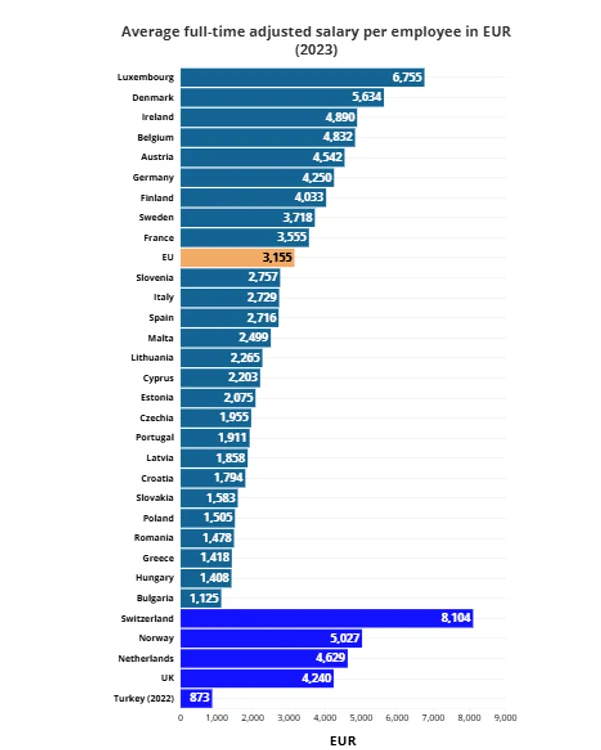
At the opposite end, ten of the 26 countries analyzed have salaries under 2,000 euros. Of these, four – Romania, Greece, Hungary and Bulgaria – have average salaries below 1,500 euros, Romania registering about 1,400 euros.
Poland is immediately above this threshold, with 1,505 euros, while the other great South European economies, Italy (2,729 euros) and Spain (2,716 euros), are below the EU average with over 400 euros.
Germany (4,250 euros) offers the highest average salary of the four largest EU economies, followed by France (3,555 euros). Both Italy (2,729 euros) and Spain (2,716 euros) were below the EU average with over 400 euros.
The highest salaries in Europe after purchasing power
The difference between average salaries is reduced when measured in purchasing power standards (PPS), as this eliminates the effect of price level differences. PPS is an artificial monetary unit, in which a unit can theoretically purchase the same amount of goods and services in each country.
However, there are still significant disappearances throughout the EU. In nominal terms, the highest average salary is six times higher than the lowest.
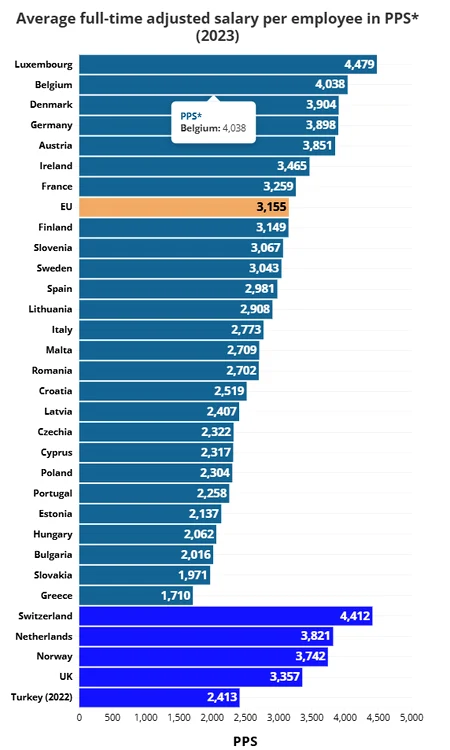
In the EU, average salaries in SPC range from 1,710 euros in Greece to 4,479 euros in Luxembourg, while the EU average is 3,155 euros.
Belgium (4,038 euros PPS), Denmark (3,904 euros PPS), Germany (3,898 euros PPS) and Austria (3,851 euros PPS) were also among the first five countries.
At the tail of the ranking, there is Slovakia, Bulgaria and Hungary, each with average salaries below 2,100 euros in PPS.
Romania is significantly above in terms of PPS.
Among the OECD data, Switzerland stands out by a high salary depending on the purchasing power, of 4,412 euros. The Netherlands and Norway follows, both offering around 3,800 euros. The average salary in the United Kingdom was 3,357 euros.
Like Romania, Turkey (2,413 euros PPS) holds a significantly better position at this indicator.