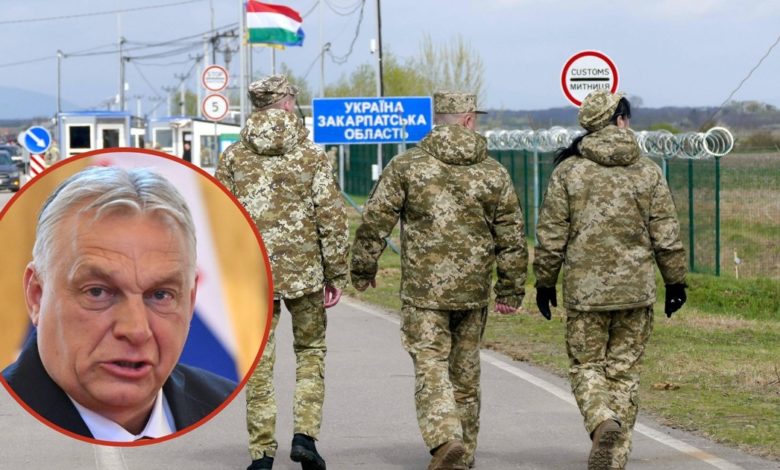
SBU informed that Hungary was employed by two inhabitants of the cornering region, specifically around the city of Berehowo, to spy on military facilities, such as air defense, as well as to assess the safety and moods of the local population in the event of the arrival of Hungarian “peace” forces. As a result, Hungary issued Ukrainian diplomats, claiming that they were spies and Ukraine answered the same.
Budapest had previously issued statements regarding the Hungarian -language population of Zakarpacie and accused Kiev by repressing it. There were often fears or accusations that Hungary wanted to take over the territory or part of it, which was seen as a political game rather than a real threat.
This operation – dangerous and based on erroneous beliefs – indicates, however, that somewhere in the intelligence and political circles of Hungary is seriously considering taking action in this region.
To understand why Hungary would spy on the corner, you should understand issues related to his language policy and history.
Hungarians in the corner
Zarpacie lies in southwestern Ukraine and is the only region bordering on four countries: Poland, Slovakia, Hungary and Romania. This is one of the most diverse and culturally diverse regions of Ukraine. For centuries he has been inhabited by Ukrainians/Ruthenians, Hungarians, Poles, Slovaks, Jews, Roma and other groups, such as Hutsuli, Lemkos and others.
Zakarpacie was part of the Austria-Hungary until the signing of the Treaty of Trianon, later Czechoslovakia, and then a short-term Carpathian Republic led by Ukrainians in 1939 and Hungary in 1939-45.
Later, the USSR joined this region to the Ukrainian Soviet Republic. This led to demographic changes, as a result of which many Russians and people who speak Russian settled in the region. After the collapse of the USSR, despite some proposals to conduct a referendum, the region remained the territory of Ukraine within the ratified borders in 1991.
From recent research [opublikowanych w 2023 r.] it follows that 13 percent Population of Zakarpacie are Hungarians or people who speak Hungarian. They focus on specific “areas” – such as Berehowo, Mukaczewo and in some cities.
Hungary issued passports to people who speak Hungarian in this region, but they also often have Ukrainian passports. Ukrainian, Hungarian, Russian, Romanian, Polish and Slovak languages coexist in many places.
PAP
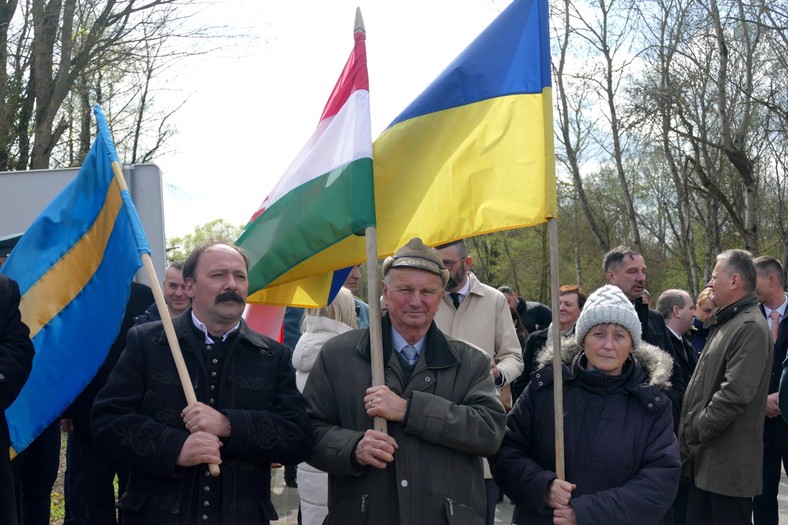
Participants of the opening of the new border crossing of Wałyk Palad-Nagyhodos on the border between Ukraine and Hungary, Zakarpacie, Ukraine, April 8, 2025.
Reality in the corner
Ukraine had various language policies. Ukrainian was announced in the state language in 1989. In 1996, there was a provision in the constitution of Ukraine that Russian and minority languages would still be protected.
In the middle of the first decade of the 21st century, during the rule of President Wiktor Juszczenka, more language provisions were introduced to promote Ukrainian in cinematography, state services and other areas.
In 2012, during the rule of the overthrown President Wiktor Yanukovych, actions were taken to give the status of the official language to Russian and the minority languages of Ukraine, but they did not take place. After the Euromaidan, interest in promoting the Ukrainian language increased in order to leave the “Russian world”.
However, in 2019, the government of former President Petr Poroshenko introduced a controversial reinterpretation of regulations, imposing penalties on enterprises that do not provide services in Ukrainian, strictly enforcing compliance with the provisions on teaching in Ukrainian in high schools and introducing additional requirements for media in the field of media in Ukrainian content.
In the end of Ukrainian acquaintance among the Hungarian people was low, and one of the justifications for the introduction of more severe resources was the desire to better integrate these people. However, Hungary, Romania, Slovakia and some language minorities say that these provisions are repressive or unfair.
It should be noted that some high schools in the corner use a bilingual teaching system, which is lawful. In Berehów you can also see signs in Hungarian and Ukrainian. The regulations were changed in 2024 to respect the rights of minorities to a greater extent, which was the initiative of Hungarian Ukrainians.
Continuation of the material under the video
Dangerous blindness of Viktor Orban
Apart from the advantages and disadvantages of Ukrainian regulations, The requirements of this language policy are a regular topic of conversations between Russian propagandists, Hungary and their supporters, who often exaggerate its effects.
In Ukraine, people using a given language with members of a given nation should never be identified. Many Ukrainians fought and died [za Ukrainę]using the Russian language, but they were not Russians. The same applies to people using Hungarian. Many people use Hungarian in addition to Ukrainian and/or other languages, and you can hear many in the corner.
The inhabitants of Zakarpacie fought in the war [z Rosją]they became prisoners, died and witnessed the effects of this war in the form of arriving refugees, returning bodies of neighbors and relatives.
These experiences, combined with insults at Ukraine by the Prime Minister of Hungary Viktor Orban, caused the loss of sympathy for Hungarians. Some Hungarian users left the corner after the start of full invasion. In addition, Hungarians, although they constitute a significant minority in some areas, do not constitute the entire population of the region and are not a homogeneous group.
Historical claims to the Ukrainian lands are not right, because they are boundaries recognized on the international arena, with the historical presence of Ukrainians, and the desire to change these borders is negligible.
Contemporary allegations regarding oppression also do not make sense, since people who speak Hungarian can still freely use it in many daily activities in cities such as Berehowo. If Orban really believes that the inhabitants of Zakarpacie will want to join Hungary, he is as dangerously blinded as Putin in relation to people who speak Russian.
Dr. Joseph Place is a scientist, writer and editor, he has been living in Użhorod for three years, and for six in Ukraine. He obtained a PhD in political sciences and international relations at the University of Nottingham. He publishes articles on the language and economic policy of Ukraine, and also runs a blog where he touches on, among others, the subject of life in the corner: jjplace.co.uk.
I’m Ashley Davis as an editor, I’m committed to upholding the highest standards of integrity and accuracy in every piece we publish. My work is driven by curiosity, a passion for truth, and a belief that journalism plays a crucial role in shaping public discourse. I strive to tell stories that not only inform but also inspire action and conversation.