
Salaries in state -owned companies are comparable to multinationals and are higher than in domestic private companies, although productivity is significantly lower. An employee of a foreign company produces 2.5 times more than one of a state-owned company, while their salaries are almost equal, Cristian Popa, a member of the NBR, in an opinion transmitted hotnews.ro.
High wages in the state sector can create pressure on the labor market (through what economists call demonstration effect), forcing domestic private companies to compete with an employer that does not necessarily depend on efficiency.
The differences in productivity between companies in Romania are not only determined by size, but also by the nature of capital.
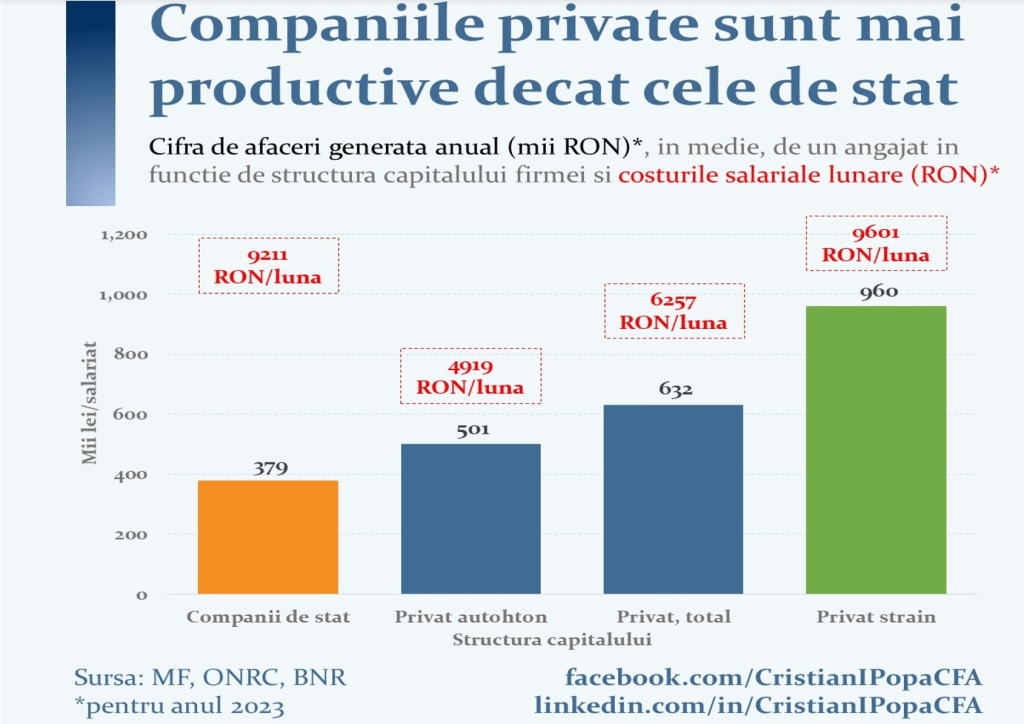
The property of the company (if it is private or state, if it has majority domestic or foreign capital) influences the efficiency with which the resources are used-tell it productivity-as the ratio between the turnover generated annually and the number of employees shows:
- State companies: 379,000 lei/employee
- Destochtone private companies: 501,000 lei/employee
- Private companies (total): 632,000 lei/employee
- Foreign private companies: 960,000 lei/employee
Private foreign capital companies are the most productive. An employee in a company with a majority foreign capital generates, on average, almost double compared to one in a Romanian private company and over 2.5 times more than one in a state-owner (and this is because many state -owned companies operate monopolies). This difference is not accidental. Foreign capital brings the best managerial practices, modern technologies, access to global markets and a superior operational discipline.
Also, most foreign -capital companies are also larger, which allows them to benefit from the effects of scale economies, constant investments in efficiency and easier access to financing. In addition to capital resources, these companies tend to attract highly qualified workforce, later investing in training and professional development of employees. On the other hand, most of the local companies are micro or small, operate with limited resources and encounter difficulties in finding/retaining highly qualified personnel, both because of the limited offer and the reduced financial capacity to provide salaries at the level of foreign capital.

Overall, the private sector clearly exceeds the state companies in terms of productivity.
Even when we analyze only domestic private companies, the average productivity is well above that of state -owned companies. Although many state -owned companies are large in number of employees (approximately 240,000 employees in 1,200 companies, on average 200 employees at a state -owned company), This does not automatically translate into high productivity. I have shown in the previous section that, in general, the size of the companies is correlated with productivity. State companies are the exception: when it comes to them, the size itself does not guarantee high productivity.
Regarding the data, another anomaly that stands out is the low productivity of state companies combined with high profits. The explanation is in the strategic position of some key companies in the state's portfolio. Many of them operate in monopolistic fields or with privileged access to certain natural resources. In these cases, profitability does not come from operational efficiency, but from the dominant position on the market.
The perspective is observed by the fact that a consistent part of the net result of the state sector is generated by a single giant, which concentrates over 40% of the total profit of public companies. Without this, the picture would be another. Such an “outlier” creates the illusion of solid performance of the entire sector, although, in reality, many of the state companies operate on a loss. Much of the profit reported by state companies does not translate into investments for increasing efficiency, but is redirected in the form of dividends to the state budget, so for financing the current expenses of the state.
It is likely that the lack of direct competition, administrative rigidity and operational inefficiencies affect the performance of state companies. In many cases, these companies work without the pressure to optimize costs or increase efficiency. In contrast, companies with foreign capital operate in strongly competitive and complex environments, are connected to global production chains, use modern technologies and daily The hardest to satisfy the customer: the market.
In the case of state -owned companies, increasing transparency and management professionalization are imperative steps necessary
The listing on the stock exchange (as it happened with Hidroelectrica) is a model to follow because it offers the company access to the capital and puts it under the discipline and scrutinization of the market and shareholders. There is even a milestone in the PNRR aimed at reforming the governance of these companies, which could bring obvious improvements.
The conclusion is that productivity differences are not accidental. Companies with a majority foreign capital perform better, because they are better integrated into a system that rewards efficiency, innovation and competitiveness.
This does not mean that there are no opportunities for domestic companies, the gap can be recovered by investments, the adoption of modern technologies, digitization and integration into global markets. Finally, the difference does not make the nationality of capital, but the efficiency with which it is put to work. I do not think there are obstacles to be unrelated to local companies. Capital flows where it is best to work.
To love your country means to want to be prosperous. There is no prosperity in isolationism or autarchy
Sovereignism without liberalism can only bring regress, the over 1.1 million Romanians working in multinationals should know better. For prosperity, efficiency, productivity, international cooperation and integration in European and global markets, capital and work are needed. Companies with private capital (local and foreign) make Romania more prosperous.
Note: This analysis is based on Official data for the year 2023 and follows the productivity of work in Romania through a simple indicator, but, I think, relevant: turnover per employee (as/employee). This report reflects the economic value generated, on average, by each employee in an active company, offering an overview of the efficiency of different types of companies. And the differences are large and difficult to ignore.
To ensure a relevant comparison, Included only companies that made non -nanic turnoverexcluding inactive companies or those who have not reported income. Also, the PFAs, or other similar forms of organization, neither the workers in the public administration or those who work for foreign companies abroad are not included.
In the analysis we included the salary costs, which reflect the total effort of the companies for the remuneration of the employees, including the gross salaries, the tickets, the first and other benefits, related to the number of employees.
Of course, each company is different, and the average hides wide variations between sectors and individual companies. We know the example of Moisil, we know that the media hides a lot, but the purpose of this analysis is to provide a general perspective on how different types of companies contribute to the well -being of the company.
Another relevant detail is that, out of the total companies in Romania, about 170,000 companies declared the turnover.
N.red: Cristian I. Popa, CFA is a member of the Board of Directors of the NBR. The present opinion belongs to the author and does not represent the position of the National Bank of Romania.