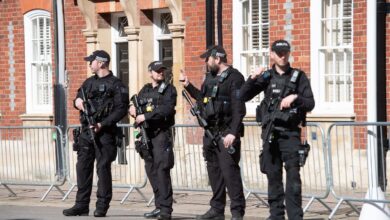
At a military training polygon near the city of Wroclaw, the ordinary Poles stand in line, waiting for their weapons to be handed and learned how to shoot. “Once the cartridge is loaded, the weapon is ready to shoot,” the instructor shouted, a Polish soldier, with his face with camouflage paint, writes BBC.
Young and old, men and women, parents and children, all came here for one reason: to learn how to survive an armed attack.
In addition to a shooting session, this initiative, entitled “Army training”, also teaches civilians to practice the body fight, give first aid and how to put a gas mask.
“The times are dangerous now, we must be prepared,” says the project coordinator, captain Adam Sielicki. “We have a military threat from Russia and we are preparing for it.”
Captain Sielicki says the program is overloaded, and the Polish government now has plans to expand it so that every adult man in the country receives training. Poland, which has borders with both Russia and Ukraine, says it will spend almost 5% of GDP for defense this year, the largest percentage of NATO countries.
Last week, Prime Minister Donald Tusk said Poland aims to build the “most powerful army in the region.” Warsaw has invested in planes, ships, US artillery and rocket systems, Sweden and South Korea, among others.
Dariusz is one of those who participate in the Wroclaw Saturday course and says it would be the “first” that would volunteer if Poland was attacked. “History has taught us that we must be prepared to defend ourselves. We cannot rely on anyone else. Today there are alliances, and tomorrow they are broken.”
As he gets his gas mask, Bartek says he thinks that most Poles “will take the weapon in hand” if they are attacked and “will be prepared to defend the country.”
Agata participates with a friend. She says Donald Trump's choice is worried about people. “He wants to withdraw [din Europa]. That's why we feel less safe. If we are not prepared and Russia attacks us, we will simply become their prisoners. ”
Agata says he feels more vulnerable after US elections
Donald Trump's statements and members of his administration have caused a deep concern among Warsaw officials. During a visit to the capital of Poland in February, the US Secretary of Defense, Pete Hegseth, said that Europe should not assume that the presence of American troops on the continent “will last forever.”
The US currently has 10,000 soldiers stationed in Poland, but Washington announced last month to withdraw from a key military base in Rzeszow, eastern Poland. Officials say that troops will be redistributed in Poland, but this move has caused even more anxiety in the country.
The apparent hostility of Donald Trump towards the Ukrainian President Volodimir Zelenski and the warm words addressed to Vladimir Putin did nothing but amplify the concern.
Poland is about to sign a defense agreement with France in the coming days, and another pact with the United Kingdom is being developed. These are the steps of Warsaw to withdraw from the strong military bond historically with Washington. There is also talk about bringing Poland under the “nuclear umbrella” of the French army.
“I think [Trump] He certainly pressed us to think more creatively about our security, “says Tomasz Szatkowski, Poland Permanent representative at NATO and presidential adviser on defense issues.” I think the US cannot afford to lose Poland, but, however, we must think of other options and develop our own capabilities. “
“If the Russians continue their aggressive intentions towards Europe, we will be the first. We will be the guards,” says Mr. Szatkowski. He attributes the rapid military development of Poland “first of the geopolitical situation, but also to the historical experience”.
Wanda Traczyk-Stawska was 12 when Russia had invaded Poland last time. Now in a state-administered state-of-the-art, Wanda Traczyk-Stawska, 98 years old, remembers the last invasion of Russian forces-in 1939, when a pact between Stalin and Hitler led to the Poland between the USSR.
“In 1939 I was twelve. I remember my father was very worried because of [rușilor]”, Wanda recalls.
On a shelf there is a photo of Wanda in the role of fighters, waving a machine gun during the Warsaw revolt in 1944, when the Polish clandestine movement fought against the German army in the middle of the city ruins. After rejecting the Germans in the last days of World War II, the Soviet Union installed a pro -oscova regime, which led the country until 1989.
Currently, about 216,000 soldiers, men and women, make up the Polish armed forces. The government states that it intends to increase their number at half a million, including reservists – which would make the Army the second largest in NATO, after the United States.
I ask Wanda if it seems like a good thing that Poland strengthens its army. “Of course, yes. Russia has the aggression inscribed in its history. I'm not talking about people, but the authorities are always so,” she sighs. “It is better to be a well armed country than to wait for something to happen.”
Eighty years after the end of World War II, the Poles again look at their neighbors with nervousness. In a warehouse in southern Poland, a company builds anti-aircraft shelters.
“These shelters are mainly designed to protect against a nuclear bomb, but also against armed attacks,” says Janusz Janczy, chief of Shelterpro, who shows me the steel bunker, fully equipped with bunk beds and ventilation systems. “People buy these shelters simply because they don't know what to expect tomorrow.”
Janusz says the demand for his shelters has grown vertiginously since Donald Trump has taken over. “Before, there were only a few phone calls a month. Now there are tens a week,” he says. “My customers are most afraid of Russia. And I am worried that NATO will not come to defend Poland.”
But are the Poles prepared to defend the country if these fears become reality? A recent poll found that only 10.7% of adults said they would enroll in the army as volunteers in case of war, and one third said they would run.
On a sunny afternoon in Wroclaw, I ask Polish students if they were ready to defend their country in case of attack. Most say no. “The war is very close, but it seems far enough,” says the medical student Marcel, “but if Russia attacks, I think I would run.”
“I would probably be the first to try to flee the country,” says another student, Szymon. “I simply see nothing for me to die here.”