Why the Orthodox Church is expanding in Germany, although the general tendency is to renounce the belonging to the official cults

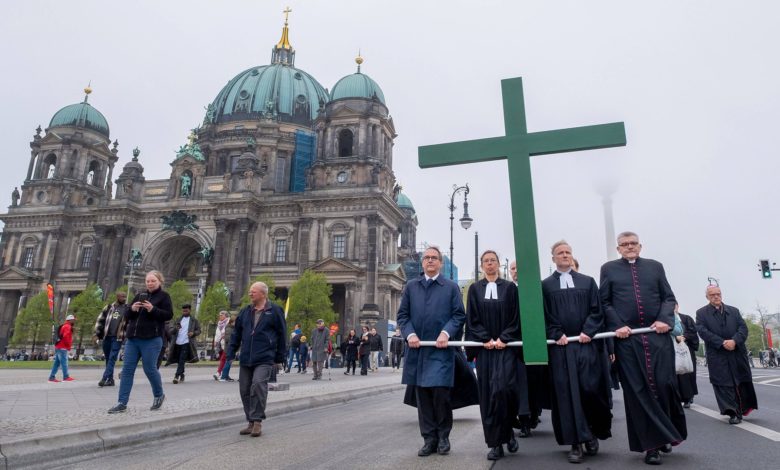
Germany and Protestant churches in Germany lose hundreds of thousands of members each year. At the same time, the number of Orthodox Christians is increasing, reaching almost four million, and more and more Romanians are among them. How is this trend explained in a country where belonging to an officially recognized state confession costs money, in the sense of automatic charge of a church tax on income?
Over 400,000 people left the Catholic Church in 2023, and around 380,000 gave up the Protestant Church. For the year 2024 the figures have not yet been published. The official statistics highlights in the years 2021-2023 a number of 2,328,828 renunciations of these confessions, ie “withdrawals from the church (KirchhenAustritt)”, volunteer, based on demand. Since 1990, since the statistics are made, the figures reach millions.
Church tax
The communities of the two major churches formalized in Germany are shrinking. Many fewer people have entered the Catholic and Protestant communities, which is done by personal declaration of belonging to the main cults recognized as official by the German state. And this entails a statutory fee.
This fee has an old tradition in Germany. In order to help the self -financing of churches and, consequently, a greater separation of the state church, church taxes were introduced at national level. For example, starting with 1887 in Württemberg, in 1905/06 in Prussia and in 1912 in the Kingdom of Bavaria.
The value of the church tax depends on the income of the limb/limb of the self-distracted confessional community and the federal land in which it lives. In Bavaria and Baden-Württemberg, the church tax is 8%, while in the other lands it is 9%.
The church tax is calculated on the basis of the tax on salary and income, that is, only those who pay income tax must also pay tax for the church.
Some recognized religious communities do not collect the tax – for example, the Orthodox churches, the free evangelical churches, the army of salvation and Jehovah's witnesses, because the official recognition as public law corporations are missing, or this is only partial, in some lands. Neither the members of the Muslim and Buddhist religious communities pay church tax.
What religions are subject to taxes in Germany?
The following nine religious communities recognized by the German state have the permission to collect church tax: Protestant regional churches, the Catholic Church, the old Catholic Church, the Jewish religious communities, the Israeli religious communities, the free religious communities, the French Church of Berlin, the congregation of menonites from Hamburg-Altona Renania-Palatinated.
What state benefits do churches receive? Especially the Protestant and Catholic churches in Germany receive benefits from the state. A total of about 602 million euros allocated to these two confessions was highlighted in the available statistics, from 2022.
The salaries of the bishops are not paid by the church. In most federal lands, they are paid by the state. The starting salary is 8,000 euros. Protestant or cardinal regional archbishops and bishops receive up to 12,000 euros per month. For example, Archbishop of Cologne, Rainer Maria Woelki, is paid by the German state with 13,800 gross euros per month.
In his book, the “Church Republic of Germany” (Kirchenrepublik Deutschland – 2015), the author Carsten Frerk addresses Christian lobbyism and analyzes the role of churches, as political and economic actors. In 2013, Frerk made calculations that the assets of the Catholic Church amounts to 200 billion euros, in 2013. The Vatican would have assets of 3.8 billion euros. And the Roman Catholic Church would be “a private property in Germany, with an area of 8,250 kmp”.
Orthodox Christianity, growing in Germany
But there is also a Christian community in Germany that grows against the tendency General for renouncing belonging to official cults. About the Orthodox Church, the information says they would have almost four million Orthodox Christians, which is an estimate, because no official number is registered.
Orthodox Christians have been living in Germany for centuries. With the arrival of the so-called “guest workers”, then from Greece and Yugoslavia, their number increased, since the 1960s. In the 1990s, in Germany about half a million Orthodox Christians lived. Ten years ago, the number of members was 1.5 million, according to the estimates of the conference of Orthodox bishops in Germany (OBKD).
Unlike the Catholic and Protestant Churches, the Orthodox Church does not charge church taxes. It is financed by donations from community members. However, according to clergy interviewed by the German press, this is not a decisive factor to justify the growing number of believers in their congregations.
In the growth scheme, immigration plays an important role, because many Christian refugees are also orthodox. For example, they visit communities such as the Syrian Orthodox Church in Antioch. According to its own estimates, it has 100,000 members in Germany. Orthodox are also the Russians, some of them naturalized in Germany as late repatriates, but also the Ukrainians more recently, due to the war triggered by Russia in 2022.
The separation of the Orthodox communities from the Catholic Church is dated in 1054. The Orthodox Church refers to the communities that appeared from the Byzantine Empire. The term “Orthodox” is of Greek origin and means “straight-faith”.
Despite some differences, the different Orthodox communities are seen as a single church. According to OBKD, most of the Orthodox parishes in Germany belong to the Romanian Orthodox Church. And this, under the leadership of IPS Serafim Joantă, for over two decades he has been steps towards his complete official accreditation in Germany.
Here is one of the recent announcements of the Metropolitan Church based in Nuremberg: “Monday evening, March 6, 2023, the Romanian Orthodox Metropolitan for Germany, Central and North Europe was officially recognized as a public law in Berlin. The ceremony took place in the Romanian Orthodox Church of the Saints Archangel, This status in the Bavaria Federal States, Baden-Württemberg, Hesa, Saarland and North Westfalia. Long of the German state, having a positive influence on society ”.
In an interview recently given to the German press, Ciprian Burlăcioiu, a priest of the Romanian Orthodox community in Munich, explains that, despite the growing number of members, he and other Orthodox clergy find that progressive secularization also affects the Orthodox Church, having experiences similar to their Protestant and Catholic colleagues.
The answer to this dynamic, in his opinion, is cooperation. “I see a higher purpose in a common renewal in the ecumenical spirit based on the common heritage,” Burlăcioiu said at the end of last year, for the German radio Bayerischer Rundfunk.
Islamism in advance
Apart from Christian religions, in Germany, Islam is advancing. In addition to an important and traditional community, such as the Turkish, other supporters of the Koran and Islam populate the federal territory.
The Turkish community in Germany is estimated at approx. 3.5 million people and has reached the third generation. However, the faith of each one remained, at sea, as in the family and as ancestors.