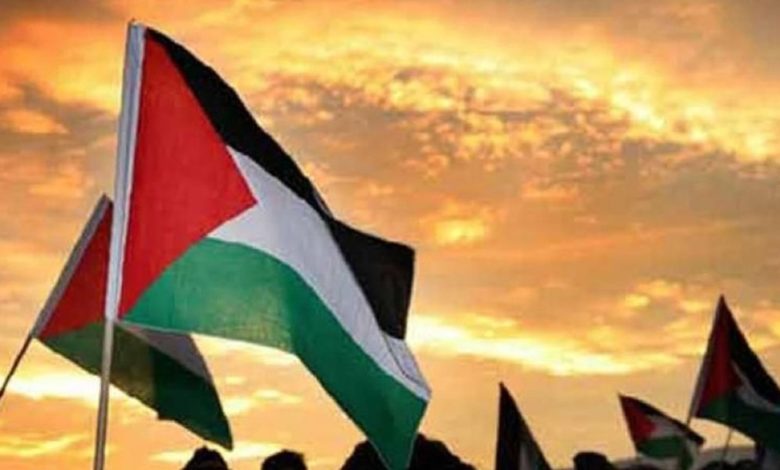
The French and Saudi Foreign Ministers met in RIAD to prepare an international Palestine conference, which aims to promote the solution of the two states and which the French President Emmanuel Macron will co-defend with the Saudi Crown Prince Mohammed bin Salman in June, at the United Nations.
Several European states have reconciled the Palestinian/photo state: Archive
The approach, which brings back the solution of the two states-one constantly supported, but never realized-comes in a context marked by the recrudescence of violence in the Gaza strip and by the failure of previous diplomatic solutions. France seems more determined than ever to take on an active role, and Emmanuel Macron has let it be understood that the recognition of a Palestinian state is “only a matter of time.”
“We must go to a recognition of the Palestinian state, and in the coming months we will do it“, The leader of Élysée said in a television interview, stressing that the gesture is not a symbolic one, but part of a collective dynamic that could encourage other states to recognize, in parallel, the right of Israel to exist-a key element in the equation of peace.
The reactions of other states
While the United States, the United Kingdom, Germany or Japan remain reserved, more and more European countries – including Ireland, Norway, Spain and, recently, Slovenia – have already taken the recognition, despite the firm opposition expressed by the Government of Tel Aviv. Israeli Prime Minister Benjamin Netanyahu firmly rejects the idea of a Palestinian state, and his foreign minister, Gideon Saar, believes that any unilateral recognition would mean “a reward for terrorism“And a direct support provided by Hamas.
For France, the stake is double: on the one hand, the reaffirmation of an autonomous and proactive foreign policy in a tense geopolitical space; On the other hand, supporting a long -term diplomatic solution, given that peace negotiations are blocked for years. Paris welcomes the reconstruction plan of the gas adopted by the Arab League in March, initiated by Egypt, and emphasizes the need for a collective security architecture in the region.
The reactions in the French political class have not delayed. Former President François Hollande claimed that such recognition would only make sense in a broader agreement of mutual recognition and exclusion of extremist organizations in the future Palestinian governance. For his part, Jean-Luc Mélenchon, the leader of the radical left, welcomed the announcement, considering that, “finally, the political solution begins to be taken seriously.”
The historian Thomas Vescovi warns, however, that formal recognition, in the absence of concrete measures, risks remaining a pure declarative gesture. “Nothing will change for Palestinians if not accompanied by diplomatic actions and possibly sanctions towards Israel, in the case of occupying already recognized territories as belonging to Palestine.. ” In his opinion, the true challenge is to reconfigure the Palestinian political representation – a complicated task of losing the legitimacy of the Palestinian authority and the military domination of Hamas in Gaza.
After all, the conference prepared by Paris and Riad could become a turning point – but only if he manages to translate the intentions into facts, and the statements in viable solutions. Sustainable peace remains, for the time being, a fragile promise between the contradictory speeches of the global actors and the tragic reality from the ground.