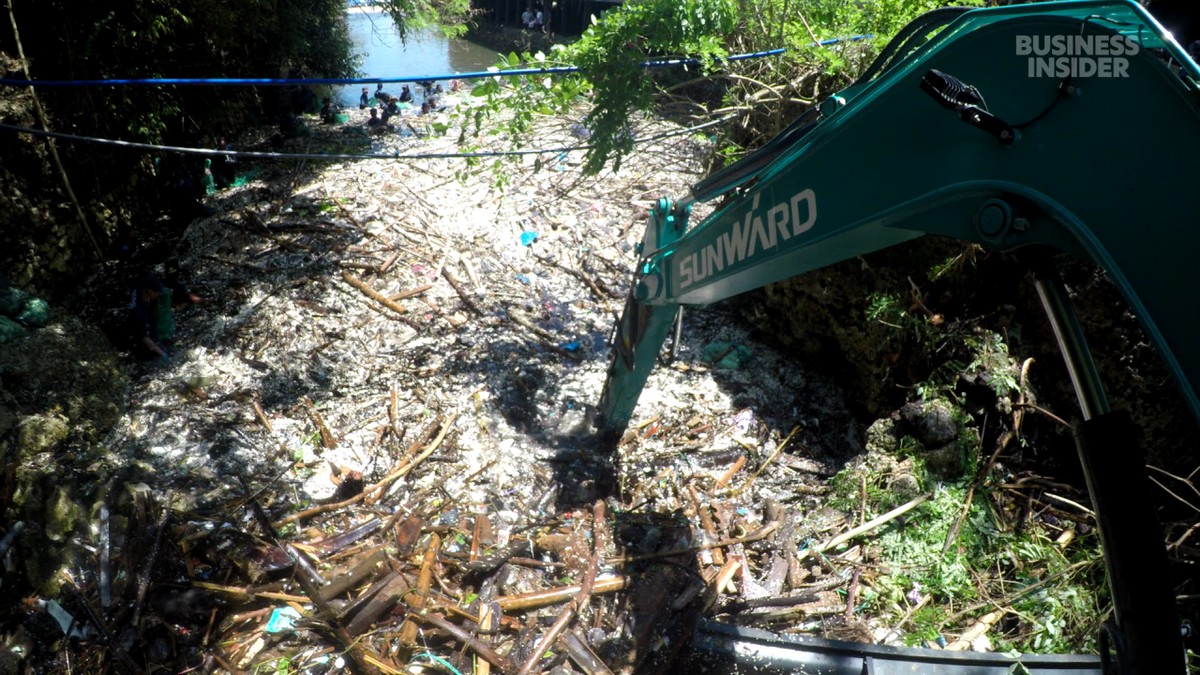
Narrator: Indonesia has one of the most difficult rivers in the world.
This team races over time to manually remove rubbish from them.
Gary BenchegHib, co -founder, sungai watch: It's a sudden case.
A resident, living along this river, sent us a recording and we try to clean it.
Narrator: The next rain could wash this plastic straight to the ocean, where it will be almost impossible to collect it.
The Non-Profit Sungai Watch organized over 2,000 tons of garbage in Bali and in Eastern Java in just four years.
Gary: We find many random things – from dildo to condom.
BenchegHib himself, co -founder, sungai watch: Interesting that you thought about these things first.
Narrator: The organization cooperates with other companies to recycled of rubbish and transform them into sandals and chairs.
But why is Indonesia covered with so many garbage?
And can hand cleaning really change something?
Today, a non-profit organization takes a team of 30 people to clean the river near the seaside village in the south of Bali.
In 2020, Gary founded an organization along with two siblings, Sam and Kelly, but they have lived in Bali since childhood.
Alone: We saw how Bali changed from this beautiful paradise 20 years ago, when we moved here, in an island filled with plastic.
Narrator: In 2019, a ban on disposable plastic, such as bags and straws, was introduced on the island.
However, some studies indicate that Bali still produces over 300,000. tons of plastic waste annually.
Gary: Everything in Indonesia is packed in small disposable sachets.
There is a culture of disposable packaging here.
The trees and the bridge stopped all those floating garbage that will accumulate until the floods occur.
Narrator: All these waste was cleaned in about three hours.
Alone: It is always difficult to determine exactly, but it looks like about two tons of waste.
This is practically only plastic that could go to the ocean.
What most people perceive as rubbish are perceived as a value.
It's like modern mining.
We are looking for the most valuable rubbish.
We place them on pickups and transport them to our sorting center, which is located 10 minutes from here.
Narrator: Non-profit organization has nine sorting plants in Bali and in Eastern Java.
Gary: Here is our sorting plant.
What will go here today will be sorted tomorrow.
Narrator: They deal with about 3000 kg of plastic waste every day.
Gary: We sort everything by hand and divide into categories.
Narrator: Divide everything into 30 different categories depending on the material, color and quality.
The most recyclable items, such as plastic bottles, are sold to recycling companies.
Employees such as Kadek Erianto use Belowanka for ironing materials suitable for recycling in cubes, which are easier to transport.
Eri ironed up to a thousand kg of up to a thousand plastic bottles.
Kadek Erianto, Sungai Watch employee: It's very important to me because I was born in Bali.
I want my children and subsequent generations to live in a cleaner environment.
Narrator: Only a third of waste collected by Sungai Watch can be recycled by external plants.
So the team had to come up with what to do with the rest.
Gary: We collect flip flops most often.
Narrator: To solve this problem, the organization has established cooperation with Indosole.
Together they transform piles of thrown sandals into new ones.
Gary: They have been our friends for many years.
We cleaned many rivers together.
We were written to each other.
Narrator: From the beginning of its activity, the organization has transferred over 200,000 sandals – about 3 percent all collected waste.
At the Indosole factory, garbage is ground and heated in a mixer.
The mixture is placed in form.
Then it is pressed.
Then it is left for about 12 hours.
Kai Paul, president of Indosole: When we have a ready foam block, we cut it into sheets, which we then cut and iron to get inserts.
Narrator: The middle sole is made of recycling material, and the inserts of a mixture of natural and synthetic rubber.
The recycled polyester belt is complemented by a sandal.
From every sandal pulled out of the river by Sungai Watch Indosole is able to produce a new one.
In 2024, siblings also founded the Sungai Design company.
It buys plastic bags collected by non-profit organizations and turns them into furniture.
Alone: Here is a chair that consists of many different elements, but all are made of 2000 plastic bags collected in Indonesian rivers.
This is the first Sungai Design product.
Narrator: About 40 percent However, waste goes to dumps because they are too damaged or too difficult to process.
Despite this, Gary sees every element removed from the rivers as a win.
All collected information is also valuable.
Gary: It is important that we transfer this data to the government to press the policy regarding one -off plastic packaging and the possibilities of their recycling.
regarding disposable plastic packaging
Narrator: Indonesia produces almost 7 million tons of plastic waste annually, and more than half of them are poorly managed.
Most of the waste in Bali goes to the side of the roads, poorly managed landfills and illegal dumps, such as this.
Every Friday, Sungai Watch sends a team that cleans these places.
Alone: Plastic usually goes to rivers from illegal landfills.
Narrator: Waste problem is not new.
In the 2015 study, Indonesia came second in the world in terms of sea pollution with plastic.
The problem worsened after 2017, when China announced that they would stop taking waste from other countries.
This led to the fact that many neighboring countries began to take many more of them.
Much more.
The import of plastic waste in Indonesia increased in 2018.
It led to the government setting an ambitious goal, which is a reduction in the amount of sea plastic waste by 70 percent. until 2025
Gary, however, does not count on it.
Gary: Waste sorting stations are opened, and in a few years closed due to lack of funds and taking action.
Narrator: Waste problem has become so serious that it caught the attention of international media.
Gary: Bali is known to the world as an island of the gods, but thanks to the international media, writing about the garbage epidemic or waves with plastic thrown to the beach, he is now known as the island of garbage.
Narrator: That's why Sungai Watch installed 170 floating barriers, such as this, in Bali and Eastern Java.
Barriers stop most of the plastic, but employees must visit every place every day to stop the accumulation of garbage.
Made Bagi, manager to the northern and eastern Bali, Sungai Watch: We immerse the garbage in the water and clean it, so they are not so dirty.
Narrator: Made Bagi was a taxi driver, but during the pandemic he quit his job to focus on the environment.
Made: I like this job because nature needs our help.
The rivers also need it.
Narrator: The organization experimented with a dozen various barrier models before it came to this simple and scalable project.
After packing the rubbish in the bags, the team weighs them.
Made: We must collect data at each barrier.
Narrator: They write the date, barrier location and total weight with each cleaning.
They also take a photo before and after.
Made: When the level of garbage is high, we must remind the society and the government that specific places need their help.
Sungai Watch will not cope alone.
Narrator: The organization employs 132 people working every day at barriers, dumps and sorting centers placed all over the island.
Gary: What we do in rivers takes place without a break.
Every day we clean the river, and the next day another rubbish gets to it.
This is a marathon we face.
Narrator: One of their greatest inspirations was the Ocean Cleanup organization, which we talked about in 2023.
This is a Dutch non-profit organization that removed over 200 tons of garbage from the Pacific and learned a few really important lessons on plastic management in the ocean.
The founder, Boyan Slat, began by using natural currents to collect floating garbage inside a giant U.
Over the years, the organization has realized that in order to really make a difference, they must approach the source of waste, i.e. rivers.
So she invented those large machines that capture waste before they get into open waters.
They were called interceptors, and the founder plans to arrange a thousand of them.
We recorded the material after the organization installed one machine in the Dominican Republic on the Rio Ozama River, which falls into the Caribbean Sea.
This is one of the most difficult rivers in the world, and Carmen Encarnacion has lived near it for 24 years.
Carmen Encarnacion, craftsman: This has an emotional influence on us. It actually affects our whole life.
Narrator: In 2020, the Ocean Cleanup installed a capture of about 1.5 km down the river from her house.
Carmen: The river is cleaner.
Feel that he is less polluted.
Narrator: The idea is to make electricity to do most of the work.
When the garbage flows down the river, the 213 m arm redirects it towards the machine hole.
Boyan Slat, CEO and co -founder of The Ocean Cleanup: Barriers pass water, but stop everything that floats on it.
On the roof there are solar panels that are connected to batteries that store energy, so we can capture plastic even at night.
Narrator: Belt conveyors transfer waste to one of six dustbins.
In the rainy season they can fill up in just three days.
Boyan began operating in the hope of cleansing the so -called great pacific garbage stains, but it turned out that this is not really a “stain”.
In fact, these are two rotating “clouds” of rubbish, which are often not visible on the surface.
Natural sea currents have created five similar vortices around the world, and each of them accumulates rubbish.
On average, one garbage truck with plastic goes to the ocean every minute.
The scale of the entire undertaking makes it virtually impossible to remove plastic from the oceans.
Jennifer Tank, biology professor, Notre Dame University: This plastic is not big.
It falls into small pieces that cannot be managed.
If there is a way to stop it from getting into the system and transform into tiny particles that we will never be able to manage, we must do it now.
Narrator: Restoration of a polluted ecosystem to normal requires major changes.
The best way to keep the plastic away from rivers and oceans is to produce it in a smaller amount.
Gary, however, still believes that change is possible.
Gary: We talk to local committees.
We run workshops during which we teach local youth and women, how to sort waste.
Narrator: Gary and the rest have won some real wins.
They cooperated with local authorities to identify strongly polluted areas.
In Denpasar, the fish were released back into the river considered clean enough to be removed by garbage barriers.
The group also cooperates with two other non -governmental organizations to develop an educational program regarding the reduction of plastic waste.
They also publish an annual report on the removed garbage and began consulting the government regarding the extension of environmental policy.
Gary: We do it every day, because we really believe that Bali can be free of plastic.
It will probably take a few years, but we hope that we can achieve it.
Crowd: Piotr Nazek