Since the beginning of his pontificate, Pope Francis wanted to break away from his predecessors, pointing the church to the poorest and defending an institution open to all. But despite the reforms that were often strongly criticized internally and the opening gestures towards the LGBTQ+ community and women, he remained half in terms of reforms, writes France 24, according to Radio Rador Romania.
Known for his notorious sincerity, Pope Francis, who died on Monday at the age of 88, sought to position himself as a reforming pope in the 12 years of pontifying, breaking with his two very conservative predecessors John Paul II and Benedict XVI. But his measures have often attracted strong criticisms inside the Catholic Church.
Since his ascension to the Holy See, he affirmed his ambition to bring the church back to the poorest and open it to everyone, while rejecting the Vatican pump. “This is what we will remember about Pope Francis. He is a pope who has tried to be close to everyone, not only by Catholics, but the whole population,” notes Elisabeth Augvillein, a journalist and correspondent for the National Catholic Reporter (NCR).
Jorge Mario Bergoglio quickly noted as a tireless defender of the cause of migrants. On July 8, 2013, he marked the beginning of his pontificate, planning his first journey abroad on the island of Lampedusa, from Italy, the entrance gate for many migrants to Europe.
Ten years later, in Marseille, in September 2023, he persists to defend this welcoming Christianity. During a Liturgy in Velodrom to pay tribute to the migrants who died in an attempt to cross the Mediterranean, he denounced in front of Emmanuel Macron “crushed lives, dreams” and asked the European Union “to fulfill a duty of humanity and civilization”.
Beyond his travels, and in Rome, his lifestyle goes hand in hand with the poorest approach: he gives up the apostolic gold and lives in a sober apartment decorated in which he regularly invites dinner homeless and detriment. To the great dissatisfaction of some of the Vatican who accuse him of desacralizing the function.
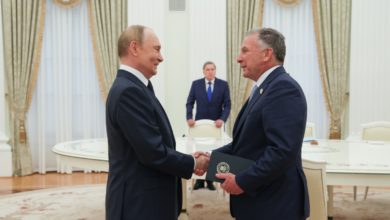
More recently, at the beginning of 2025, Francis also wrote a letter to American bishops to mourn the mass deportations of migrants without documents implemented by the new Trump administration. Enough to cause the anger of American and European religious rights, and this will continue until its disappearance. His last meeting with a foreign politician was with the US Vice -President JD Vance on Sunday, April 20, the day before his death. The “cordial” meeting addressed “the international situation, especially in the countries marked by war, political tensions and difficult humanitarian situations, with special attention paid to migrants, refugees and prisoners,” a Vatican statement said.
“Who am I to judge?”
But beyond this position of “Pope of the South”, aimed at the poorest and to the outskirts, his opening gestures towards certain sectors of society have won his perception inside the “Pope of Rupture”.
He really took a few steps towards remarried divorces and the faithful of the LGBT+community. He received homosexual couples at the Vatican. As he had already done in Argentina when he was Archbishop of Buenos Aires, he reiterated his support for the legislation that protects the rights of gay couples, such as civil unions or PACS, provided that such arrangements are not considered marriage. At the beginning of 2023, a few weeks before traveling to Africa, he expressed openly against the criminalization of homosexuality.
One of his iconic phrases will remain the one he spoke in August 2013, in the plane that brought him back from the World Youth Days (ZMJ) in Brazil. “Who am I to judge?” He said with reference to gay.
In December 2023, he went on and took an additional step by authorizing the blessing of gay couples, arousing intense controversies among the church and a rebellion among the bishops of Sub-Saharan Africa.
It remains that in this matter Pope Francis will not be revolutionized. Confronted with this reaction, the Vatican has developed a “clarification” to defend itself from any doctrinal wandering, at the same time acknowledging that the application of this blessing would be “reckless” in certain countries where homosexuality is forbidden. Moreover, the article that expressly condemns the practice of homosexuality in the Catechism of the Church has not been abolished.
“Pope Francis remained faithful to the Catholic doctrine. There was no question of him to cancel the ban on abortion or to return to the ordination of women,” explains Frédéric Mounier, a former correspondent for Rome for the newspaper “La Croix”.
“But as Jesuit, he was very careful about a moral moral. The pope was very careful about the question where you come from and where you go and your way. That's why he published, for example, a very careful text. A text that has aroused a very, very strong opposition.”
Challenge the struggle against sexual violence
From Ireland to Germany, passing through the United States, the proliferation of sex scandals in the church and Pope Francis to take a new position in this issue. During a disastrous trip to Chile in 2018, he defended a Chilian bishop accused of pedophilia and asked for evidence to the alleged victims. Before presenting, three months later, personal apologies for his left -hand remarks – a premiere for a pope. Then he often asked for forgiveness to the victims he met regularly.
However, by eliminating American cardinal Theodore McCarrick, in 2019, after being found guilty of sexual violence against minors, he sent a powerful signal about his promise of “zero tolerance”. And various measures followed: the lifting of the pontifical secret regarding the sexual violence committed by the clergy, the obligation of religious and laity to report any case to their hierarchy, listening platforms in dioceses around the world.
But the secret of confession remains absolute and the associations reproach them that it has not gone far enough.
From Canada to Portugal, Francis met numerous victims and has made numerous calls for help and forgive requests. Although it is the Pope who did the most to combat this scourge, he never recognized the “systemic” causes, that is, inherent in the church. It was also very distant to the shocking report of the Independent Commission for Sexual abuses in the Church (CIASE) published in 2021 in France, whose members never met, demanding “caution” in front of 330,000 people assaulted within the church when they were minors between 1950 and 2020, but he felt “.
Women in key positions in the church
Within the Church itself, Pope Francis will also be taken significant steps. He thus put order in the unclear finances of the Vatican, clogged in scandals, with the creation of a secretariat for the economy, but also the supervision of investments, anti -corruption and cleaning measures in the Vatican bank, which resulted in the closing of 5,000 accounts.
“The Pope brought the Vatican finances at the international level. It was a fiscal paradise. It is no longer the case,” continues Frédéric Mounier.
And in the question of the woman's place in the church, the pope was noted by some progress, but again, without supporting these developments with a doctrine change.
At the beginning of 2021, he named a woman for the first time in a strategic position at the Vatican, the French Nathalie Becquart. He became an undersecretary general of the Synod of Bishops, the equivalent of a degree of bishop, but without title. Soon after that, by his reform of the Roman courier, he generally allowed women to access key positions.
Recently, in January 2025, it also named Italian Simona Brambilla in front of the “Ministry” of the Vatican responsible for religious orders and congregations, a function previously reserved for cardinal and exclusively male.
But here, the results remain mixed, according to the Catholic feminist circles that lament that the appointments are primarily “cosmetics”. “Although the approach [numirea unei femei să conducă un minister] It is interesting, it will not necessarily be contagious. We are far from parity, “said Caroline Pigozzi recently for France 24, describing the persistent Machism at the Vatican.” Pope Francis can be in favor of [feminizării]but there is such reluctance in the back ”. Reserves expressed especially in a conservative part of the church.
A fragile inheritance
Within the church, other expected reforms were not finally made or remained dead. Among them, for example, the possibility of ordaining married men. In the autumn of 2019, just before the Covid Pandemic, the Synod of Bishops for Amazon voted in favor of experiencing the ordination of married men in this region of the world. Finally, the Pope rejected the proposal, without ever explaining his gesture, which was contrary to his declared desire.
In 2021, Pope Francis modified by Decree and “Traditionis Custodes”, drastically limiting the use of the Litin Liturgy, thus reversing a more flexible edict from 2007 issued by his predecessor Benedict XVI. This decision has aroused misunderstanding and anger among some of the clergy and Catholics attached to the so-called “Tridentine” Liturgy, some accusing the Pope to prevent them from practicing their faith. Four years later, the measure seems to have been a little applied.
Confronted constantly with a radical opposition, the Argentine Pope finally leaves a mixed inheritance. But above all fragile. Nothing, as it is, would not prevent his successor from returning to the past. Especially since the result of the conclave who is planned to designate his successor seems very uncertain.