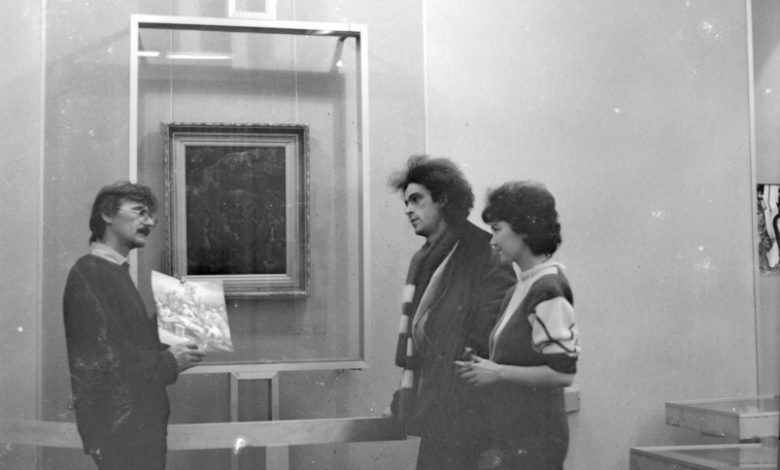
Exhibition of one picture. On the right is the artist Victor Zef. 1989
Photo: Archive of EAO
April 22, 1916
On this day, Tenzer Boris Samoilovich (Shneovich), an honorary citizen of the Jewish Autonomous Region, and a veteran of the medical service was born.

In 1935, Boris Tenzer graduated from a medical school and, together with his release, came to work in the Jewish Autonomous Region. He was appointed to Blucherovo (now – Leninskoye), then he was sent to head the hospital in the village. Vengevo, then a hospital in with. Pashkovo.
During the Great Patriotic War, Boris Samoilovich became a lieutenant of the medical service, worked in a military hospital.
After demobilization B.S. The tenter returned to Birobidzhan. He headed the malaria station, headed the health department of the city executive committee.

Boris Samoilovich (Borukh Shnneovich) Tenzer with his wife Maria Borisovna (Mintsya Bencenovna) Boym. Photo: photo: newspaper “Birobidzhaner Stern”
He graduated from a central tooth medical school, worked as a dentist-orthopedic doctor in the clinic of a sewing factory, a regional dental clinic.

Tenzer Boris. Photo: Photo: Archive EAO
B.S. The tenter was awarded the Order of the Patriotic War of the II degree, medals “For the victory over Germany in the Great Patriotic War of 1941-1945”, “Veteran of Labor”.

The memorial plaque to Boris Samoilovich Tenzer in Birobidzhan (the middle name on the board is not true). Photo: photo: newspaper “Birobidzhaner Stern”
In 1997, Boris Samoilovich Tenzer passed away. On the wall of the house along Gorky Street, where he lived, a commemorative board was installed.
April 22, 1980
In with. The Leninskoye on the 110th anniversary of the birth of V. I. Lenin opened the historical and party museum, which later became the Leninsky district historical museum.

Leninsky District Historical Museum. Photo: Photo: Regional Library
A small hall was taken under the museum in the House of Culture. The first exhibits were about the revolution, civil and World War II. Valuable exhibits – the original of the Iskra newspaper and one of the letters of Lenin were transferred from the Museum of V.I. Lenin in Moscow. The initiator of its creation was Peter Kudish, then – the third secretary of the Lenin district committee of the party.
The first director of the museum was Natalia Kiryukhina. The leading artist was the designer of the party historical museum Boris Viktorovich Kosvintsev.
The entrance to the museum is crowned by the bust of Mikhail Semenovich Korsakov, General Governor of Eastern Siberia in 1862-1871. In his honor, the village of Mikhailo-Semenovskaya (now the village of Leninskoye) was named.
Today, various exhibits are collected in the district historical museum of the village of Leninskoye, telling about the settlement of the Amur region, the formation of Soviet power, collectivization, and repressions. The museum stores photographs and letters of those who fell on the battlefields, fragments of shells, helmets, and weapons details. Many exhibits also remind the war with Japan on Chinese land. In addition, a lot of important documents, certificates, photographs about the history of the Leninsky district have accumulated in the museum.
In the early 2000s, the Lenin Historical Museum moved to a new building and became municipal with a permanent staff of employees.
The museum is held excursions, lessons on various topics, lectures in groups are given, meetings with interesting people are held.
The Leninsky District Historical Museum was awarded the honorary sign “For active work on the patriotic education of citizens of the Russian Federation.”
April 22, 1982
In Birobidzhan, the V pleading of the regional committee of the CPSU was held. At the Plenum, the tasks of the regional party organization were determined to further improve the increase in the efficiency of political work in labor collectives in the light of the requirements of the XXVI Congress of the CPSU. It was noted that the party organizations of the region have accumulated a certain positive experience of a comprehensive solution to the issues of communist education of workers, ensuring the unity of organizational, political and economic activity, and the mobilization of labor collectives for the successful implementation of state plans and socialist obligations.
The labor groups conduct wide propaganda of the materials of the XXVI Congress of the CPSU, the decisions of the November (1981) Plenum of the Central Committee of the CPSU, the Decree of the Central Committee of the CPSU “On the 60th anniversary of the formation of the Union of Soviet Socialist Republics.”
More than 400 lectures, film lectures, 58 folk universities operate in the region. In 1981, more than 16 thousand lectures were given. However, ideological work does not fully meet the requirements of the XXVI Congress of the CPSU, often it lacks concreteness, a close connection with life. The Plenum ordered party committees, primary party organizations to increase the level and effectiveness of all ideological work in labor groups.
April 22, 1989

Exhibition at the Museum of Modern Art. Photo: Photo: Archive EAO
In Birobidzhan, the “Museum of Modern Art of the EAO” as a branch of the Far Eastern Art Museum (Khabarovsk) was opened in Birobidzhan. The initiator of its creation was the creative public of the regional center.
Since July 1996, the museum has become independent, preserving the name “Museum of Modern Art of the EAO”. The organizer and permanent director of the museum is Kostyvvintsev Boris Yuryevich. The museum consists of a department of funds, the exposition and cultural and educational department and is a cultural, research and scientific-educational institution.

1990. Glory DAC and Vladimir Antonovich Mizgalsky on one of the first vernissages .. Photo: Archive EAO

The first large exhibition at the Museum of Modern Art. 1990. Photo: Archive of EAO

Exhibition at the Museum of Modern Art. Photo: Archive of EAO

B.Yu. Kosvintsev (left) and V.N. Goryachev at one of the first exhibitions in the State Duma. Photo: Archive of EAO

Exhibition at the Museum of Modern Art. Yu. E. Kosvintsev at the opening of an exhibition of caricatures of his father Evlampy Nikolayevich Kosvintsev. 1995. Photo: Archive of EAO

Exhibition of carications in the Museum of Modern Art. Photo: Archive of EAO

Event at the Museum of Contemporary Art. Photo: Archive of EAO

Museum of Modern Art. 1991 Marina Rusova – Mishchenko leads a tour at the exhibition of children's drawing. Photo: Archive of EAO

Artists Oleg Chernov and Sergey Bunkov at the opening of the joint exhibition of the Birobidzhan Museum. Photo: Archive of EAO
Since the opening in the museum, a collection of paintings by artists of the Jewish Autonomous Region has been formed.
In addition to storing and studying works of art, a large exposition work is carried out by the Museum of Contemporary Art.
Thematic exhibitions are organized. In addition to the possibility of participating in vernissages, the museum gives everyone the right to exhibit personally.
In recent years, the museum has introduced the practice of creating digital versions of exhibitions and thematic discs based on the museum collection. A similar practice is designed to create equal conditions for access to the cultural heritage of the region for residents of Birobidzhan, and for residents of the regions of the region.