
In the era of increased inflation and uncertain economic situation, Polish and Poles look even more closely at who bears the main burden of home expenses. In Poland, 68% of couples declare that together they make decisions related to daily expenses, including food products. However, this does not always mean an equal division of costs. This is the result of the report “Love and money” prepared at the request of Goldman Sachs TFI.

The “Love and Money” study shows that finance -related decisions in Polish households They are most often taken together – regardless of whether it is consumer expenditure or ways to save or invest money.
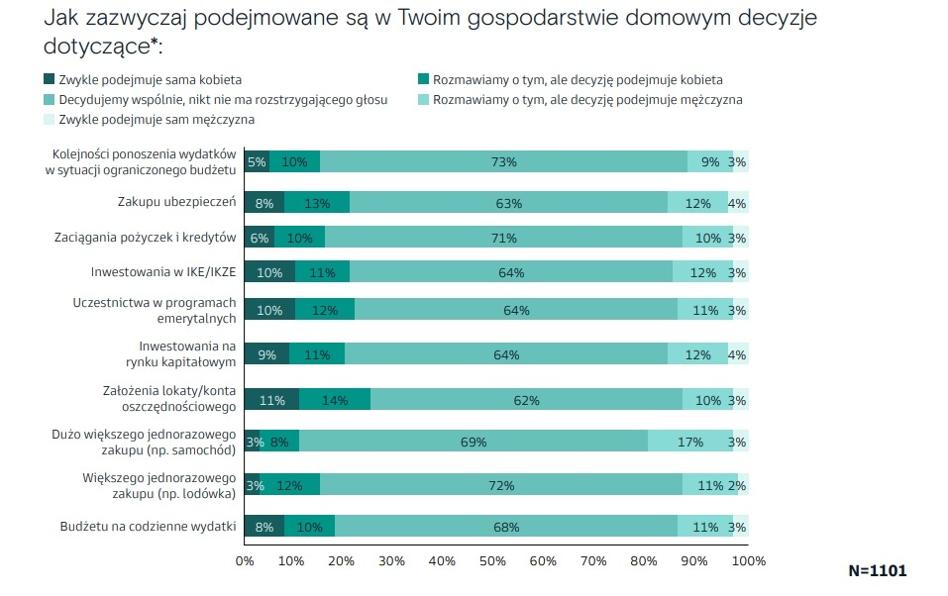
The report has shown that Polish couples most often consult each other in the case of expenses in a limited budget situation (73%), higher one -off expenses, e.g. on household appliances (72%) and in the situation of taking a loan or a loan (71%). Joint decisions regarding daily purchases were slightly lower (68%). In matters related to expenses for everyday life, however, a woman has a slightly more often decisive voice.
Women – independently or after talking to a partner – make purchasing decisions in 18% of cases. Only 14% of respondents indicated that men decide in these matters themselves.
– Interestingly, if the household decisions are not made together, they are more often made by a woman than a man. Exception is expensive good, for example, buying a car/car. When the purchase of this type is done without prior discussion with a partner, men more often decide on it. It is also worth noting that the study clearly showed that couples, which together agree on home expenses, declare a higher level of satisfaction with the relationship – explains prof. Katarzyna Sekścińska, author of the study “Love and money”.
Equally, but not always
Almost half of the pairs (48% in the case of partnerships and 49% in the case of marriages) Every month he creates a common pool of money for home expenses. On the other hand, 38% of people in partner relationships and 34% of spouses choose a model in which each partner pays for home expenses from their own account, without prior combination of income. Most often, the couple share costs in equal proportions. However, if it happens that only one of the parties is borne by the whole or most of a given expenditure, it is usually the purchase of products for the exclusive use of this person – regardless of whether they are cheaper or more expensive.
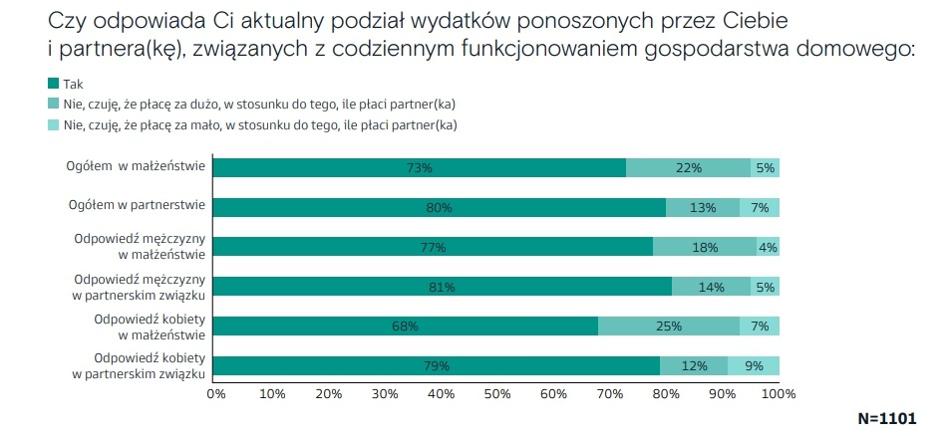
65% of couples divide everyday living costs equally. In 13% of cases, a man is more added to shopping. The opposite situation applies to 12% of relationships. There are also relationships in which daily purchases are covered only by one of the partners (3% of women and 4% of men).
Where do we keep the money?
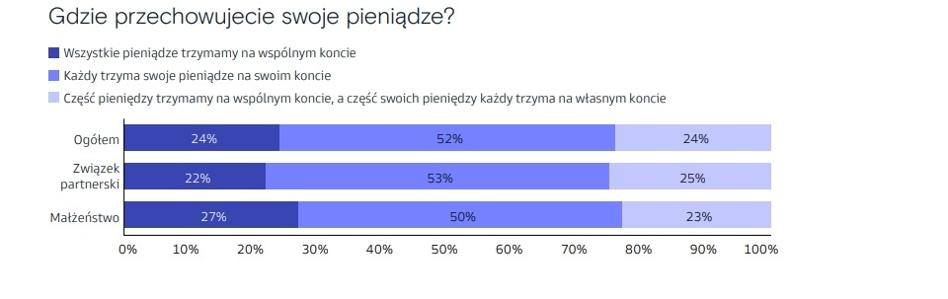
“Love and money” study indicates that Although in 86% of marriages and 28% of partnerships, income is counted to joint property, many couples prefer to keep at least some of the money on separate accounts. Only 27% of marriages and 22% of partnerships declare that all funds are kept on a joint account. The model in which each partner operates money only on their own account clearly dominates. This is the case with every second marriage and 53% of partnerships. On the hybrid model (part of the funds on the joint account, and some on the personal) decides close to every fourth couple (23% of marriages and 25% of partnerships).
– A little more than half of the couples keep the funds they earn on their private account. Sometimes it is a manifestation of a lack of trust in a partner (ki), but more often it is simply a matter of the fact that someone had an account before joining his (his) partner (Ką) and it has already remained. The latter situation is often reflected in sharing accounts, which is decided by 30% of marriages and 31% of partnerships. Interestingly, the study showed that happier couples are those who have each other access to their accounts. It seems that this becomes a indicator of trust. It is worth remembering and thinking about why my partner (my partner) do not have access to my account. If by omission, but in principle we do not see contraindications, it is worth considering changing this situation. This will give a signal to a partner (partner) about our trust and in an emergency situation will allow you to launch funds from the account if they are needed and we will not be able to take them – says prof. Katarzyna Sekścińska.
Poles talks about money
According to the study “Love and money”, the subject of finance in partner relations still evokes mixed emotions and is sometimes treated as a taboo. At the same time, almost three -quarters of men (73%) and almost two -thirds of women (65%) consider conversations about money to be something natural, which does not differ fundamentally from other life issues. Despite this, 35% of men and 38% of women admit that they try to shorten the discussions about finances and wanting to avoid prolonged conversations on this subject. Almost every third woman and every fourth man feels awkward during conversations about money.
– Despite the changing approach to money, more and more social consent to talk about them, we still feel awkwardly raising financial issues. Asking someone how much he earns, he is not only a question about the account status, but also with a question that the answer will indicate what professional success the interlocutor, what his social position is, will allow him to feel good or bad. We do not feel comfortable in conversations about money, we do not want to offend anyone, we do not want to think about us – e.g. that we are materialists since we are asking about money. This is because the money has become a symbol of success, prestige, social position today, and unfortunately often a man of man. There should be no such fears in healthy relationships. It is worth breaking them, because honesty and financial openness in a relationship is very important and allows you to function harmoniously in a relationship. Polish couples often speak – we haven't talked about money yet, because somehow there was no opportunity. Easter is approaching, maybe this will be this “opportunity” to the conversation – comments prof. Katarzyna Sekścińska.
– Pre -Christmas expenses are an inflammatory point, but also a chance for a sincere conversation about the budget. Our study proves that couples in Poland are more and more financially responsible – jointly plan and seek balance between independence and responsibility for home finances – adds Radosław Sosna, a member of the board at Goldman Sachs TFI.
Wage gap and assessment of your own material situation
Almost half of the respondents (49%) consider their financial situation at least rather good. However, 11% of respondents assess their situation as rather bad or worse. Surprisingly, 19% of men and 20% of women are not aware of the exact structure of their household income.
In addition, the results of the study confirm that there is a pay gap in Poland. Women estimate that the partner's income is an average of 8% more in the household budget than their own earnings. Men estimate this difference at 12%. These results suggest that the perception of the financial contribution may vary depending on the gender, although the general income structure may remain similar.
The “Love and Money” study was conducted at the request of Goldman Sachs TFI in December 2024 at the sample 1101 adult Polish women and Poles remaining in partnerships or marriages.