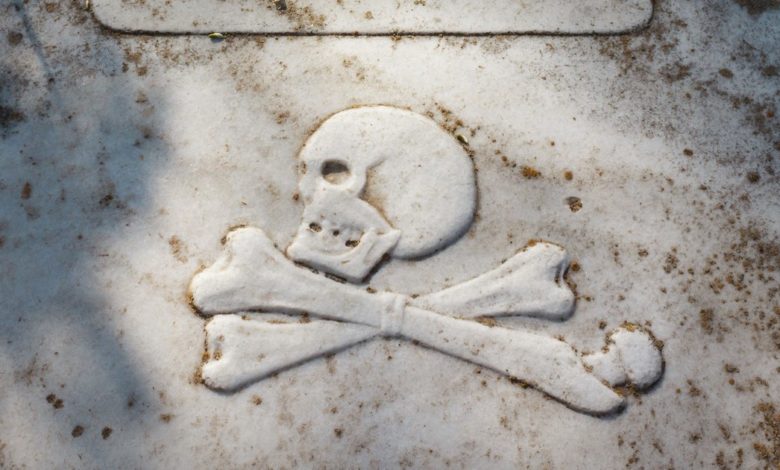
The only pirate tomb in Europe is in Romania. More precisely, in the town of Sulina. It belongs to a Greek, a kind of Jack Sparrow on the Danube lands, which used to plunder all the ships that fell in his hand, terrorizing the Black Sea coast.
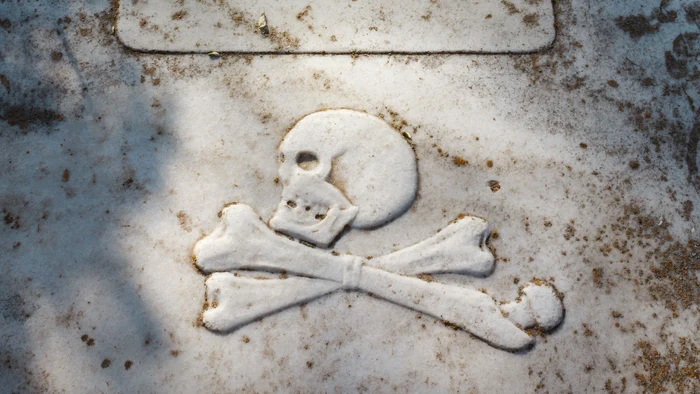
The sign on the grave of Pirate from Sulina Photo Ghiorghios Kontoguris/ Facebook
The pirates have sparked and still arouses fascination among people. As proof the success of film productions related to the activity and legends of the pirates in the Caribbean area. Although the most famous, the Pirates of the Caribbean or the Moorish bouncs in the Mediterranean, were not the only great bandits who slipped fear in those who traveled or transported precious goods at sea.
Little known is the fact that on the arms of the Danube or on the Black Sea, dangerous pirate bands were operating. They did not work as spectacular as the French or English cooks in the Caribbean, with approaches and volumes of the side and the other, but they were certainly as efficient. Even more inventive. The Danube pirates were based on the element of surprise, on concealment and efficiency. The people of the Danube Delta Balti, say that these sea bandits have hidden many treasures, on the roads only known.
The only known pirate on the Danube
The Black Sea has been haunted since the ancient period, as Herodotus confessed. Greeks, in particular. For a long time, in the Middle Ages, under Ottoman control, the Black Sea was somehow away from the pirate activity. But this was resumed after the Russians prevailed as a great power and began to challenge and threw Ottoman hegemony in the Black Sea.
This happened in the eighteenth century, a true golden age of piracy in the Black Sea but also at the mouths of the Danube. The commercial vessels were targeted by the rapid attacks of the pirates on the Danube channels. “The piracy was omnipresent at the beginning of the modern era, a large part of the naval history of that period being in fact the story of the efforts made by different regional powers either to combat it or to surround it. The pirates were, of course, both a burden and a blessing: a burden when they attacked your ships, when they could attack them,the historian Charles King said.
A pirate nest was Sulina, at that time a cosmopolitan port, a variety of Romanian Royal Port. In Sulina, Russians, Greeks, Turks, Armenians, Jews, Albanians, Germans, Italians, Bulgarians or English were met in Sulina. Each handed by his business. There were many pirates in Sulina's taverns. They did not resemble those in the Caribbean. I mean, they had no wood legs, pistols stuck in the belt, flamboyant hats and parrots on the shoulder. They were rather the Cazaci or Greek mathelots who were pulling their ear and waiting for the right information to them. Among them are the only certified pirate, which we know with first name and name, from the mouths of the Danube. It was called Ghiorghios Kontoguris and was a Greek from Cephalonia, an island in the Ionian Sea. It had a band of pirates of several nationalities, probably Cazaci, Lipovans, Greeks, Bulgarians and Romanians. All tightened together by Captain Ghiorghios to get prey.
An effective method: bull, lanterns and prey
It is said that this Ghiorghios applied an ingenious method when he did not want to go out. He used a buhai that was grazing and tied a plank between the horns, to which two lanterns were hanging. Then he walked him on the seafront or let him graze the Danube. In this way, he cheated on many ships to get to the place where he saw the lanterns swaying. The rudders confused the animal's swayed walk with a ship on the waves, located in the port of the port.
So they went straight to the lanterns and failed in the first sandbank. Immediately, Ghiorghios's crew was shaking in the boats and tackled the ship, plundering it. When the method did not go, the Greek pirate and his people were out. They did not go too far, preferring the area of the shores. Their boats were easy but easy, and did not face a confrontation. Instead, they took advantage of the darkness to stick to the larger vessels. The pirates were climbing on board and making a break. Local legends say that the delta road would be a stone road, as wide to fit, well hidden at two palms underwater.
There the pirates would have led and hide their treasures. Ghiorghios jerked at the age of 33, in 1871. He probably attacked an escort vessel and was seriously injured. In any case, it is the only pirate in Europe that has a specific tomb. That is, what describes his profession. The tomb is located in the Sulina cemetery, made at the expense of his brother, and on the funeral plate is the sign of the pirates, a skull with two cross bones. Ghiorghios was not the only pirate in Sulina. It was the last one. For over three centuries, Sulina has been a pirate nest that attacked both on the Danube and the Black Sea.
The most famous were the pirates of Cossacks. They operated both in the coastal area, quickly attacking the darkness, especially the isolated ships, but also on the Danube channels. They used some fast boats, called “seagulls”, in which 50 people were. These boats were very fast and handling, useful for fast, surprising and extremely efficient attacks. The Cossacks used both curved, knives but also pistols, muskets and light cannons.