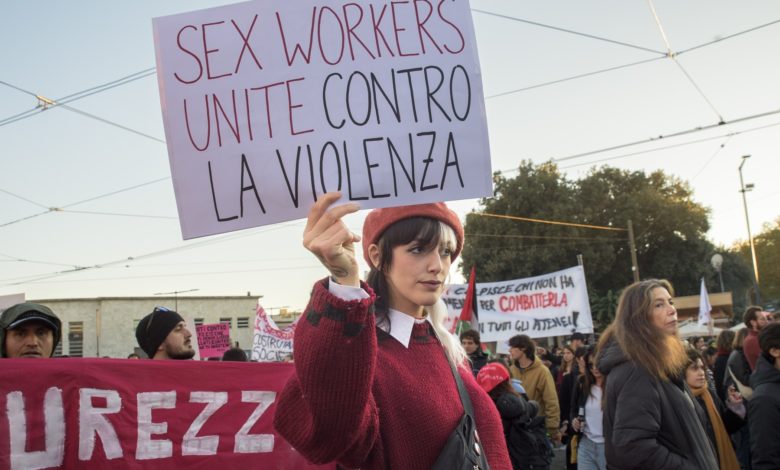
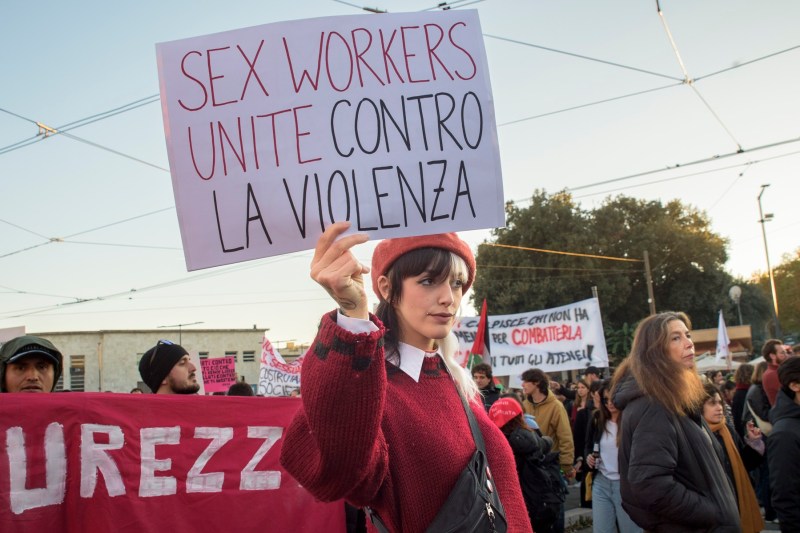
Woman manifested against violence against sex workers, at a protest organized in Rome in November 2024, photo: Marcello Valeri / Zuma Press / Profimedia
Italy has made the first direct reference to prostitution in the classification of the economic activities that it uses for data collection and fiscal purposes, the National Institute of Statistics in Rome announced on Friday, quoted by Reuters.
In Italy, prostitution is in a legal vacuum, the persons being allowed to offer sexual services, but without this activity being regulated by specific norms. On the other hand, the organization of sex workers, such as in a brothel, is strictly forbidden.
Sexual workers are now expected to use the classification of economic activities adopted by the Italian authorities to obtain a VAT code and try to regulate their status.
Therefore, such workers do not often have access to Italy to the rights guaranteed by the Labor Code and cannot declare their income or pay taxes. The situation makes a strong contrast to those from other European countries such as the Netherlands and Germany, where sexual work is regulated.
The so-called ATECO system helps government agencies and researchers to classify activities in order to develop policies and analyzes for the Italian economy. It was updated this year, the new codes entering into force on April 1.
How will the Italian sex workers be classified
The National Institute of Statistics has included sex workers in the category of personal services, which also includes tattoo studios and party organizers – a decision that brings official visibility to a historically hidden industry.
In a statement issued on Thursday evening, ISAT said that sex workers could already be registered in previous classifications of the ATCO system, but the update for 2025 refers directly to them, in accordance with a modification of the accounting norms of the European Union.
The EU accounting regulations also refer to activities that are illegal in Italy, such as organizing groups of sex workers.
However, ISAT stated that, in terms of Italian classification, only the legal activities for the attribution of the atheco codes will be taken into account.
Previously registered as masseuses and other professions
An official familiar with the subject said that sex workers in Italy have registered over the years under alternative names, such as a masseuse, to formalize their activity.
As in Greece, governments that succeed in Italy have failed to combat a flowering underground economy, in a country where the circumvention of taxes and taxes is often considered a necessity-or even an art.
The latest available data show that the “gray” economy in Italy was worth over 200 billion ($ 220 billion) in 2022, the equivalent of about 10% of the country's GDP and up to 9.6% compared to the previous year.
Ernesto Maria Ruffini, the former head of the Italian Treasury, resigned in December last year, complaining that politicians “demonized” the fight against evasion and tax fraud.
Ruffini did not name anyone directly, but his statements seem to be directed to Prime Minister Giorgia Meloni and Deputy Prime Minister Matteo Salvini, who both accused the Agency led by Ruffini of harm the ordinary Italians.
Salvini had previously stated that he wanted to release “millions of Italians who have been held hostage for many years by the Income Agency”, while Meloni compared tax inspections on small businesses with the extortion of mafia.