
publication
2025-04-07 22:07
It was a crazy day on global stock markets. He could easily give the events and twists of action. It ended so that the S&PC brushed with a conventional Bessa line and during the Monday session he was the lowest since January last year.
The beginning of the Monday session brought a continuation of the powerful discount of the action from last week. Shortly after the opening of the S&PCs, it was reduced by nearly 4.5% and from the February peak of the bull market it was divided by over 21%. So the conventional bessy border was understood as a decrease in the stock market index by more than 20% relative to the last peak. Anyway, S&PC and NASDAQ were not lonely in this state, because in such a defined BESS were, among others Indexes in Japan, Germany, Taiwan or the Philippines.
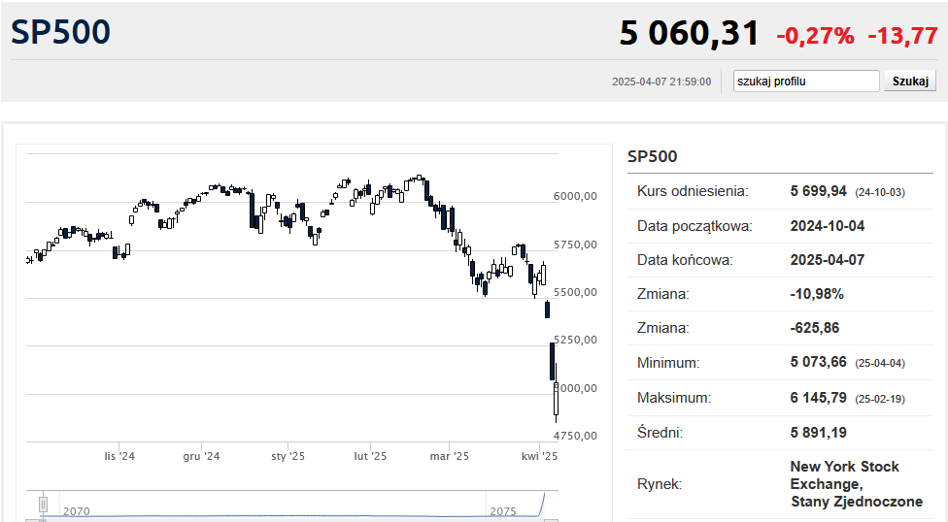
Later, however, something happened that is extremely rare. The S&PC suddenly jumped above the line, temporarily gaining up to 3.4%. It was therefore 8.5% compared to the minimum from the beginning of the session. This is how the market reacted to the reports of Kevin Hassett, one of the older advisers of Donald Trump, who said that the president is to consider 9-day erection of duties to all countries except China. The White House, however, quickly denied these reports and after a while he lost over 2%.
Later, Donald Trump added olive oil to the already buzzing stock exchange fire. The US President wrote fury that the answer to the Chinese retaliation duties announced on Friday Additional tariffs of 50%. It is obvious that Beijing cannot fulfill the demands of President Trump, because in this case the Xi Jinping regime would lose his face. Therefore, we have another salvo in the world customs war that broke out last Thursday thanks to the President of the United States.
In the second phase of the session, New York indexes came out again, and the head of the European Commission proposed the mutual abolition of duties between the EU and the USA. It is doubtful, however, that President Trump would agree. However, it can be seen that the rest of the world (except China) so far tries to not escalate accurate conflict. However, ultimately the Monday session brought a continuation of the declines, although the other half was much calmer. And the very scale of the discount was much smaller. The S&PC lost only 0.23% and stopped at level 5,062.25 points. Nasdaq even managed to gain 0.10% and finished with a score of 15,603.26 points. Dow Jones after a decrease by 0.91% amounted to 37,965.60 points.
Long white candles appeared on the daily charts, signaling the appearance of demand for discounted actions. A tiny spark of optimism is enough for a powerful reflection on an extremely sold out and very terrified market. We saw a sample of market capabilities on Monday, when one good rumor was enough to raise the S&PC by over 8%. This is how the market reacts, which are governed by emotions, not a rational assessment of the situation and prospects for the economy and the results of the stock exchange of companies.
However, in the long run the situation does not look very interesting. High import duties in the world's largest economy seem to be a permanent element of the economic landscape in the coming years. This is a shock for the global economy, which for the previous 35 years developed on the basis of opening and liberalization of international trade, low tariff barriers, work specialization and expansion of global supply chains. This world order has just been undermined.
A direct consequence may be a recession in the American and world economy. Economists of the Goldman Sachs investment bank have estimated the risk of recession in the USA at 45%. However, no one has the idea of what customs will apply next week, let alone in the following months and years. Now their amount is probably negotiated in the comfort of the office of the heads of government and presidents of international corporations.
It is also worth placing the Monday session in a broader context. After very violent declines from Thursday and Friday during the weekend, the administration of President Trump seemed to confirm investors that he would not change customs policy. The head of the Federal Reserve also failed people from Wall Street on Friday. Jeroma Powell summed up that customs will probably slow down economic growth and increase inflation, but that it is too early for any decisions in monetary policy.
In this way, Powell quite brutally walked with the hopes of some investors. Even an extraordinary reduction in interest rates at the unannounced FOMC meeting was speculated on the market. The term market has already begun to value the 25-point reduction of the Federal Fund's foot in May another in June-according to the Fedwatch Tool calculations. For now, however, he does not promise to get them. Therefore, the “Fed Put” principle that remembers Alan Greenspan's time is currently threatened.