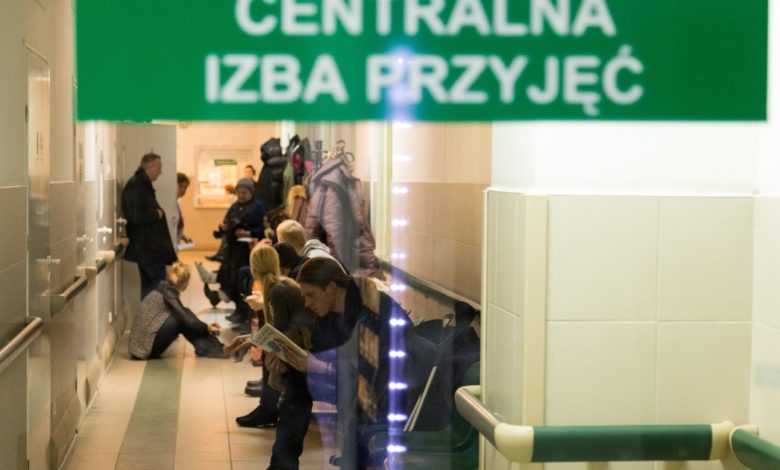
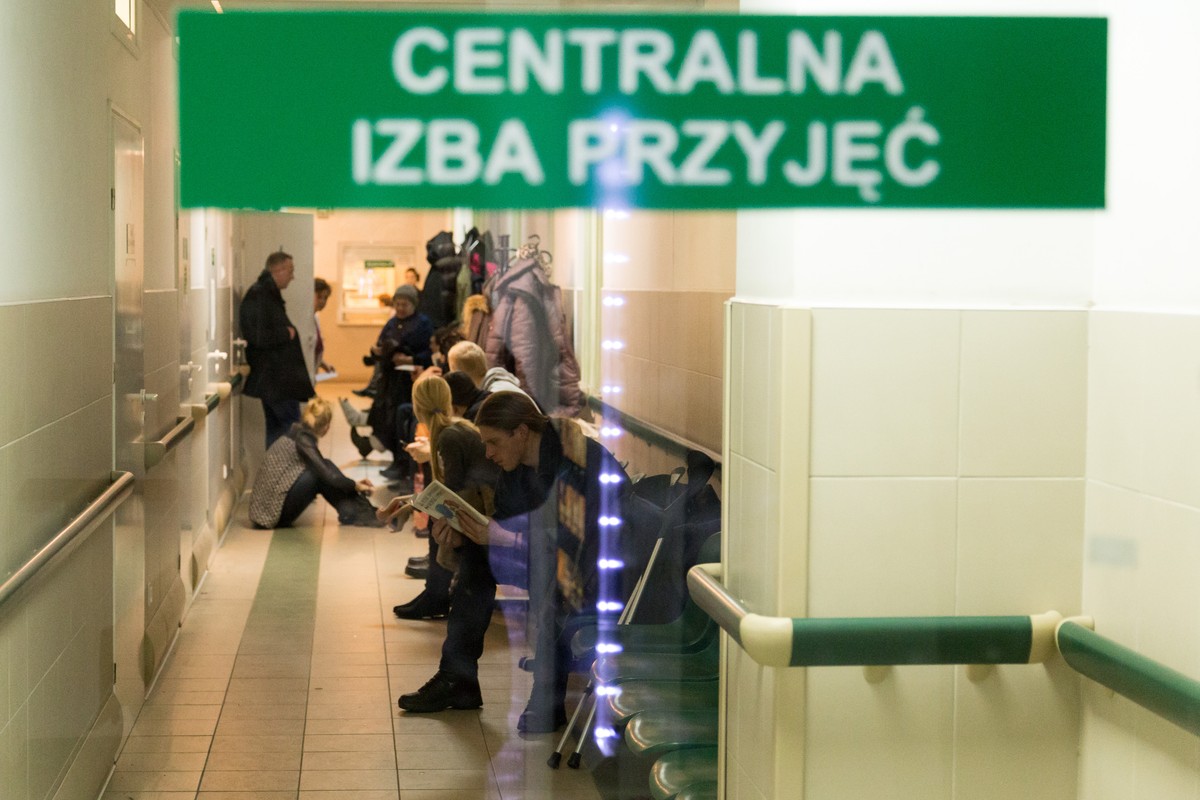
Hospital emergency departments (SOR) are places where life saves and suddenly endangered human health. You do not come here with indigestion, cold, with a headache or tooth, or for a referral or prescription.
You can, and even have to report a sudden injury: fracture, injury, resulting from an accident. But also when our health suddenly worsens: we suspect a heart attack, stroke or we have a circulation problem.
The problem is that for many years it has been said that quick help for SOR will not receive. Patients complain about long queues, underestimating applications. You can also hear about fatal cases.
Read also: Do not go to SOR with these matters. Your doctor has the right not to accept you
No otherwise, the better one, better
On SOR, there is no principle, first served, better. Here, a medical worker decides about the admission. A triaż is used, i.e. the division of patients into those who need help immediately or urgently, and those who can wait from a medical point of view to wait for help. The division is carried out: red (means the highest priority, i.e. immediate contact with the doctor), orange (high priority, waiting time for contact with a doctor should be up to 10 minutes), yellow (up to 60 minutes), green (low priority, waiting time up to 120 minutes) and blue (lowest priority, up to 240 minutes).
If a medical employee finds that health does not require immediate medical assistance (green or blue), he may refer patients to primary healthcare (pos) or to night and festive healthcare.
Even over 6 hours in the queue
We checked if the time on SOR is observed. How? You can check the queues at hospital emergency departments on the patient.gov.pl website. We looked at different times of the day to see what the intensity of patients is. Both in the afternoon and late in the evening, the most difficult situation among the facilities we monitor was at the University Clinical Hospital Jan Mikulicz-Radecki in Wrocław. There at 15th, March 27, 46 people were waiting for help. The least urgent cases had to wait more than six hours, and they should have a maximum of four. Late in the evening the situation was still difficult. 55 people waited in the queue, and 14 people qualified as “low priority” had to take into account more than four hours of waiting. Meanwhile, there were no crowds in other Wrocław facilities. Six people waited in the Provincial Specialist Hospital, as in the 4th Military Clinical Hospital with Polyclinic.
In Warsaw in the afternoon the most difficult situation was in the Wolski Hospital dr Anna Gostynińska. There, 37 expected in the queue, which had to take into account getting stuck in the emergency ward for over 3 hours. Late in the evening you had to wait the longest in the Bielański Hospital. 60 people were waiting for help. Most of those with “low priority” – the waiting time is over four hours. At that time, there were nine people in Bródno, in the Czerniakowski Hospital – 13, and in Prague – only six.
There were no crowds in Krakow. Most people – 20 – expected late in the evening at the University Hospital. People who were qualified as the lowest priority had to take into account the expectation of about four hours.
However, what we noticed when browsing the status of queues is that in some facilities the processing powers were so small that even serving six expecting people lasted several hours. From this arises that the time spent on SOR depends not only on the number of cases, but also the organization of work.
No doctors
For years, there has been talk of the problem of lack of emergency medicine specialists. Pursuant to the Regulation of the Ministry of Health of 2019, it is the doctor with such a specialization who should be the head of the emergency department. The problem is that such doctors are missing. The date of entry into force of the regulation was therefore moved several times. Last year, as reported by the ministry, the 249 SOR, head of 182 emergency departments, was an emergency medicine doctor. However, 47 out of 67 other SOR, which is nearly 19 percent. all the emergency departments in the country informed that by the end of 2024 it would not be able to meet the requirement that the head of emergency medicine would be the headmaster.
Therefore, the ministry went on hand and enabled the head of doctors after the second year of specialization. The Presidium of the Supreme Medical Council sees in this danger and believes that the position of the head physician should be reserved for doctors with high specialist qualifications.
NRL wonders if the Minister of Health asked himself why there are so few rescue medina doctors. According to NRL, there is one answer: too much legal liability in cases of unintentional damage.
“Working at emergency departments is burdened with a special risk, and the lack of appropriate legal regulations means that doctors bear too high the risk of legal liability for decisions taken in conditions of high pressure and a short time to act. In addition, doctors of the state emergency medical system, including SOR, are exposed to behaviors that threaten their health and bodily innocence, worship and personal incorporation. The current legal protection, which they are entitled to is not enough, “says the Presidium of NRL.
With a cold to the clinic
Queues on SOR are also generated by patients themselves who treat the rescue ward as a clinic. – Please remember that SOR is a special place where patients are first available in a state of health or life. Therefore, before the patient goes to SOR, he is subjected to the wall. This is a special procedure during which the patient's health is assessed in several categories. The time of coming to the ward depends on the priority that will be given to the patient during the triage. Priorities are described in the information to which the link above. To sum up, e.g. a patient who suffered in a car accident and his condition threatens health or life will be accepted first as the highest priority. However, if another patient goes to SOR with a cold, then he will have to wait the longest for help – emphasizes Paweł Florek, director of the Social Communication and Promotion Office at the National Fund of Zdią.
He emphasizes that the National Health Fund regularly appeals with other institutions, even in the educational campaign “SOR (Ry). Here is saved by life” that the hospital emergency department is the place where the most urgent cases go. – On the other hand, patients, even with the aforementioned cold, will be given to the family doctor first, and after 18.00 to 8.00 next day and at weekends around the clock a doctor at a night and holiday health care facility – reminds Paweł Florek.
Deregulation of healthcare
Rafał Brzoska has an idea to discharge queues to doctors, who manages the team to submit proposals for deregulating legal provisions. The entrepreneur proposed a “queue package”, i.e. the central e-registration of medical visits. He wants to introduce a central electronic registration to doctors, visits notification system and the possibility of canceling them.
– The problem is that we are dealing with a completely non -nuclear system at the central level – noted Rafał Brzoska. As he pointed out, at GOV.pl you can check how many minutes you wait for the Emergency Room, how many people are in the queue, how many minutes are waiting with a light, medium and heavy accident, which allows you to choose SOR, where you wait for the shortest. The problem is that nobody knows it. – We will propose to get this information to the mobile. This will make the most loaded less loaded. These are trivial things that no one falls into – added Brzoska.