Houses repairs resulting from the EPBD directive by 2050 may cost over PLN 1 trillion. Will most of the costs cover the owners of these buildings?
At the end of March this year. The media attention was drawn to the “Clean Air” program. Not only due to the start of the new installment of this program, but also the problems related to delays in the payments of older funding. However, it is worth looking much more widely about thermomodernization and decarbonization of Polish homes. The more that the project has been published recently National Building Renovation Plan. This document confirms that the EU renovation wave in the case of Polish homes can cost over 1 trillion zlotys by 2050. Experts of the RynekPierwotny.pl portal checked what sources this considerable amount is to come from.
Renovation may include about 6 million houses
Single -family houses are the largest group of Polish buildings. The already mentioned project of the National Building Renovation Plan contains information about almost seven million Polish homes. This respect based on BDOT database data also includes home vacancy, which will generally not be subject to thermomodernization and decarbonization. The current number of such empty houses can be carefully evaluated at over 0.5 million. The group of “home” vacancies will definitely grow gradually due to demographic tendencies (especially regarding rural areas).
Two scenarios, both with similar costs
The project of the national building renovation plan presents two scenarios of mass repairs of Polish homes. Despite the preliminary nature of the aforementioned scenarios, it is worth paying attention to them. National Renovation Plan This is an important document whose project will be presented at the end of the European Commission at the end of this year. Directive of the European Parliament and of the Council (EU) 2024/1275 of 24 April 2024 on the energy characteristics of buildings (called the building directive/EPBD Directive) indicates that domestic renovation plans are the basis for later activities of the Member States.
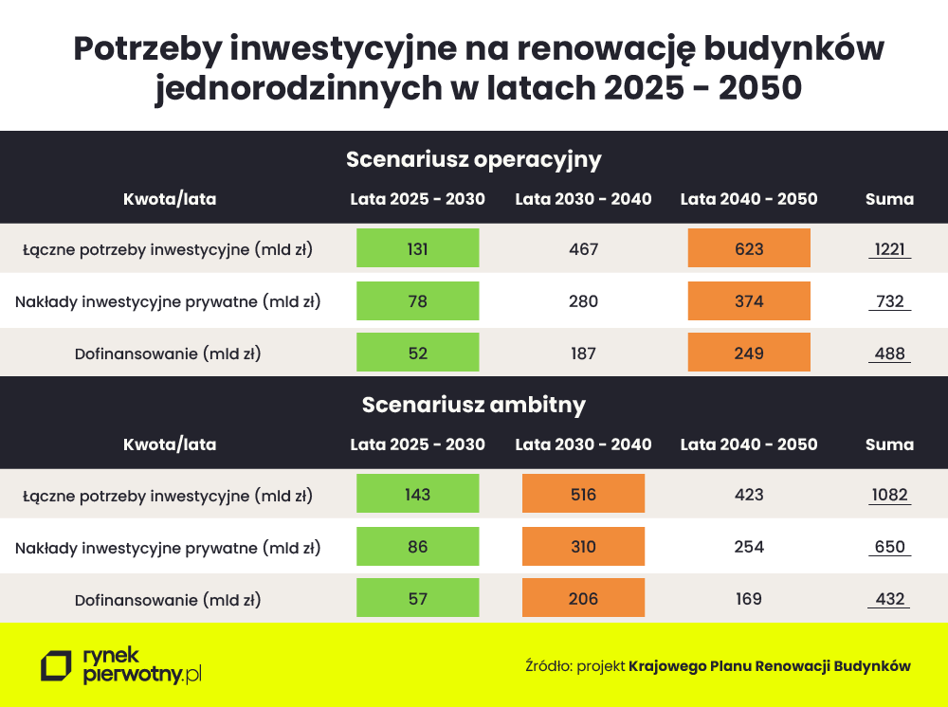
The preliminary design of the national building renovation plan contains Two scenarios for single -family houseswhich were compared in the table below. Each of these variants is to result in the fulfillment of the EU goal, i.e. Bez emission and high energy efficiency almost all Polish single -family houses. As you can see in the table, the operational scenario for houses is characterized by the shift of the largest investment outlays to 2040-50, i.e. a decade. In the case of single -family, multi -family buildings and public buildings, total investment outlays for the ambitious scenario are PLN 1.8 trillion. In the operational scenario, the same amount increases to PLN 2.0 trillion.
Public funds can cover about 40% of the expenditure
The prepared table confirms that according to preliminary assumptions Houses are to “consume” about 60% of total investment outlays for single -family and multi -family buildings and public buildings.
Depending on the script, we are talking about an amount of PLN 1.1-1.2 trillion. Both the operational and ambitious scenario assumes that most of the investment outlays will come from a private pocket. Public funding will cover about 40% of investment needs, and therefore slightly more than in the case of multi -family buildings (approx. 30%).
Will the least support receive the most support?
Interestingly, experts of the RynekPierwotny.pl portal just over a year ago (in an article entitled “Mass renovation of buildings will cost much more than CPK?”) Predicted that the level of participation of public funds in renovation needs for houses can be about 33%. The article also contains a quote, which says that: “a big challenge will be to convince home owners, premises and other buildings, that environmental benefits and those caused by energy saving justify investing large amounts from your own pocket or bank loan.”
The above quote is the most current. In his context, it is worth remembering that the least wealthy house owners will receive the greatest renovation support. This principle is now used – including on the occasion of the “Clean Air” program. Unfortunately, in Polish conditions the question always arises whether some people using state support do not hide some of their income. This is a problem that goes beyond the sphere of strictly housing help.