It is not developers who put the largest area for use. Private houses – the forgotten part of the “apartment”?

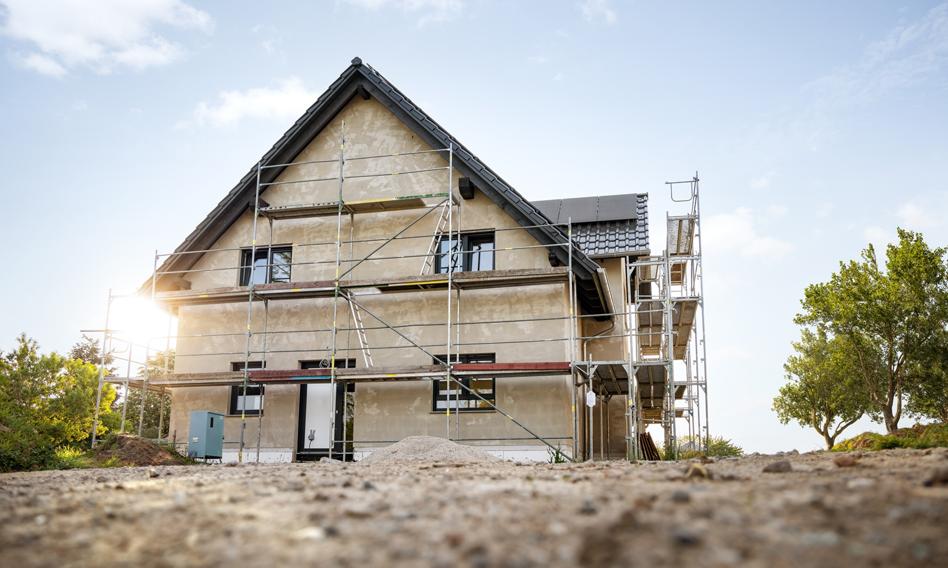
Contrary to appearances, it is not developers, but the “Kowalski” make the largest area. Private single -family housing, however, is struggling with problems.
Following reports from the broadly understood “apartment”, one can sometimes get the impression that new residential buildings are only erected by developers. In fact, the participation of rent (municipal, social and cooperative) construction still remains very modest. However, one must not forget about the segment of private single -family housing, which enjoys not particularly high media interest in relation to the scale of operation.
Meanwhile, “Kowalski” as investors in total, put into use a much larger area than developers. Experts of the RynekPierwotny.pl portal decided to remind you. By the way, it is worth paying attention to the problems of single -family housing and its marginalization in the political dimension.
The area advantage of private investors is great
Very often the investment results of housing construction are presented in a number. This approach indicates, for example, that, according to the final data of the Central Statistical Office, in 2024 200.1 thousand houses and residential premises were completed, or “apartments” in accordance with the names of the Central Statistical Office. The premises and houses built for sale or much rarer rental were involved in this last year's result of up to 62%.
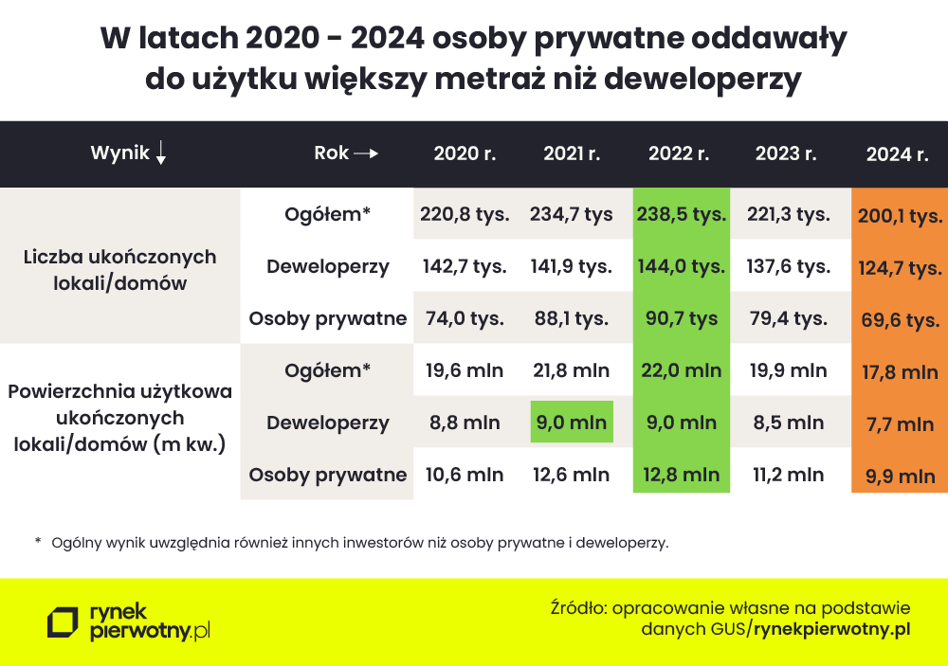
However, if we look at last year's area statistics, it turns out that private investors have put into use 9.9 million sq m (practically only single -family houses), and developers “only” 7.7 million sq m. The situation looked similar, for example, in the record year 2022. Then the total completed meter was 22.0 million sq m and thus it was significantly beaten and thus beaten Gierkowski Record from 1979 (17.7 million sq m).
The area advantage of private investors, of course, results from the fact that a typical completed single -family house is clearly greater than a dwelling of about 50 sq m – 60 sq m, i.e. a typical “product” of developers. Does this mean that measures should be depreciated? Certainly not – all the more so because in terms of area per person we are still chasing Western European countries.
Construction of private houses constantly under cost pressure
Many private investors who have put their homes for use in the past or current year can remember the effects of inflationary shock. Sekacenbud data indicate that only in 2022 the cost of building a typical house increased by about 19%. The total change from the end of 2019 to the end of 2023 was almost 50%. Later, the cost situation calmed down, but investors are still complaining about the path – of course, reasonably. Remember that the increases of house construction costs above do not include land purchase prices.
Cost pressure combined with a high interest rate on mortgage loans was probably one of the reasons for the fact that in the years 2023 – 2024 the average utility area of private houses (from permits issued) has shrunk by more than 5 sq m. In recent years, such an average area of planned private homes has changed as follows:
- 2018 – 147.5 sq m.
- 2019 – 145.1 sq m.
- 2020 – 143.1 sq m.
- 2021 – 143.3 sq m
- 2022 – 143.4 sq m
- 2023 – 141.4 sq m
- 2024 – 138.1 sq m
- And half 2025 – 138.2 sq m.
A small consolation may be the fact that in the first half of this year private single -family houses did not shrink.
Private construction still without special support
The recently published information of the Central Statistical Office indicate that despite difficult conditions, private investors' activity has increased slightly. Namely, from January to June 2025, private investors obtained permits for 39 107 single -family buildings, which meant an increase relative to the same result from the first half (36 808) and the second half (37 732) of the past year. Until the time when permits for over 57,000 houses (1st half of 2021) were issued for half a year.
As you can see, private investors are doing despite the lack of special state support. It seems significant that the last initiative targeted only for single -family and large -scale construction There was a partial VAT refund. This solution was first cut off by limiting its scope of operation to the MDM program, and then completely dimmed. Over a year ago, 41 organizations of employers and trade unionists appealed to the government to restore the refund of part of VAT paid in the construction of their own home or renovation, but this appeal did not have a positive answer.