In Saturday funeral ceremonies, among others, Minister of Culture Marta Cienkowska and deputy president of the Institute of National Remembrance dr hab. Karol Polejowski. Families of the murdered are also present at the ceremony.
– The victims of the murder in Puźniki for long decades rested in a nameless grave, but the memory of their loved ones and those who fought for this memory, the truth and act of elementary justice, continues. Today's burial is to restore dignity to those who were taken away in the most inhuman way – said Cienkowska.
The minister also expressed the conviction that the joint effort of Polish and Ukrainian experts would be able to find the other victims of the crime, and then ensure due respect, name and place of rest.
– I believe that thanks to genetic tests, the identity will be able to restore victims, and their loved ones, often deprived of memorial sites for years, will be able to light a candle – the head of the Ministry of Culture and National Heritage emphasized.
Exhumations of victims of Ukrainian genocide. The remains of 42 people were found
Exhumations in Puźniki lasted from April 23 to May 10. The remains of at least 42 people were found. This was the first such work since the abolition of the Ukrainian side of the ban on the search and exhumation of Polish victims of wars and conflicts on the territory of Ukraine in November 2024.
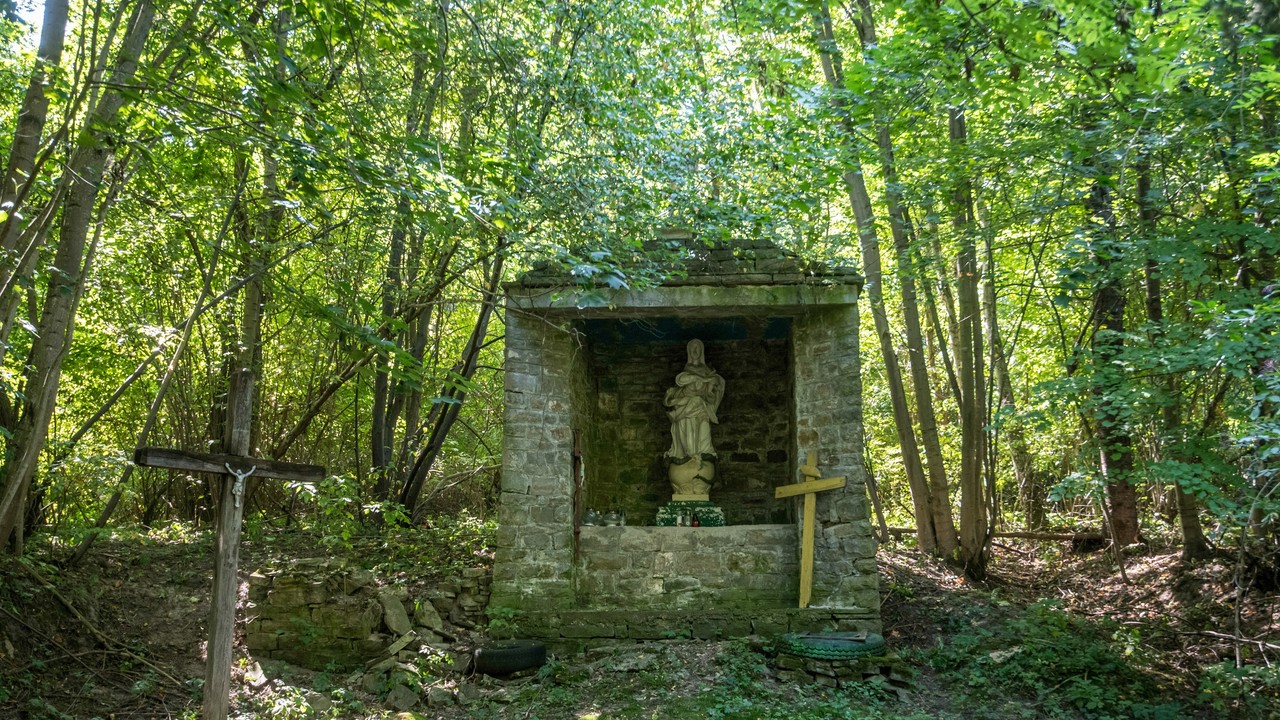
Puźniki is a former village in today's Ternopil region, where on the night of February 12-13, 1945, Ukrainians murdered – according to various sources – from 50 to 120 Poles. The main perpetrator of this crime was Petro Chamczuk, who headed the sub -unit (sotni) gray wolves (Siri Wowky). February 13 at 3 composed of two sotni Kureń (equivalent to the Polish battalion) chamczuk attacked the inhabitants of Puźnik. Only a dozen or so people capable of defense stayed there. The crime in Puźniki was one of the last actions of the Gray Wolves. Chamczuk and his subordinates from the Ukrainian insurgent army (UPA) never suffered a punishment.
Exhumations in Puźniki were a continuation of works carried out by the Freedom and Democracy Foundation from May to August 2023. The grave was found with the remains of the victims of the crime of February 1945 in January this year. The Ukrainian authorities granted permission to exhumation.
Experts from the Pomeranian Medical University, the Ukrainian Volyn Foundation of Antiquities and the Institute of National Remembrance took part in the works coordinated by the Freedom and Democracy Foundation. They were entirely financed from the budget of the Ministry of Culture and National Heritage. According to the Vice President of the Foundation Maciej Dancewicz, the Volyn crime is usually associated with the summer of 1943-In fact, however, this operation was stretched until the first months of 1945 in Volhynia and in the former southeastern voivodships-he emphasized.
– Puźniki no longer exist, they are not on the map, they were erased from memory. A forest grew in this village. What we want to do is restore the memory of the people who lived there – he added.
“This cannot be called a grave.” Poles bury the remains of the murdered
In May, the then Minister of Culture Hanna Wróblewska emphasized that work in Puźniki will be crucial for subsequent consents for search and exhumation work. – Today I can say with full conviction that we have developed standards and good practices together, which can be a model – she noted.
Prof. Andrzej Ossowski, a geneticist from the Pomeranian Medical University, said that the grave in Puźniki was very shallow. – You can't call it a grave. It is more a place where the corpse was hidden – he said.
– We gave 42 numbers to skeletons and 172 numbers of objects that we found at the remains. On the basis of anthropological analysis, we determined that among the exhumed remains were the remains of at least 11 minors, under the age of 18, a minimum remains of 16 women and 10 men – he described.
After completing the work, Alina Charłamowa from the Volhynia Antiquity Foundation passed the search in PAP in Puźniki to continue, because there should be another grave there. Prof. Ossowski added that survey tests can start this year.
On August 30, exhumations in Lviv-Zboiska were also completed, where in September 1939, in defense of Lviv, the soldiers of the Polish Army fell. During the work, two collective graves were found, in which the remains of 31 people and many loose remains probably belonging to the next several dozen victims were located.
“The final number of victims whose remains have been exhumed will be determined as a result of further anthropological and genetic research,” wrote the Institute of National Remembrance in a statement.
Volhynia slaughter. Ukrainians murdered up to 120,000 Poles
The bloody Sunday in Volhynia took place on July 11, 1943. It is the climax of the Volyn Slaughter, i.e. the mass extermination of the Polish civilian population in Volhynia by the organization of Ukrainian nationalists Stepan Bandera (OUN-B), the Ukrainian insurgent army (UPA) and Ukrainian civilians.
On a bloody Sunday, Poles were attacked in 99 cities, mainly in the following poviats: Włodzimierski and Horochów. In the following days the massacre was continued.
The victims of the murders whose culmination took place in the summer of 1943 were Poles, on a much smaller scale Russians, Ukrainians, Jews, Armenians, Czechs and representatives of other nationalities living in Volhynia. The exact number of victims is unknown, but historians estimate that during the Volyn slaughter 50 to even 120,000 were killed. Poles.
Dispute about exhumations in Volhynia. Ukraine had previously banned work
From Warsaw and Kiev since spring 2017, there was a dispute over the ban on the search and exhumation of the remains of Polish victims of wars and conflicts in Ukraine, introduced by the Ukrainian IPN. The ban was issued after dismantling the UPA monument in Hruszowice (Podkarpackie Voivodeship), which occurred in April 2017.
-Without commemorating Polish victims in Volhynia, there is no question of entering Ukraine to the European Union-said Deputy Prime Minister Władysław Kosiniak-Kamysz at the end of August in an interview with Polish Radio.
In October, the head of the Ukrainian Institute of National Remembrance proposed a “work plan” in this matter. The Polish Ministry of Foreign Affairs received positively.
The issue of exhumation and commemoration of the victims of the Volhynia Slachet was previously the subject of conversations between Polish and Ukrainian politicians. As we described in Onet, in September, the head of the Ministry of Foreign Affairs Radosław Sikorski visited Kiev, but he did not find understanding in this matter with the President of Ukraine Volodymyr Zelanski.