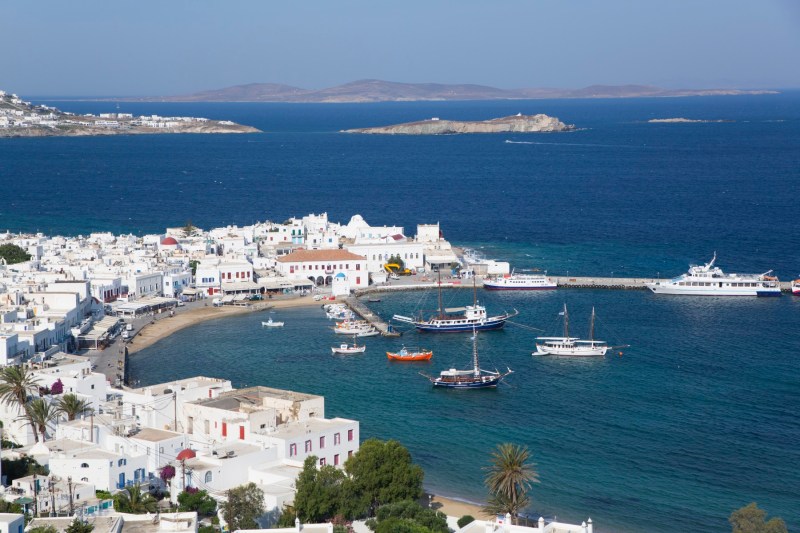
Mykonos, the “wind island” of Greece, photo: Richard Maschmeyer / Roberthating / Profimedia
On the main scene of the largest tourism fair in the world, ITB Berlin, in front of an audience made up of travel agencies, car rental and hoteliers, a renowned researcher has entered into a new era.
The idea that due to climate changes the cost of Tusim will increase, and the number of tourists will decrease, it was “a prediction that no one wanted to hear,” writes The Guardian.
The prophecy of Stefan Gossling, a renowned researcher in the field of sustainable transport, may seem fantasy for tourists in Europe and North America who have traveled by plane this summer, as well as for industry directors who are delighted that international tourism returned to the peaks reached before the pandema.
However, the researcher argues that as carbon pollution supplies heat waves and vegetation fires, ruining harvests, and the cost of traveling abroad will increase vertiginously, and fewer people will be able to allow them.
“I have already entered the beginning of the non-tourism era,” said Stefan Gossling, a professor at the Linnaeus University of Sweden University, who was a consultant for the UN and the World Bank.
“80 years ago, mass tourism began in Europe,” Gossling continued. “Over 80 years, I doubt that there will be too much tourism in the world,” the researcher added.
Popular tourist destinations already feel pressure
Stefan Gossling does not lack examples of destinations that already feel the pressure. The hot weather melts the snow, which keeps alpine skiing in life. Costive erosion removes the sand from the beaches of southern Europe. The drought forces the Spanish hotels to carry fresh water, because the pools are empty, while the vegetation fires set on fire.
The Greek islands in the south of the Aegean Sea, where there are popular locations among tourists, such as Mykonos, Kos and Rhodos, are the “most critical” hot point on the continent, according to a study by Gossling last month, which combines exposure to climatic dangers with tourism addiction. Next is the Ionic Islands, which also include Corfu. Q
The financial pressure caused by these problems, which the travel agencies will probably transfer to customers, will be aggravated by the cost increase in food – from coffee, chocolate and olive oil – and the increasing need for insurance against extreme weather, writes The Guardian.
The phenomenon “will become more frequent, cover more places”
“At this moment, he is a local concentrated,” Gössling said in an interview for The Guardian earlier this year, at ITB Berlin, the largest meeting of tourism companies in the world. “However, in the future, it will become more frequent, will cover more places and turn into something disturbing,” the researcher said.
It remains to be seen whether this cost increase will exceed the expected increase in global income – some problems can be avoided by adaptation, but this also has a price. However, tourists risk feeling growth even if the volatile weather is under control. If carbon pollution will decrease suddenly, which is necessary to stop global warming, the highest costs will be for sectors such as aviation, which is limited by physical constraints.
Some governments hope to impose carbon taxes for flights to facilitate the financing of the energy transition, and the ecological groups insist on a fee for loyal travelers, which would increase taxes for each additional flight in a year.