There is no month in which he would not conduct at least one company integration in the middle of the forest. – Companies that decide on such experience are usually brave organizations, open to new ways of thinking about management and ready to get inspiration from various paths. This is an avant -garde – pioneers who are looking for something more than just duplicating patterns – explains Łukasz Długowski, a tracker of Wilków, a certified guide Rewilding Europe and a SWPS lecturer.
The programs are always tailor -made: sometimes it is a one -day trip, sometimes the whole weekend. Most groups want to experience something interesting in the field, but spend the night in agritourism or hotel. However, there are more demanding customers. – I recently heard: “We want something completely non -standard.” I proposed a march of wetlands, sleeping in the woods and the morning tracking of wolves. They agreed without hesitation – he says.
What can business learn from wolves?
Łukasz Długowski believes that we can learn a lot from nature, but it is a perspective that we treat with care.
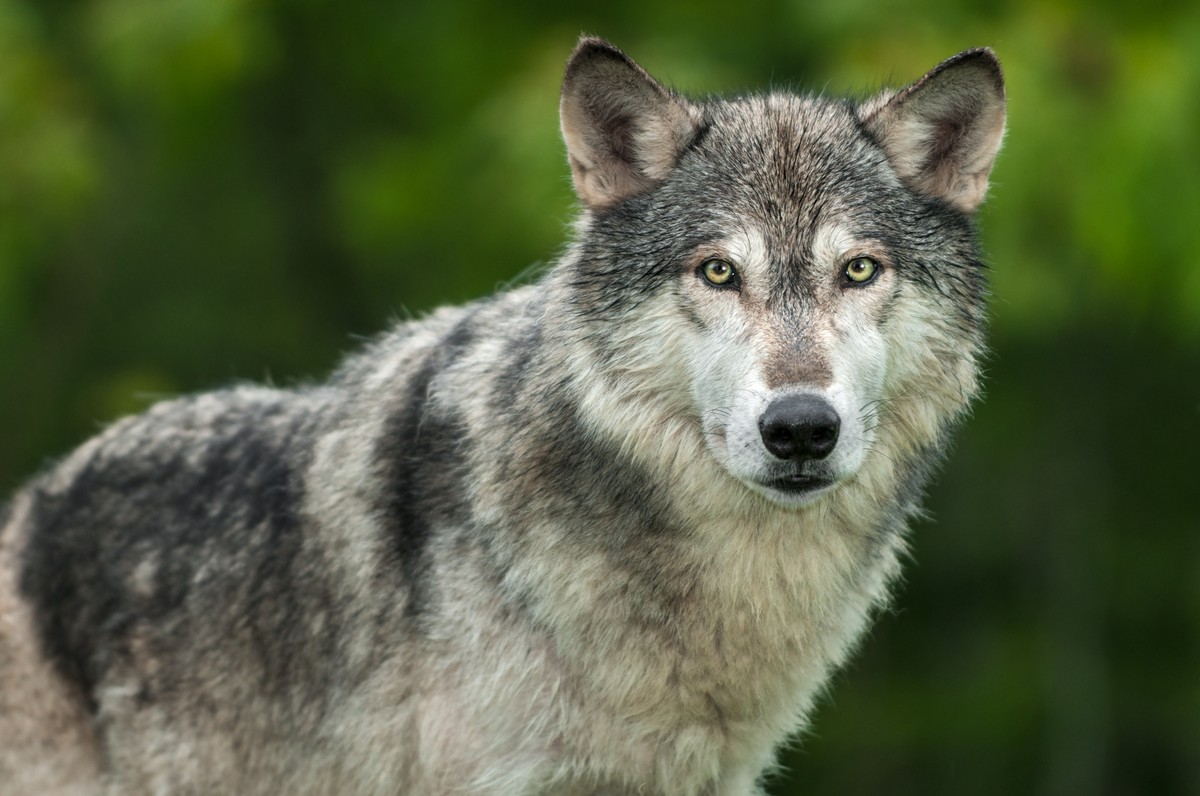
– For two million years, which there is a species, wolves have overcome countless crises – climate change, diet, threat to extinction. In Europe, we are observing today how new areas are inhabited. Until recently, they were not there, e.g. in Germany, Denmark or the Netherlands, and now they are – and to a large extent thanks to the population from Poland. From a country where they were almost completely exterminated in the 70s. This is evidence of their extraordinary ability not only to survive, but also a real flourishing after the most serious experiences. It would be a mistake at least not to look at the sources of this success – he explains.
Mindfulness and building a team
One of the strongest experiences is the night passage through the forest. No flashlights, no phones. – over 80 percent Stimuli that our brain receives is visual stimuli. When we take away the possibility of seeing people, they suddenly sharpen other senses: hearing, touch, smell – says Długowski.
This exercise combines an element of adventure, cooperation in a group and building trust – both to a partner or partner and yourself. It is also a great time to look at my own approach to team management: am I a person who has to hold everything in my hands, can I let go and trust others?
It also shows that we already have many resources, but we do not use them every day. – We live in a world that makes us constantly train, add further courses and certificates, while the foundations of action, both in life and business, are often at your fingertips – he emphasizes.
Flexibility is a survival strategy
Nature teaches humility in the absence of control and the ability to adapt. – This flexibility – as some economists indicate – is one of the greatest forces of the Polish economy. And this is also a lesson that wolves show us for centuries – emphasizes Długowski.
– I am laughing when economics are treated as exact science, which is subject to unchanging rules. It's nonsense. Economics is social science. Business is based on people's behavior, and people are influenced by countless factors: emotions, moods, experience – he adds.
– Nature cannot be fully controlled. And it is exactly the same with the market – we can moderate it to some extent, sometimes adapt to it, but it will always remain an absolutely unpredictable area. This can be seen from subsequent crises, which economists often comment: no one could predict it.
ALFA male myth
The theory of “male alpha” came from research conducted in the 1940s in Switzerland on a small group of unrelated wolves, locked in a zoo. As Łukasz Długowski emphasizes, it's a bit like we were trying to describe a man based on his behavior from Pandemia. Many people were closed in apartments at that time, watched television for 16 hours a day and sipped wine. If someone on this basis wrote a scientific work, it would come out that a man is a remote, passive and addicted species.
– I suspect that at some point the business was very suitable for such an explanation. It was perfectly inscribed in the “stick and carrot” management model: through strength, power and dominance, as part of a rigid hierarchy, where man was treated as a resource rather than a partner. – Today business opens to other paths.
This myth was by scientists, including American biologist David Mech, who in the 70s contributed to the popularization of this term, considered erroneous. – Learning has been saying clearly for several decades: wolves do not function like a military unit, but like a family. It is a community based on cooperation in which everyone has their own share. Of course, parents play a more important role – just like with us, people – but there is no question of a system based on the dominance of one individual. That is why the paradigm of the “male alpha” loses its raison d'etat. It is no longer a justification for the authoritarian management style. The real lesson offered by wolves is cooperation – says the expert.
Effective project management, i.e. hunting
Wolves hunting is a model metaphor for project management. Different animal species require different tactics: sometimes a single individual hunts, sometimes a couple, and sometimes a whole pack.
With large animals, like bison, it is necessary to coordinate and divide roles. Part of the pack sets a trap and the rest of the victim on it. It looks almost like a human strategy: someone commands, someone is responsible for a dishwasher, and someone else for an ambush.
It also impresses the ability of wolves to change tactics depending on the species of the victim. They use various “tools” for this: terrain, river, frozen lakes. – A few years ago, a situation was observed in the Białowieża Forest when Wataha closed the young deer on the effect of ice -ice lake. For an animal with hooves, such ice is a trap – the legs run down, there is no grip. And wolves, thanks to claws and pillows, can run further and that's where it caught him – says Długowski.
– The life of wolves is based on cooperation. To survive, they must work as a team – both during hunting and when raising young people. This is flat management in practice – no one gives orders, but everyone takes responsibility and everyone has their own role.
Risk management after the wolf
Wolves make mistakes – often fatal. That is why they test their victims: they approach, irritate, observe reactions. They check which animal will first lose their vigilance, which is weaker.
On average, only about 20 percent Hunting is successful. But, as the expert emphasizes, a deeper analysis shows that most “unsuccessful” hunting is a strategic decision. Wolves estimate that the risk is too high – and then they give up. This is a lesson for every manager: does the task that I set for the team does not carry too high personal costs?
Everyone matters in the ecosystem
– Thanks to the photoplapts, we know today that Wataha can leave food to wounded or disabled individuals, and also look after them, although from the point of view of “utility” they do nothing in hunting.
As Długowski explains, stars are often glorified in companies – names on the covers of warehouses, great leaders, forgetting about the rest of the team. Meanwhile, in nature, the concept of “I” simply does not exist. There is a community. It is worth looking at the business for an ecosystem – and the ecosystem is always based on interdependence and co -responsibility. In this approach, each function, even the least media, is necessary for the whole.
– And this is a very important perspective, not only for managers, but for all employees. At a time when many people lack sense and feel invalid, such a change in perspective is extremely soothing. It restores the meaning, agency and awareness that you are an important part of a larger whole – he adds.
When asked about a prescription for a selected team, Łukasz Długowski answers: mature openness. – It is a readiness to listen to feedback, to change plans when the circumstances, to cooperate and to use other people's resources change.
– Wethaha wolf in many aspects resembles the human community. People often surprise that an animal, which is a pop culture symbol of evil and bloodthirsty, is so empathic and caring. If I were to indicate two key features that determine their survival, it would be: cooperation and adaptability. The life of wolves is a constant change – there are no two of the same situations, two of the same hunting. This is a species that survived because he was able to perfectly adapt to changes in the environment, climate and in cooperation with the whole wolf family. This is a species that understood that he would not survive thanks to the stars, but thanks to the team. – he sums up.