The fires in Europe broke record after record, although the alert period did not end. Emissions comparable to some countries like Portugal or Sweden


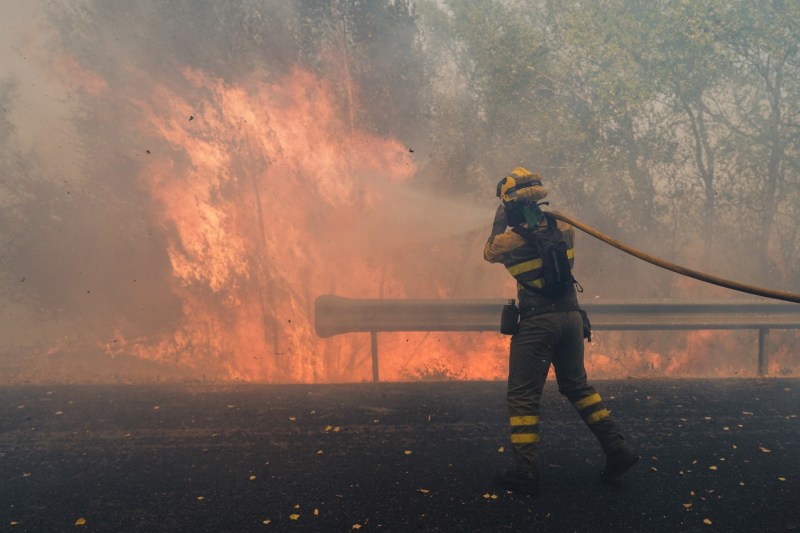
Fire in Galicia, Spain. Photo: Pedro Pascual / AFP / Profimedia
Vegetable fires that ravage in Europe have burned over an area of over one million hectares this year, according to official data. Thus, 2025 is already the worst year in the history of measurements from this point of view, even if until the end of the fire season there is a whole month, notes The Guardian.
The fires have affected an area four times higher than the average of the similar periods of the last two decades, according to official data, which have been updated on Friday and could be reviewed below.
Data from the European Forest Fire Information Information (EFFIS), which starts in 2003, show that this year 1,015,024 hectares have burned, lowering the negative record of 988,544 hectares that had been established in 2017, although on the horizon there are weeks for which the weather conditions are forecast.
37 million tons of CO2
The fires released 37 million tonnes of carbon dioxide – an amount similar to the annual CO2 emissions of some countries such as Portugal or Sweden, each with populations of 10 million people.
Records have also been shot down for this period of the year for nine other atmospheric pollutants, including in the case of fine particles known as “PM2.5”, which experts say they make vegetation fires much more deadly than previously thought.
Cristina Santín Nuño, a fire specialist at the National Research Council in Spain, said that from the case of climatic changes and the way people use lands, more and more “perfect conditions” for large and dangerous vegetation fires use. “It is sad and scary – my native region burns right now – but not surprising,” she said.
The vegetation fires included areas in southern Europe as the heat wave, prolonged and intensified by fossil fuel pollution, pushed the temperatures above the 40 -degree threshold in most of the Mediterranean basin and the Balkans. Extended periods of heat have dried the vegetation, which in countries such as Spain and Portugal had grown rapidly after a rainy spring, which allowed fires to burn more and expand.
The smoke of fires, a cause of deaths in Europe
Due to the fires, over a dozen deaths have been reported, but scientists believe that the real balance is probably much higher. Thick smoke clouds have dirty people with harmful gases and toxic particles to infiltrate the bloodstream. A study published in December showed the smoke of vegetation fires as a cause for 111,000 deaths per year, including in Russia, between 2000 and 2019.
On Tuesday, the Copernicus EU atmosphere monitoring service found that this year's “unprecedented” fire activity has led to Vegetation Fire emissions to the highest annual total in the history of 23 years of measurements. The smoke from the fires of the Iberian peninsula was aggravated by the smoke floating over the Atlantic from Canada, where there have been a serious place in recent weeks.
In August, the emissions of vegetation fires in Spain and Portugal were “exceptional”, said Mark Parrington, a scientist in Copernicus. “The large amounts of smoke – and especially PM2.5 – released into the atmosphere have led to a serious degradation of air quality at local level and further, in the Iberian Peninsula and in certain parts of France,” said the expert.