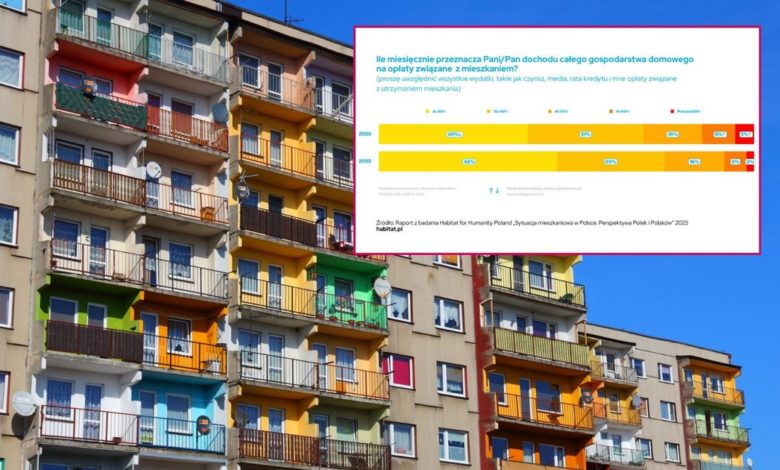
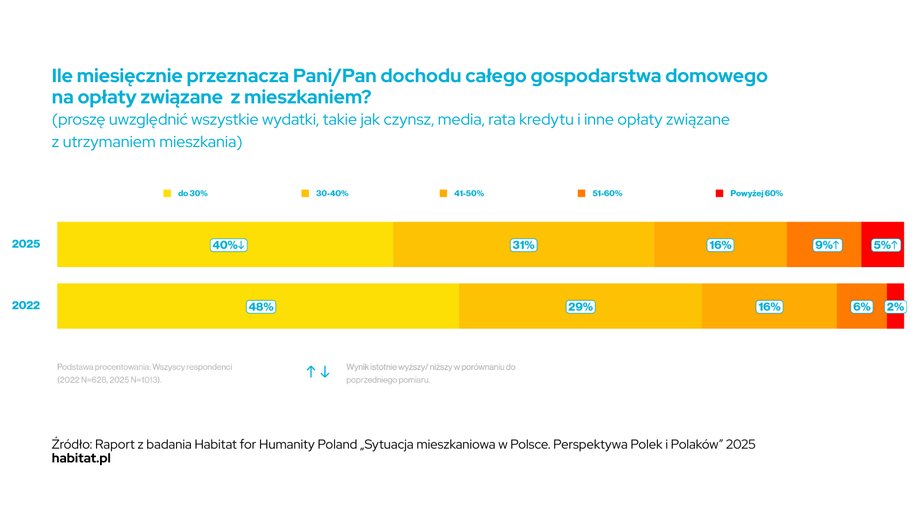
Nearly half of the respondents (47 percent) admits that they spend from 30 to 50 percent for expenses related to the apartment. income. The number of people who spend more than half of their income on the apartment has also increased significantly. In just three years, this percentage has almost doubled – from 8 percent. in 2022 to 14 percent in 2025
Only 11 percent respondents admit that they can now afford a stable, long -term rental. This is a dramatic decline compared to 2022, when there were 21 percent such people. Although 7 out of 10 respondents believe that fees for rent are not lower than the loan installment, this does not mean mass mortgage. Only part of society can afford it and meets the criteria of banks.
The rent gap affects every third Pole
As much as 27 percent Society declares that he is dealing with the problem of rent. – We earn too little to buy or rent an apartment tailored to our needs, and at the same time too much to use the housing support of the state, e.g. a municipal apartment – explains Justyna Nakielska, senior residential expert at Habitat for Humanity Poland.
Housing situation of Poles
|
Habitat for Humanity Poland Foundation / Habitat for Humanity Poland Foundation
This group is in a particularly difficult situation. She cannot afford to buy an apartment, even for credit or renting an appropriate apartment, and on the other hand does not meet the criteria to receive state aid. This situation forces life compromises that affect the quality of life of entire families.
Read also: Your own apartment is the key to happiness? Here are the results of the latest research
Housing compromises and their consequences
The rent gap is the main reason why young adults put off plans not only for purchase, but also the rental of the apartment, delaying the moment of moving out of the family home. Over the past three years, the percentage of people renting apartments and co -extending people with family or friends has increased – from 12 to 14 percent.
Read too: Be like a neognzhlanker. By choice, not out of necessity
– However, this is not a problem only for young Polish women and Poles. Every 10. The respondent admits that he shares the space with people he doesn't want to live with – comments Mateusz Piegza, program director at Habitat for Humanity Poland.
According to Eurostat data, nearly 34 percent Polish residents live in overcrowded premiseswhich significantly exceeds the average European Union of 17 percent. This phenomenon particularly affects families with children, which has far -reaching consequences. Children raised in overcrowded houses have worse academic performance, greater risk of diseases and a more difficult social and educational start.
Sick buildings and heating problems
Not only too small premises are a problem. Every fifth person is not able to live in a place that meets their needs, and a quarter of society lives in “sick buildings” – poorly ventilated, damp, underheated, which negatively affect physical and mental well -being.
As much as 14 percent Polish women and Poles cannot afford to warm the apartment. The problem mainly concerns the elderly and those with low income living in buildings with low energy efficiency.
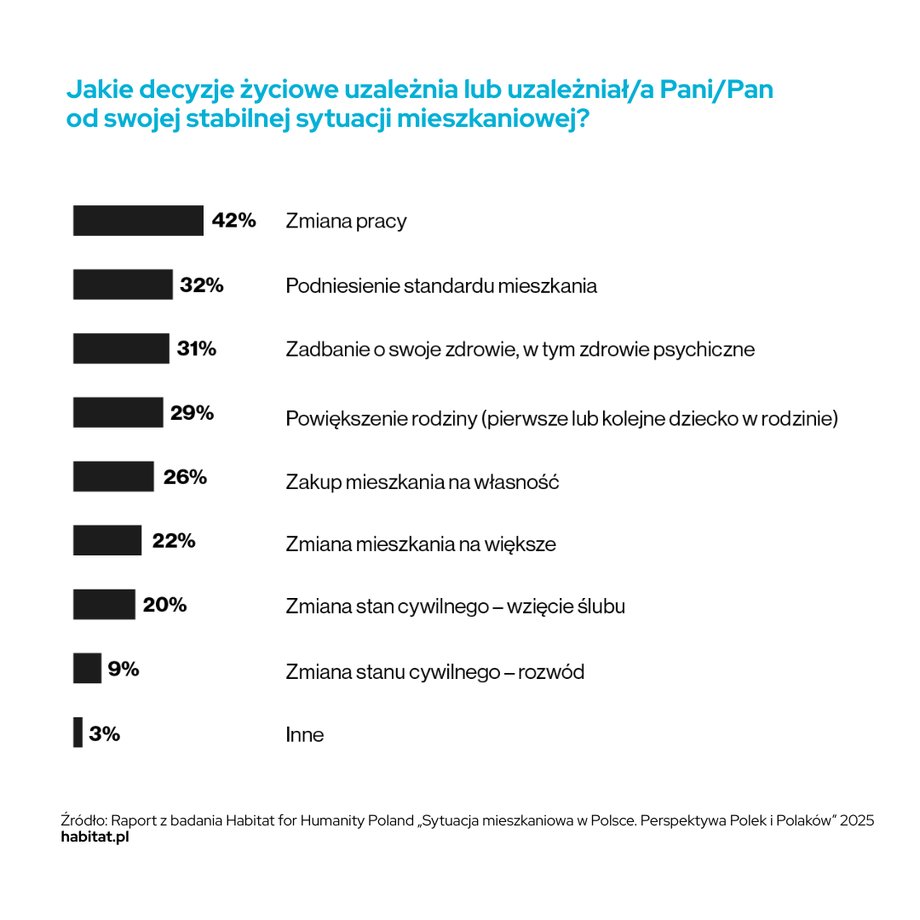
Housing situation and life decisions
|
Habitat for Humanity Poland Foundation / Habitat for Humanity Poland Foundation
Poles make many life decisions dependent on having a stable housing situation. For 29 percent Young lack of a stable housing situation is the main barrier in the assumption or enlargement of the family. According to the calculations of experts from Habitat for Humanity Poland, if the aforementioned group did not have to postpone during these decisions, it could populate a city with a population of over a half Warsaw.
– There is no sense of security and well -being without the right place to live. The apartment, which we can afford, not working on most of our salary, well -ventilated or heated, non -sensitive to our life and health – this is the basis. When we have a roof over our heads and comfortable, worthy living conditions, we can think about development, plan the future. If this does not happen, we have a sense of constant fight and exclusion – says Justyna Nakielska.
Social flats as a solution
In Poland, there are even about 2 million price -available apartments – it is as if all the inhabitants of Warsaw had nowhere to live. – The housing gap is filled primarily by developers. However, the high prices of new apartments make them available only to the chosen part of societyi.e. not for the one that needs them the most. The answer to this problem would be, among others Increasing investments in state apartments for rent with rental rates available to most society – comments Aleksandra Krugły, director of the spokesman from Habitat for Humanity Poland.
A similar solution works in Austria, where over 60 percent The inhabitants of Vienna use social or supported premises. – They have no sense of shame in connection with the use of support, they do not think they are awkward. They simply use one of the social services that are offered to them. In Poland, we should also accept such a perspective and change the way of thinking about social housing – adds Mateusz Piegza.
Social expectations and postulates of experts
Poles expect changes. 80 percent respondents believe that public authorities should help in obtaining an apartment to certain social groups. The high position on this list is occupied by the elderly or with disabilities, living in apartments not adapted to their needs, as well as young people whose income does not allow rent or buying a flat on credit.
– The responsible housing policy of our country should focus on investing in apartments from the public resource, with a priority for the renovation of vacancies. It should also take into account the needs of those who are statistically not in the worst financial situation. Because work should not be used only to have a place to sleep – sums up Aleksandra Krugły.