On Sunday, Baku canceled all Russian cultural events in Azerbaijan – both official and private. The murder of two Azeria – identified as Zijaddin and Husein Safarow, both at the age of about 60 – and arrests prompted the Ministry of Culture in Baku to make a statement on the same day on profile on the X, in which they condemned them as “intentional and out -of -court murders and acts of violence committed by Russian progress bodies against Azeria.” In a statement, the ministry also described these practices as “systematic”.
The Ministry of Foreign Affairs in Baku also condemned the murder in its statement and, according to state media, canceled the upcoming visit of Russian Deputy Prime Minister Aleksiej Owerczuk, claiming that “he does not consider her to be appropriate in current circumstances.”
However, diplomatic effects are only part of the wider, complex relationships between Baku and Moscow – a friendship that is not without problems and which has deteriorated in recent months.
In short, Azerbaijan and Russia remain mostly allies, despite sporadic trips, but a series of incidents over the past year has strained their relations.
Natalia Kolesekova / AFP / AFP
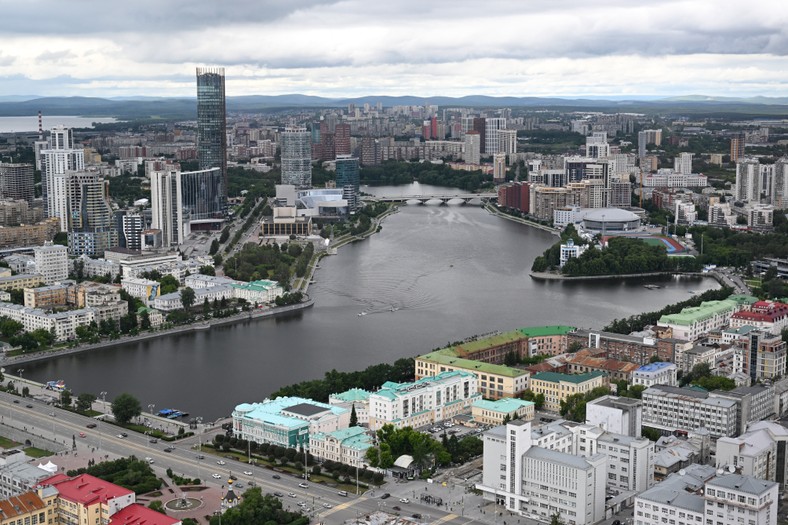
View from a bird's eye view to Ekaterinburg, Russia, June 26, 2025.
Both countries are rich in fossil fuels, which makes them allies and competitors at the same time – As members of OPEC+, they coordinate the maintenance of oil production, but Baku is increasingly taking over Russia's foreign markets in connection with sanctions imposed on Moscow after the invasion of Ukraine in 2022.
However, Azerbaijan is also a central place where Moscow bypasses sanctions, redirecting forbidden goods to Russia. That's why in May this year. Great Britain imposed sanctions on the state tanker of Azerbaijan for the transport of Russian oil.
Shared civil aircraft
The diplomatic dispute that broke out last weekend, however, deteriorated this Russian-mazeria friendship, which had already suffered as a result of a serious quarrel between Baku and Moscow.
At the end of December 2024, a plane carrying mainly passengers from Azerbaijan was shot down shortly after starting from the threat, the capital of the Russian Chechen Republic. The investigation showed that the plane was shot down by the Russian air defense.
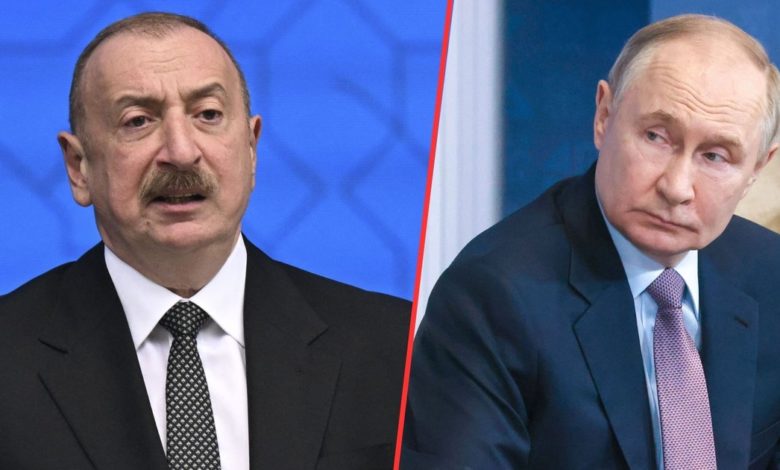
Baku sharply criticized this event and demanded an apology from Moscow and confession. The Russian leader Vladimir Putin finally apologized, but not accepting responsibility.
The President of Azerbaijan Ilham Alijew later expressed his dissatisfaction and demanded from Moscow “full transparency and behavior” in connection with the tragedy.
Hostile steps
Official statements disseminated by the state media in Baku may shed light on the deteriorating relations between Baku and Moscow – especially considering how warm Putin was accepted in Baku in August 2024.
In May 2025, the state media of Azerbaijan reported that the MP was deprived of the possibility of flight to the Russian region of Astrakhan, despite the fact that he was invited to the event from the vice -debtor of the region.
“We consider this decision of the Russian side to be an unfriendly step and we expect Russia a justified explanation in this matter,” said spokesman of the Ministry of Foreign Affairs in Baku.
Then, at the beginning of this month, Baku sharply criticized Putin Vladimir's adviser [Władimira] Miedinski – who is also the head of the Russian delegation in conversations in Istanbul with Kiev – for his comments on Baku claims regarding the disputed territory of mountain karabach.
-statements of Vladimir Miedinski, adviser to the President of the Russian Federation, given during an interview for Russia Today, June 9, in which he distorted the facts regarding the former Armenian-Azerbaijanian conflict and presented the Karabakh region as the dispute territory, are both poorer and surprising-commented the spawn of the Ministry of Foreign Baku.
Continuation of the material under the video
Dispute about Górski Karabach
It is worth noting that the conflict in Górski Karabakh was a turning point in relations between Baku and Moscow, changing the dynamics of forces in the Caucasus region existing for over two decades.
Azerbaijan fought with Armenia for the region of mountain karabakh for two decades – up to the victory of Baku in September 2023. Earlier Armenia, supported by Russia, managed to maintain control over the region, which worsened Baku relations with Moscow.
However, Baku's victory in September 2023 – partly thanks to the passivity of Russian peace forces – reversed this dynamics. Armenia broke off relations with Moscow and withdrew from the organization of the system of collective security (CSTO) managed by Moscow in June 2024.
After losing Karabakh, Prime Minister Armenia Nikol Paszynian also accused two OUBZ members of actively supporting Azerbaijan in his offensive. One of them is Belarus, Moscow's ally, the identity of the other remains unclear.
The improvement of relations between Baku and Moscow after the events in Karabakh finally led to Putin's loud visit to Baku, where he and Alijew discussed bilateral relations and “international and regional problems”.
This was the case until December, when the incident with the plane occurred, and now to the murder of two Azeri in Ekaterinburg. Signals transmitted by the state media in Baku suggest that after Armenia Moscow may lose another ally in the Caucasus.
I’m Ashley Davis as an editor, I’m committed to upholding the highest standards of integrity and accuracy in every piece we publish. My work is driven by curiosity, a passion for truth, and a belief that journalism plays a crucial role in shaping public discourse. I strive to tell stories that not only inform but also inspire action and conversation.