

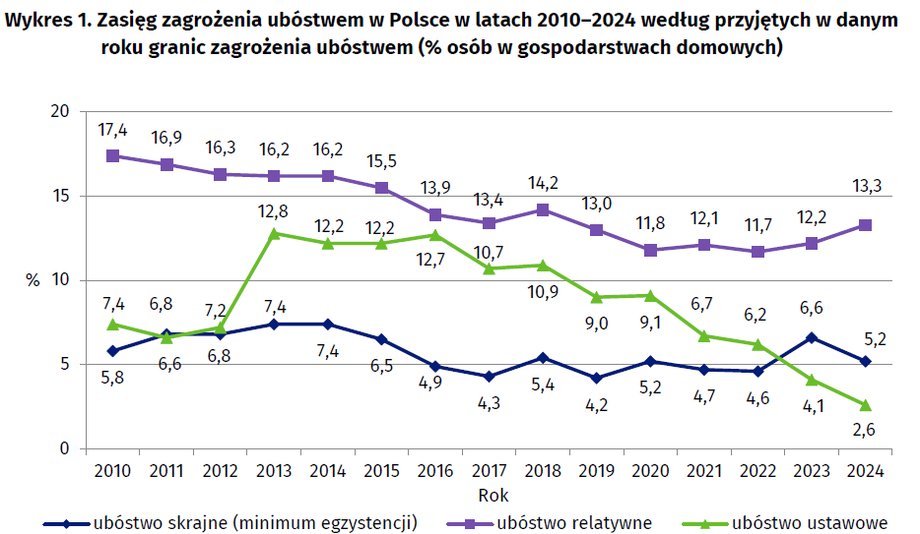
In extreme poverty, i.e. at a minimum level of existence, there were 5.2 percent. people in households in 2024. – results from the data of the Central Statistical Office (CSO). This means a decrease by 1.4 percentage points compared to 2023.
However, this decrease was smaller than the increase between 2022 and 2023 (then the range of poverty grew by 2 percentage points). In the years 2010-2015 its range was about 6-7 percent. people in households, and from 2016 to 2022 inclusive-about 4-5 percent
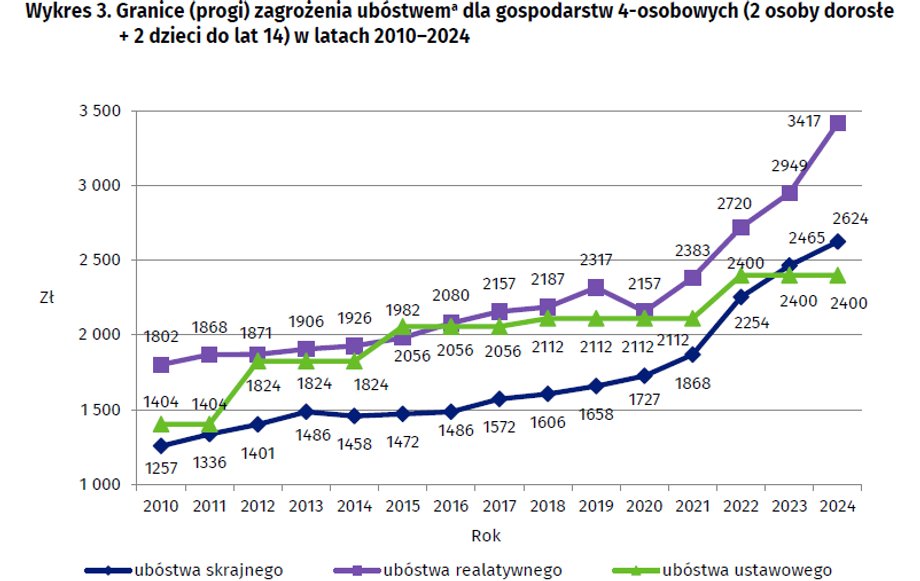
Last year, the exposure to the threat of statutory poverty (by 1.5 percentage points from 4.1 percent to 2.6 percent) decreased, with the thresholds unchanged from 2022, this type of poverty). In turn, the range of threat with statutory poverty from 2010 to 2012 was about 7 percent. In 2013, the risk rate of this type of poverty clearly increased to approx. 13 percent. and in the years 2013-2016 it remained at the level of 12-13 percent, which was associated with an increase in the limit of threat of statutory poverty. In subsequent years, the range decreased up to 2.6 percent. in 2024
At the same time, in 2024, the risk of relative poverty increased (by 1.1 percentage points, to 13.3 percent). In the years 2010-2015 this indicator was at 16-17 percent. people in households. In the next four years (2016-2019) he fell to 13-14 percent. From 2020 to 2023, about 12 percent were at risk of relative poverty. people.
|
Central
The Central Statistical Office regularly, faces and publishes indicators regarding the scope of emergency with economic poverty (so -called poverty threats) in Poland, based on the results of studying household budgets. The presented indicators are average annual data. The calculations include three different thresholds (boundaries) of poverty risks: the limit of hazardous poverty of extreme, relative and statutory poverty. People living in households were considered to be at risk of poverty, in which the level of expenditure was lower than the adopted poverty thresholds.
Definitions of poverty according to the Central Statistical Office
- The basis for determining the threat limit extreme poverty (earlier the limit of extreme poverty) is a minimum of existence estimated by the Institute of Labor and Social Affairs (IPISS). The minimum category of existence determines a very low level of satisfaction. Consumption below this level hinders survival and poses a threat to human psychophysical development. In 2024, the hazard rate of extreme poverty amounted to 5.2 percent, i.e. by 1.4 percentage points. less than a year earlier
- Level of danger limit statutory poverty (earlier the limit of statutory poverty) corresponds to the values of the amounts, which, in accordance with applicable regulations, entitle to apply for a cash benefit from social assistance. In 2024, the range of statutory poverty was 2.6 percent, i.e. by 1.5 percentage points less than a year ago. However, the Central Statistical Office emphasizes that the threat limits of this category of poverty have not been raised from 2022.
- Application of the threat limit relative poverty (earlier the limit of relative poverty) at 50 percent The amounts that households spend in Poland on average in a month allow you to separate those farms and people whose level of consumption is significantly below the average level. In 2024, the range of risk of relative poverty amounted to 13.3 percent, which was an increase of approx. 1 percentage point. compared to 2023.
The Central Statistical Office pointed out that the changes in the emergency of poverty were accompanied by an improvement in the average income situation of households in relation to 2023. The average monthly income and average monthly expenses per person on households, while weakening the inflation rate, increased (in nominal and real). The diversity of income per person in households measured with the gini coefficient has decreased.
|
Central
Annual analyzes indicate the same groups that are most often or rarely threatened with extreme poverty. In 2024, there were no significant changes in this area on the map of extreme poverty. In 2024, people from farmers' households (11.4 percent) and households persisted mainly from other than retirement and disability pension, non -pension sources (10.8 percent) belonged to the most endangered groups in 2024.
Groups of the least threatened extreme poverty were people from households, whose main source of income was self -employment (4.5 percent) and employees (4.7 percent). Lower than average rates of hazardous poverty in the country were also observed among pensioners' farms (4.9 percent). The latter group, for years, has recorded lower percentage of pensioners who are threatened by extreme poverty, for whom in 2024 the value of the percentage of people at risk of extreme poverty was 6.0 percent.


