President of Goldman Sachs about the USA in the Trump era: Investors did not change their minds

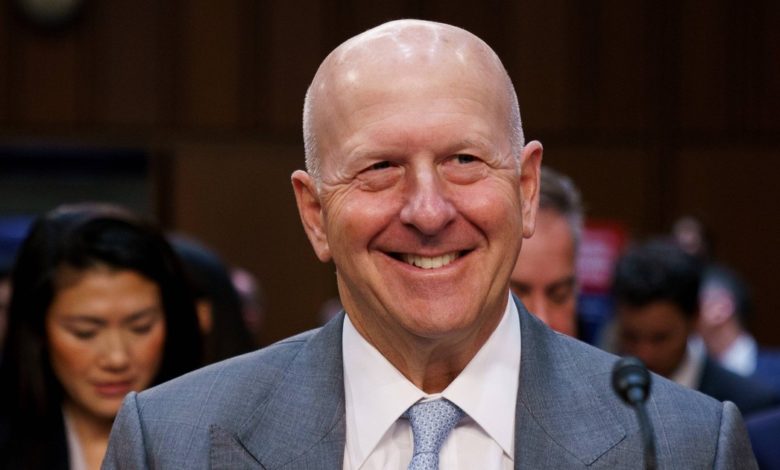
“At the moment there is a feeling that things are going in the right direction,” said President Goldman in an interview with Politico magazine shortly after Trump announced a new agreement with China, which meant further alleviating trade tensions. – People would like the level of certainty about the direction of politics to continue to increase.
Like everything in the era of Trump 2.0, the direction of travel can change in the blink of an eye. A few hours after the announcement of the agreement with China – and the Secretary of Treasury Scott Bessent informed the legislators that the administration would probably delay the date of commercial negotiations set for July 8 – the president said that in the coming weeks he would unilaterally set customs. This interview with Solomon took place on Wednesday afternoon, before both events – now President Goldman Sachs says that the level of uncertainty “increased significantly”.
I would like to start with your macroeconomic forecast for this year. There are still many uncertainty about commercial and tax policy, but inflation seems to be falling for now, and the increase in salaries lasts at about the same level. In your opinion, do your enterprises adapt to this situation or are many plans still suspended?
The year began with enormous optimism and high expectations, but with the development of the discussion about politics – especially in April in the field of commercial policy – the level of uncertainty increased significantly. You ask an accurate question about the impact of this situation on future investment expenses and investment plans. In my opinion, there is no doubt that the level of uncertainty has increased, which caused that in the last two months the presidents of companies have become more cautious.
In most companies, the planning process takes place in the summer or autumn. So we are approaching the period when people start thinking about capital planning for next year. Probably some capital plans for this year were suspended or postponed, which in my opinion had some impact on growth trajectory and expectations regarding growth in 2025. Of course, we will see what the situation will look like in the summer.
I follow trade messages on an ongoing basis. All this changes expectations. At the moment, it seems that things are going in the right direction. People would like the level of certainty about the direction of politics to continue to increase.
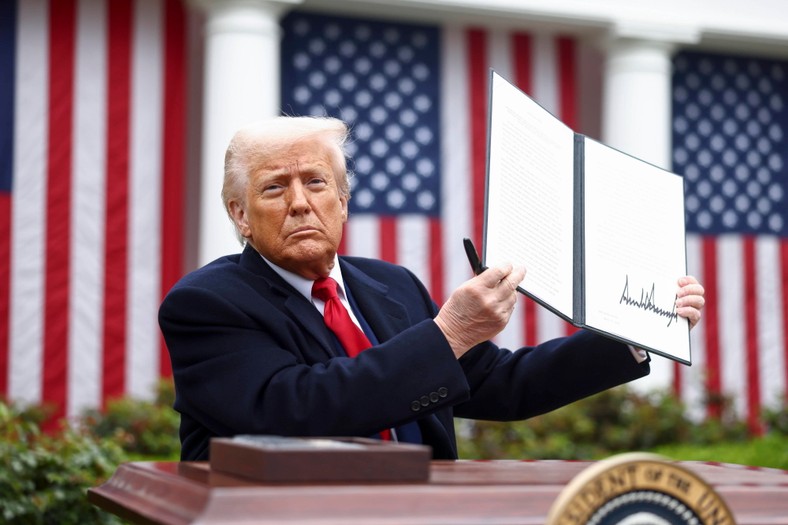
President Donald Trump with a signed decree introducing new “mutual” duties towards US trading partners on “The Day of Liberation”, Washington, USA, April 2, 2025.
Staying on the subject of trade, do you have any base scenario in which the situation will stabilize?
Talks with general directors show that most people think that we are heading towards a more moderate approach and I think this trend will persist. I will not speculate about specific solutions, but I think that the approach is definitely more moderate than expected in April, which of course promotes economic growth and investments.
As for investments, the president of Goldman Sachs John Waldron said a few weeks ago that you have a lot of interesting projects. Are these mainly transactions in the United States? Do you see more possibilities abroad?
But in general, as John said, we have a lot of interesting projects.
There is a lot of talk about transactions that have not come to fruition, but this is not something that we observe, especially in the case of larger transactions. The announced value of fusion and acquisitions from the beginning of the year is just below $ 1.9 trillion. [ponad 7 bln zł]. It is an increase of 26 percent. In terms of year -on -year 12 percent compared to the average of the last five years. Although I think that activity could be greater in the first half of the year, if not for the debate on trade policy, the number of transactions is still quite good. Transactions with a value above $ 500 million [1 mld 850 mln zł] They constitute the majority of total value and increased this year by 16 percent. If you look at medium -sized transactions, their increase was also noted, which also contributes to the increase in the number of transactions. Capital markets were slightly more subdued in this quarter, but in general, the situation was successful.
The economy turned out to be more resistant to fluctuations, and our activity was more stable than I expected.
A plaque with the name Bank Goldman Sachs on the dance floor of the New York Stock Exchange in New York, USA, January 18, 2022.
Can you notice a concentration in a sector or geographical region?
This is a fairly wide phenomenon. I would say that the regulatory environment, in principle in the last four years, had a real impact on the cooling of the mood of general directors who wanted to implement their strategic plans. Despite political uncertainty, general directors believe that they have a more open field to act to implement their strategic plans through inorganic activities, so they actively engage in this area.
However, it should be remembered that there is still some regulatory uncertainty. The Federal Trade Commission maintained the fusion guidelines, which was followed by Lina Khan, chairwoman of the Federal Trade Commission in Biden administration. General directors have to deal with some unique political threats from Washington. How did this influence your appetite for the risk or management of Goldman Sachs?
We deal with risk management. Above all, however, our task is customer service. We perceive everything through the prism of how to position a company to consistently serve our clients. Of course, in a situation of growing uncertainty, we constantly analyze our risk and managing methods.
During the period of uncertainty and variability that took place in the last few months, we have been a bit more cautious in taking risks. In general, however, we focus on serving our clients and there are currently no major changes in the way our financial resources are used for this purpose.
But there are also headlines for the risk associated with some transactions and markets. Does this affect the decision to undertake a given transaction or cooperation with a given client?
NO. We serve our clients. They enter the market. They evaluate their needs based on the market environment, and we are there to serve them. We do not change our approach to customer service depending on the current situation.
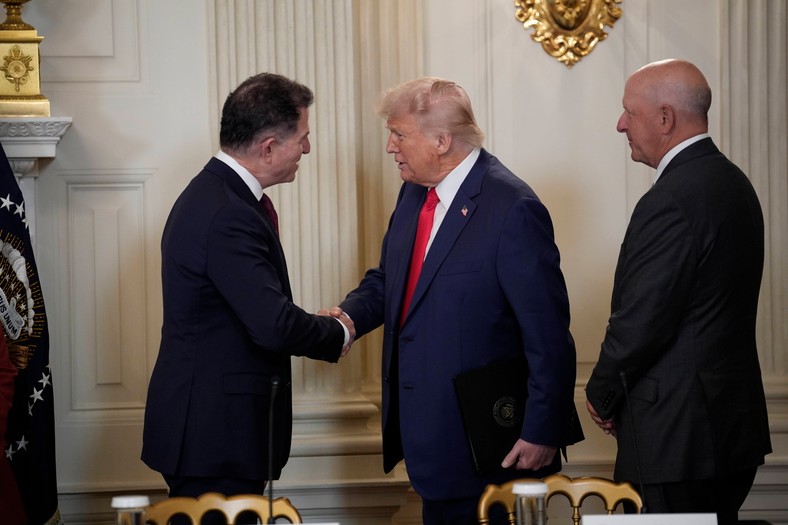
US President Donald Trump (Ś) welcomes the president of Dell, Michael Dell (L) and president of Goldman Sachs, David Solomon during participation in the Invest America Roundtable conference in the State Dining Room room in the White House in Washington, DC, USA, June 9, 2025.
Thank you for the direct answer. What is the current perception of American assets and American markets?
We are currently observing a more moderate approach to politics than a few months ago, which makes people feel more comfortable. Looking at the situation in the world – at international investors – I do not think that they basically change their minds about the United States.
However, there is no doubt that, for example, in the case of dollar exposure, people can protect themselves a little more against currency risk, observing the situation to better understand the direction of changes and their effects. So I think that people would like more confidence, and greater confidence would increase trust in future investments.
Future investments are good for economic growth. The greater political confidence and less uncertainty, the better for investments, and thus for economic growth.
At the end of May, the bond market was a bit upset when the House of Representatives began working on “a great, beautiful act”. Do you expect to improve fiscal prospects in connection with the decisions of the Senate? Does the Act create any risk for the bond market?
It is important that we maintain the current tax system. This is the main purpose of the Act, and its non -concept would be associated with the risk for the economy. The act now went to the Senate and I can't predict how it all goes, but when it is finally accepted, I will have a brighter opinion about its impact on fiscal trajectory.
How do you assess this act in the context of debt and deficit?
I think we should focus on asking whether we can reach a higher level of economic growth in the future.
It's not just about debt and deficit. It is about debt and deficit in relation to the general size of the economy. Can we reach a higher level of growth, which will facilitate the absorption of the current level of expenses and deficit over time? Will the debt and deficit stop growth? It is not clear at the moment.
Last question about the Tax Act: What do you hear from clients about Section 899, which raises tax rates for foreign entities associated with “discriminatory countries”?
I understand the President's desire to negotiate the righteous international taxation rules, but I hope that Section 899 of the Tax Act will not be introduced in a way that will limit or difficult for global investors in any way.
It would not be in our interest. I hope that the final version of this provision will not limit foreign investment in the United States.