Astronomers discovered “a needle in the hay car”: a star with different behavior than any other

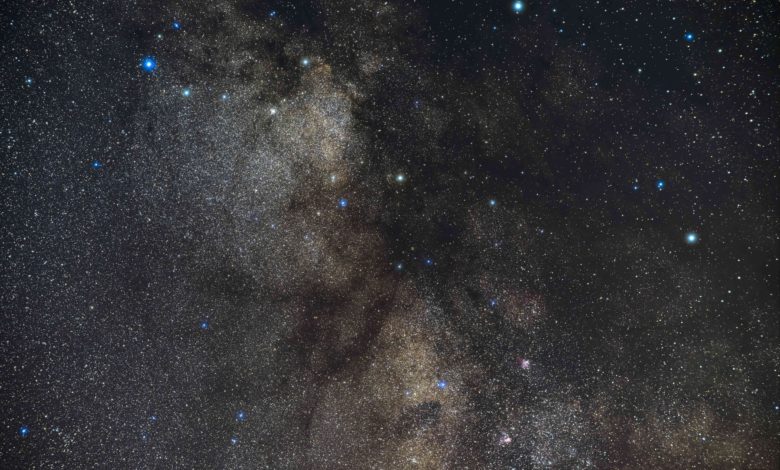
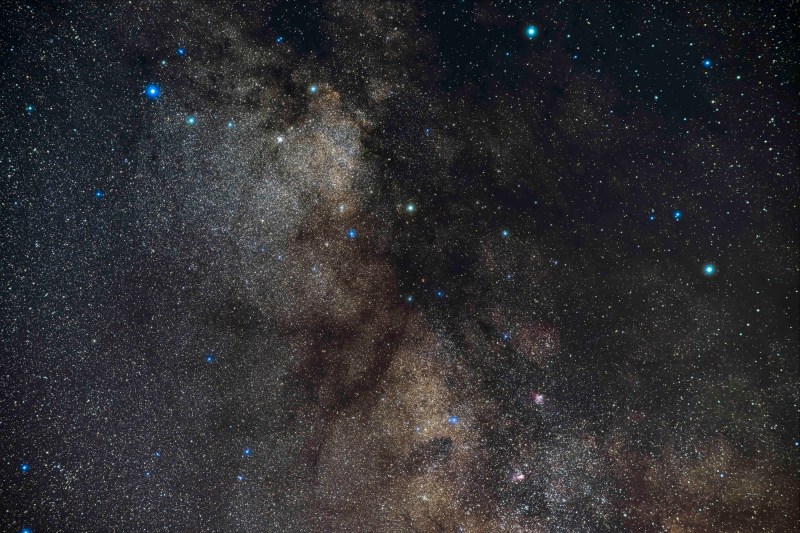
Constellation The Shield, at the top of a Milky Way Photo, Photo: Alan Dyer / Zuma Press / Profimedia Images
Astronomers have discovered a star that behaves differently from any other ever observed, because they release a strange combination of radio and X -rays, which is why this star is considered an exotic member of a class of celestial objects identified for the first time only three years ago, informs Reuters, quoted by Agerpres.
Steaua was located in our galaxy, the Milky Way, at a distance of about 15,000 years-light years in the direction of the constellation of the shield and shines every 44 minutes both by radio waves and by X-ray emissions. One-year-old represents the distance traveled in a calendar year, ie 9.5 trillion.
The researchers said that this star belongs to a class of celestial objects called “long -term radio transients”, known for their bright radio explosions that appear every few minutes.
This period is much longer than the rapid radio pulsations usually detected in the pulsars – a type of neutron star that rotates quickly, representing the dense and collapsed nucleus of a massive star after its death.
You see from the ground, the pulsation seem to blink and extinguish at intervals between a few milliseconds and a few seconds. “What are these celestial objects and how they generate their unusual signals remain a mystery,” said astronomer Zetang Wang of Curtin University in Australia, the main author of the study published this week in Nature magazine.
None of the Astronomers's assumptions can fully explain Star's behavior
In the new study, the researchers used data provided by the Orbital X Chandra -developed by NASA -, ASKAP telescope in Australia and other telescopes.
Although the emission of radio waves from the newly identified cosmic object is similar to about 10 well -known examples in this class, this is the only one who also issues X -rays, according to researcher Nanda Rea, astrophysicist at the Institute of Space Sciences in Barcelona and co -authors of the study.
The researchers have some hypotheses about the nature of this star. They said they could be a magnet, a neutron star in rotation with an extreme magnetic field, or perhaps a white dwarf, a very compact stellar embryo, with a close and fast orbit around a small companion, along with what is called a binary system.
“However, none of them can explain all the observational characteristics we have seen,” said Zetang Wang. Stars with a mass up to eight times higher than that of our sun seem to be intended to end their life cycle becoming white dwarfs. Finally, they burn all the hydrogen they use as fuel. Gravity then causes them to collapse and expel their outer layers in the “red giant” stage, leaving behind a compact nucleus with approximately equal diameter – white dwarf.
A discovery compared to the needle in the hay car
According to the researchers, the observed radio waves could have been generated by the interaction between the white dwarf and its hypothetical accompanying.
“The radio brightness of the object varies a lot. I did not see any radio emission from that object before November 2023. And in February 2024, I saw that it became extremely bright. Less than 30 objects in the sky have ever reached such a radio waves. At the same time, at the same time, we have detected X, we can detect it.
“It is exciting to see a new type of behavior for the stars,” he added.
“The X -ray detection was made by the Chandra Al NASA space telescope. This part represented a lucky discovery. The telescope was, in fact, to something else, but it happened to capture the source during his light” crazy “.