The minority governments in Romania were among the best performing / enter the PSD in government

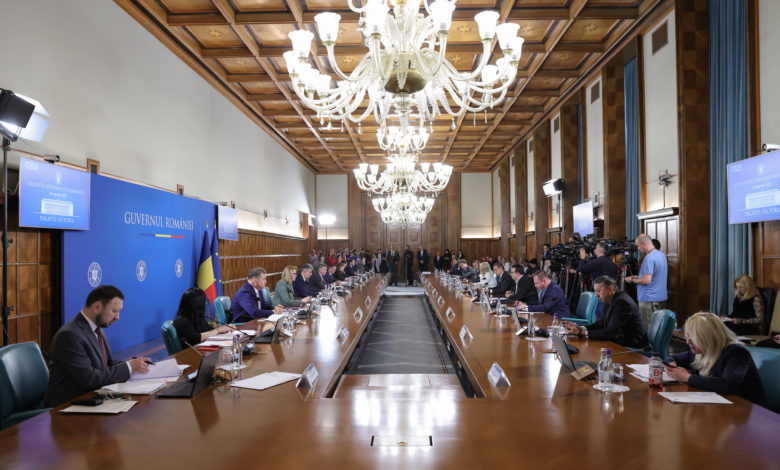
Despite the PSD dilemma to be in government or opposition, whose solution also depends on the idea of social reconciliation according to the presidential elections, from a functional point of view, Romania can also go on the variant of a minority government and that of a majority government, says political commentators Ionela Gavril, which explains, in an analysis, on the analysis and the advantage of the two.
- “Beyond the way in which the future government will look, which is more important, in the idea of societal reconciliation, is the way in which the disagreements will be structure after the formation of the new government.”
The two possible variants for the formation of the future leadership are a majority government, about 54%, which also include PSD (PSD+PNL+USR+UDMR) or a minority government of about 32% (PNL+USR+UDMR), writes Ionela Gavril, which also exhibits the third variant, which President Nicuşor Dan does not exclude, and that the future government does not exclude, It also has a technocratic component.
Each variant of a future government has different meanings and advantages/disadvantages, both for the Romanian society and for the politicians included in the negotiations, according to the political commentator. It also speaks of a different significance of the future government, the one from the perspective of the function of mediation between citizens and elected, in a representative democracy, as a result of the rows of recent elections.
A minority government
Although the formula of a minority government (PNL+USR+UDMR) generally attracts criticisms of the risk of instability and lack of efficiency, there are empirical studies that disassemble this prejudice.
The historian of minority governments in Romania does not obviously show that they were less effective than others, writes Gavril, which draws the attention that such a government can only work by crossing the PSD into opposition.
The political commentator analyzes two scenarios: the one in which the PSD is the one who refuses the government and, therefore, in opposition, and the one in which Nicușor Dan would exclude the Social Democratic Party from the government.
If the choice to refuse the governance belongs to the PSD, it will be evaluated by its voters accordingly, but if the election belongs to the chosen president, this would be a problem of crisis of consensual democracy, notes Gavril, adding that the last variant is not a founded one.
About those who support the variant of a minority government, Ionela Gavril says that they are those in the hard core of Nicuşor Dan's voters: “Those who want at any cost for PSD to be in opposition, and the minority government to coagulate around USR, and not of the PNL, at least in the” unreformed “version of the PNL”.
Also, says the political commentator, those who consider, inaccurately inaccurately, that, by sending the PSD in opposition, an alternation, desirable for a democratic plus, says.
She also says, they are not in mind that Romania is, on the current institutional construction, a consensual democracy, which necessarily produces fragmentation and the need for coalition governments, which can no longer be very clearly outlined.
Variant with PSD to government
It is said to what extent it would be more advantageous for the PSD to enter the government or to oppose, writes Ionela Gavril.
A majority government, which includes all four parties considered non-radical, would involve at least theoretical guarantees for stability, she explains. At the same time, it would assume that a wider beach of voters will be represented in government.
The political scientist's warning is that such a governance formula would involve a risk of gold, SOS and can: if they remain isolated in opposition, the risk of radicalization may increase.
Nicușor Dan does not exclude the technocratic version
Although the most discussed variants are those of majority / minority political governments, Nicuşor Dan did not exclude a government variant that has a technocratic component, writes Gavril, who recalls that the president said that “the company wants new people” at the head of the ministries.
About this variant, the political commentator writes that he would satisfy some of the societal wishes that, in the second round, have been expressed by a consistent vote for the anti-system discourse, but that such attitudes should raise reports to representative democracy.
RISK radicalization
According to Ionela Gavril, regardless of which variant of the government will materialize, it will have to mediate a possible structuring and favavorization of the disagreement of power-opp, so that an isolated opposition does not radicalize even more.
Basically, to put into practice the “reflexivity”, that is, to allow the prospect to use political freedom by those who have lost, in order not to reach a domination from a single political vision.
This article originally appeared in contributors.