“I will order.” Trump's announcement just before meeting with the Islamist President of Syria

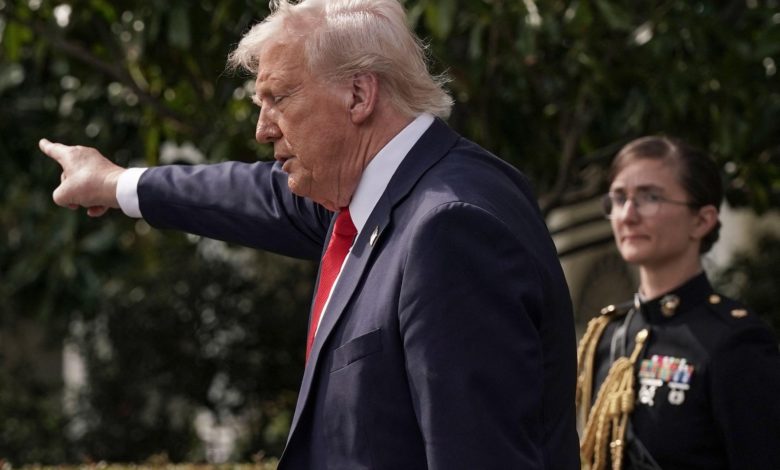
US President Donald Trump said on Tuesday that he will order the sanctions imposed on Syria, at the request of Saudi Arabia, a decision that marks a major change in US foreign policy, notes Reuters.
Trump is about to meet on Wednesday in Saudi Arabia with the Islamist president of Syria, Ahmed Al-Sharaa, the former commander of the Al-Qaeda network, who took over after Bashar Al-Assad was removed, two Syrian presidential sources said.
“I will order the cessation of sanctions against Syria to give them a chance at greatness,” Donald Trump said on Tuesday at an investment forum held in Riad, at the beginning of his tour in the Golf Arab states. “It's their time to shine. We'll raise them all,” Trump added. “Much success, Syria, show us something really special.”
Trump said he made this decision after discussions with Saudi Crown Prince Mohammed Bin Salman and Turkish President Recep Tayyip Erdogan, whose governments have insisted on lifting sanctions.
The announcement, made unexpectedly, comes despite the deep suspicions manifested by Israel towards Sharaa's administration. Israeli officials continue to describe the Syrian President as a jihadist, although he broke the ties with the Al-Qaida network since 2016, notes the quoted source.
Trump said he would raise all the sanctions, emphasizing that they played their role, but that the time has come for Syria to go further. He stated that steps are taken in the direction of restoring normal relations with the Syrian regime and that the US Secretary of State, Marco Rubio, will meet this week with his Syrian counterpart.
The American sanctions, imposed during the period when Bashar al-Assad was in power, isolated Syria from the global financial system and discouraged investments and foreign trade, seriously affecting post-conflict reconstruction efforts.
The Syrian Foreign Minister, Asad Al-Shibani, told Reuters that the decision marks a turning moment for the Syrian people in his reconstruction efforts.
“We are ready to build a relationship with the United States based on mutual respect, trust and common interests,” said Shibani.
He also said that Trump could get “a historical peace agreement and a victory for American interests in Syria”, without giving additional details.
Under the leadership of Assad, Syria remained in a state of war with the neighbor Israel, maintained close relations with Iran and Russia and had tense relations with the West.
Since December, the Israeli army occupies the Syrian territories near the Golan heights, a region that Israel has controlled since 1967, and continues to carry out regular air attacks in Syria.
Meanwhile, Syrian officials have expressed their availability for relating to relationships and even for possible peace with Israel.
Ahmed Al-Sharaa has been the leader of the official Al-Qaeda branch involved in the Syrian conflict for many years. It was initially joined to the Al-Qaida network in Iraq, where he spent five years in an American prison. In December, the United States withdrew the reward of $ 10 million in its name.
Most of the sanctions on the sanctions adopted by the American Congress, including a hard package imposed on Syria in 2019, include a provision that allows the president to suspend them if he considers that this serves the US national interest.
The United Nations, which has been putting pressure in recent months to raise sanctions against Syria, welcomed the decision announced by the Trump administration.
“It was important for us to see a relaxation of sanctions on Syria, to support the reconstruction of the country and to help the Syrian people to recover after more than a decade of conflict and sub -investments,” said UN spokesman Stéphane Dujarric.
Previously known as the Al-Nusra front, the Islamist group Hayat Tahrir al-Ham (HTS) was the official branch of the Al-Qaida network until the ties were broken in 2016. HTS was officially dissolved in January.
The group has been on the list of the UN Security Council for Al-Qaeda and Islamic State for more than a decade, being targeted by a global assets frost and an embargo on weapons. In contrast, the UN Security Council did not impose direct sanctions on Syria on civil war.
It is not yet clear whether the United States will also request the lifting of HTS sanctions at the UN level.