In reflecting on the 21st-century economy through the lens of ancient Greek history, Professor Marek Węcowski from the University of Warsaw draws parallels between past and present economic systems. He notes that the unpredictability of supply chains today echoes the realities faced by the ancient Greeks, who lived in a politically fragmented world around the Mediterranean.
Węcowski points out that the ancient Greek city-states, or poleis, operated independently, leading to a complex tapestry of political entities, each with its own institutions. This diversity also fostered a shared cultural identity, with consistent intellectual and ethical frameworks across regions, despite significant geographical and social differences.
He highlights the cyclical nature of communication and trade, where periods of connectivity were often interrupted by isolation due to seasonal maritime conditions, a reality that may now be relevant as global disruptions occur. Current events, such as conflicts in the Gulf region, remind us of the fragility of international trade and the potential for long-lasting impacts on supply chains, akin to those experienced during the COVID-19 pandemic.
Węcowski emphasizes the need to absorb lessons from the Greeks, particularly regarding economic expectations. He critiques the prevailing belief in inevitable progress, suggesting that many contemporary metrics, such as health and longevity, are not improving as anticipated. This discontent with the idea of continuous advancement poses challenges for both individuals and industries.
He also addresses the growing issue of debt across various levels of society, drawing comparisons to Solon, the Athenian leader known for his debt relief reforms. Solon’s seisachtheia aimed to alleviate burdens on the lower classes but often benefited the wealthy, a pattern seen throughout Greek history.
Modern economic disparities, Węcowski argues, contrast sharply with the relatively equal wealth distribution of ancient Greece. In those times, even the wealthiest citizens were not significantly richer than their peers, due to limited opportunities for wealth accumulation outside of risky maritime trade.
He suggests that the rise of the banking system in the late classical period transformed financial relationships, contrasting sharply with the localized nature of early monetary systems, and introduced levels of wealth disparity that were previously uncommon.
Węcowski invites us to consider what true wealth means today, echoing Aristotle’s distinction between necessary resources and the mere accumulation of riches. He posits that the ancient Greeks valued comfortable living and social connections over material possessions, a lesson that may offer insight into contemporary capitalist values.
In conclusion, Węcowski reflects on the historical tendency for wealth and political power to form intertwined networks of influence, warning that trends observed in ancient Greece, including the use of wealth to sway political outcomes, could serve as a cautionary tale for today’s economic landscape.
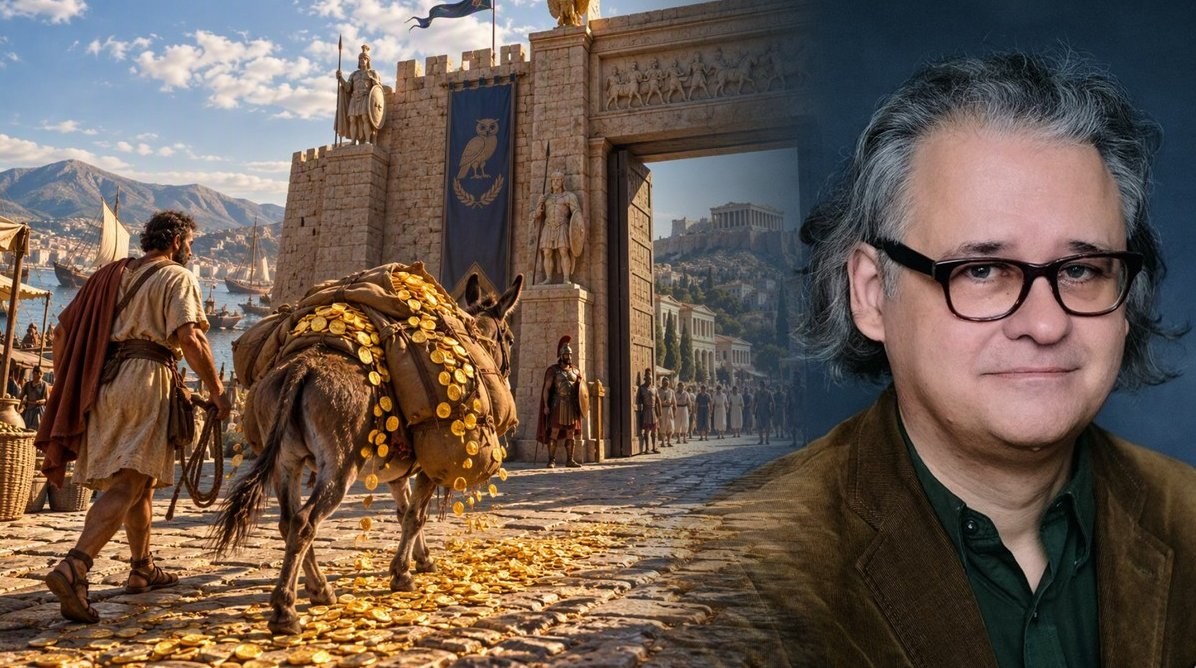
Ultimately, he reminds us of the ancient saying attributed to Philip of Macedon, that “the best siege machine is a donkey loaded with gold.” This highlights the profound influence of wealth in political maneuvering, a concept that remains relevant in the current global economy.