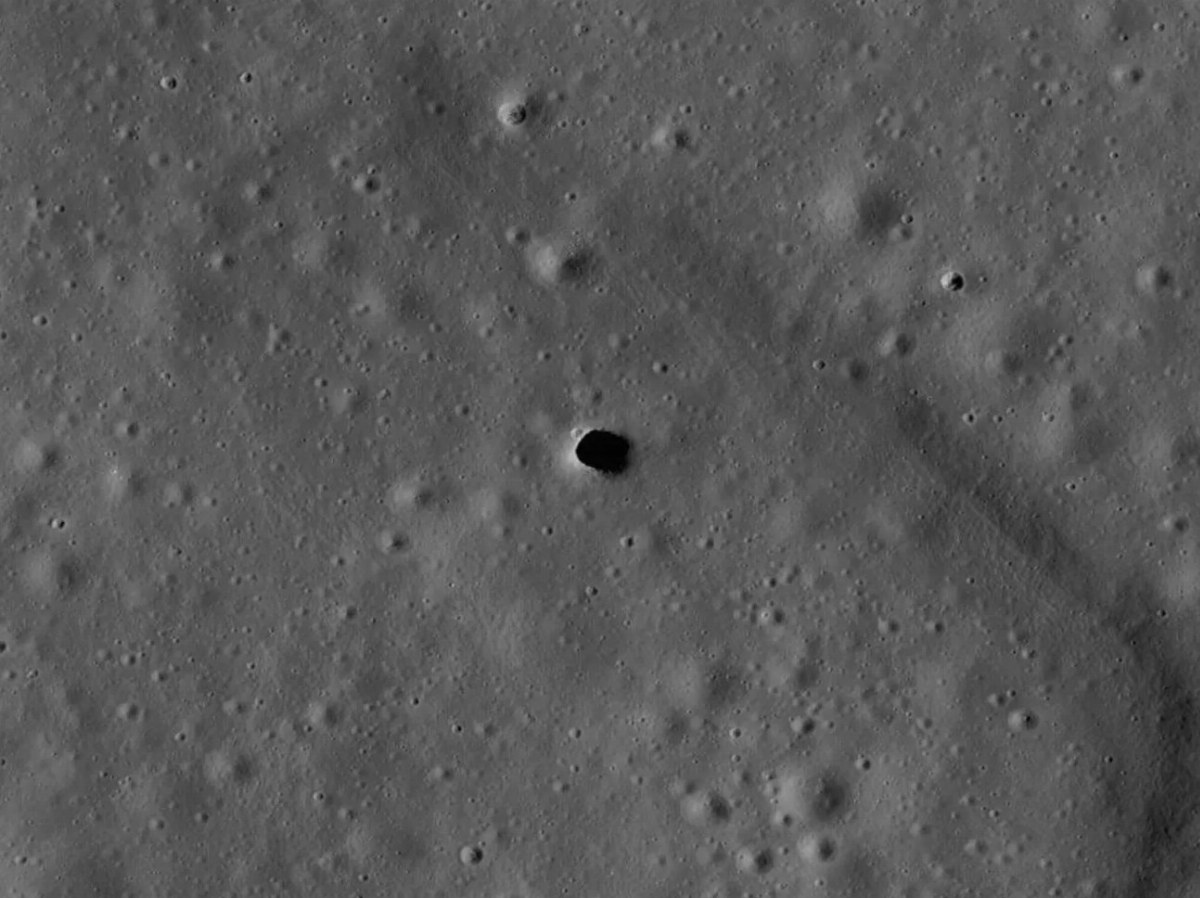
The NASA PRISM program is set to investigate a mysterious hole on the Moon, which scientists believe may lead to a cave that could offer natural shelter for astronauts from radiation and extreme temperature fluctuations on the lunar surface.
Using ground-penetrating radar, seismic sensors, and gravimeters, researchers will examine the space beneath the Moon’s surface, while cameras will capture images of the hole’s surface and walls.
According to the Planetary Science Institute (PSI), observations from orbit have provided significant evidence suggesting that caves and lava tubes could exist beneath the lunar surface. The Mare Crisium region, where the Marius Hills pit is located, is one of the most volcanically diverse areas on the Moon, potentially being an entrance to subsurface spaces formed by ancient volcanic activity.
If a subsurface cavity is detected, researchers will attempt to determine its size.
PSI emphasizes that such a cave could serve as a natural refuge for astronauts against radiation and drastic temperature variations on the Moon’s surface.
Even if the GIMLI project does not uncover a cave or lava tube, the data gathered may provide insight into the formation of the Marius Hills pit itself and enhance our understanding of the region’s geology and volcanic history.
The GIMLI project is led by PSI senior scientist Tan Putzig and involves collaboration with Honeybee Robotics, the Norwegian Space Agency, Boise State University, Johns Hopkins University, the Lunar and Planetary Institute, and the University of Oslo.