Official results from Sunday’s regional elections in Germany, specifically in Mecklenburg-Vorpommern and Berlin, were released on Monday, marking a significant setback for Chancellor Friedrich Merz.
The Christian Democratic Union (CDU), led by Merz, failed to secure entry into the regional parliament of Mecklenburg-Vorpommern, recording only 4.9% of the vote, just below the threshold needed for representation in the eastern state’s legislature. This is the poorest performance by the conservative party since World War II.
On the night of the elections, conservatives were still hopeful of securing a parliamentary seat. However, the elections were won decisively by the far-right Alternative for Germany (AfD), which garnered 38.2%, marking their second consecutive victory following recent success in Saxony-Anhalt.
Despite their electoral win, AfD is unlikely to seize control in Mecklenburg-Vorpommern. Analysts predict that the upcoming regional government coalition will likely be formed by the Social Democrats (SPD), who came in second with 35.5%, along with the Left Party at 6.5% and the Greens at 5.7%.
Prior to confirming that his party would not enter the regional parliament, Merz acknowledged on election night that the CDU was facing a “disaster,” particularly after losing elections in Berlin as well, which likely means losing local governance in the capital.
For now, Merz remains in his position, though uncertainty looms over his future.
Merz’s Strategy: Buying Time
Merz’s issuance of a statement on the night of the regional elections reflected the significant internal pressure he is under.
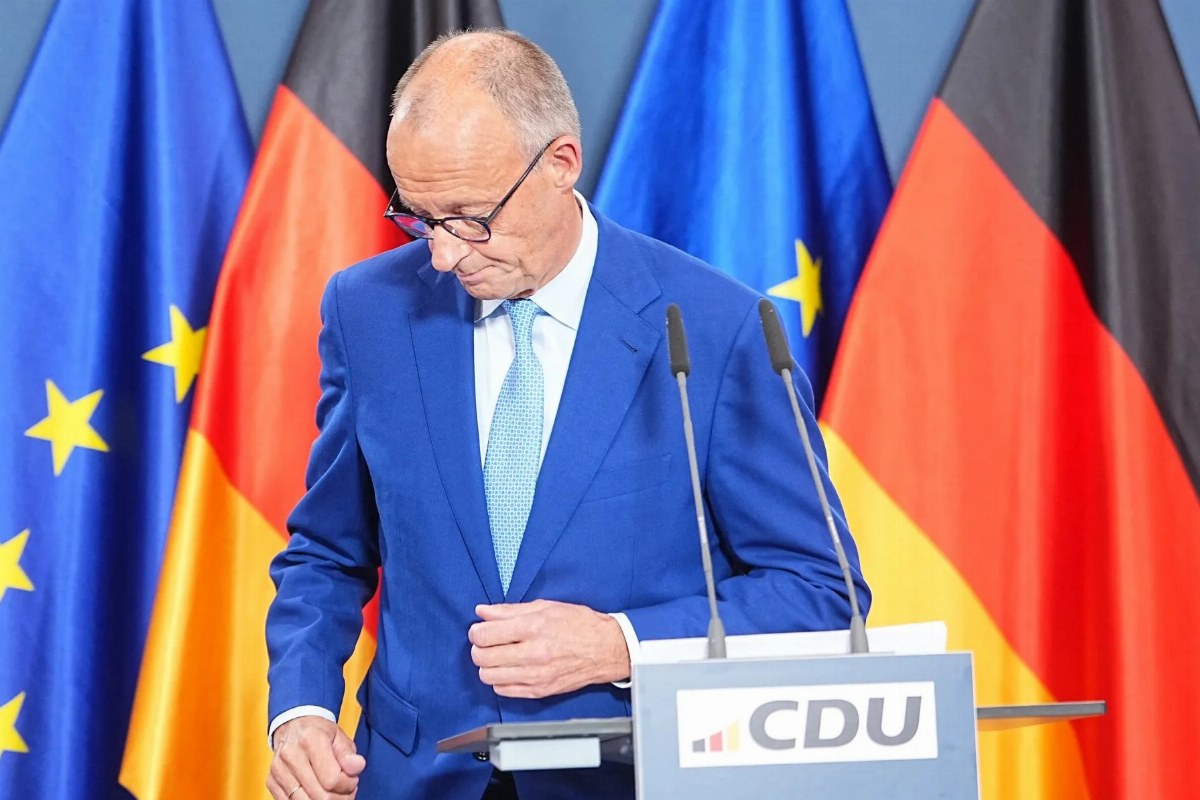
The staging of the event at the CDU’s headquarters was unconventional, as indicated by Tagesschau24, with German and EU flags positioned prominently behind the podium, where the CDU emblem was also displayed.
Commentators in Germany believe Merz aims to minimize speculation regarding his role in the aftermath of the elections. The federal executive committee of the CDU is set to meet on Monday, followed by a parliamentary meeting on Tuesday in the Bundestag, where the atmosphere is expected to be tense.
What is Merz’s strategy for navigating this crisis? Essentially, it is to buy time.
Merz’s Hopes vs. Ground Reality
According to his plan, no further regional elections are scheduled until April 2027, which may provide some respite for the party. In the meantime, Merz hopes for improved economic news, partially because investments financed through special fund loans are expected to start yielding results.
He hinted at this in the days leading up to the elections, stating at a Berlin campaign closing event that people would soon experience positive changes. “In 2026, we expect a 1.3% growth,” he announced, claiming that Germany has “emerged from the economic crisis.”
The Federal Statistical Office typically releases its annual GDP estimate in mid-January, and Merz is optimistic that positive figures will dominate headlines starting in 2027, allowing him to begin each address by highlighting two years of economic growth.
However, the problem remains that statistics do not automatically translate into tangible relief for people’s lives. Gas prices are still high, and healthcare costs are not expected to decline.
Coalition Tensions
Additionally, there are issues concerning the coalition. Merz’s 16 months in federal office have been marked by slow decision-making, largely due to repeated disputes between conservatives and social democrats, leading to the impression that he struggles to manage his fragile majority.
Conditions could deteriorate further. In Mecklenburg-Vorpommern, the state premier, social democrat Manuela Schwesig, campaigned against the AfD and the federal CDU-SPD government’s policies, particularly criticizing the proposed pension reforms.
This campaign has likely led to increased local support for the SPD, allowing her to maintain the state chancellorship.
Commentators have noted that Schwesig’s statements are gaining traction among social democrats, paralleling criticism aimed at party leaders Lars Klingbeil and Bärbel Bas.
Speculation is rife about whether Schwesig should replace them as party leader, as there are strong arguments for the last popular social democrat leader to take charge amidst the SPD’s current crisis.
On election night, Vice Chancellor Klingbeil was unprepared with an official statement regarding Schwesig’s influence in Berlin. “I’m glad she is on our side,” he remarked succinctly in an interview with ARD, adding that they must “take criticisms seriously.”
Challenges Facing Germany and Beyond
Merz had pledged to revive the stagnating national economy, to rearm the country to deter an aggressive Russia, and to limit illegal immigration to win back voters who shifted their support to the AfD.
However, the slow pace of reforms and a series of failures have fueled the AfD’s rise, which now outpaces the CDU in national polls.
This rise is viewed as shocking by much of society and the political class in a country whose identity is still marked by the historical guilt of Nazi crimes.
Thus far, no political party has expressed a willingness to ally with the far right, but their successes could reignite debates, especially within the Chancellor’s conservative party.
While Merz has assured that he will remain in office and continue his reform agenda, the defeats on Sunday raise questions about his standing within the CDU.
Merz’s weakened position as leader of the largest and most powerful member state of the European Union could also undermine the bloc’s unity as far-right parties continue to gain ground, relations with the United States have significantly chilled, and economic pressures have intensified.