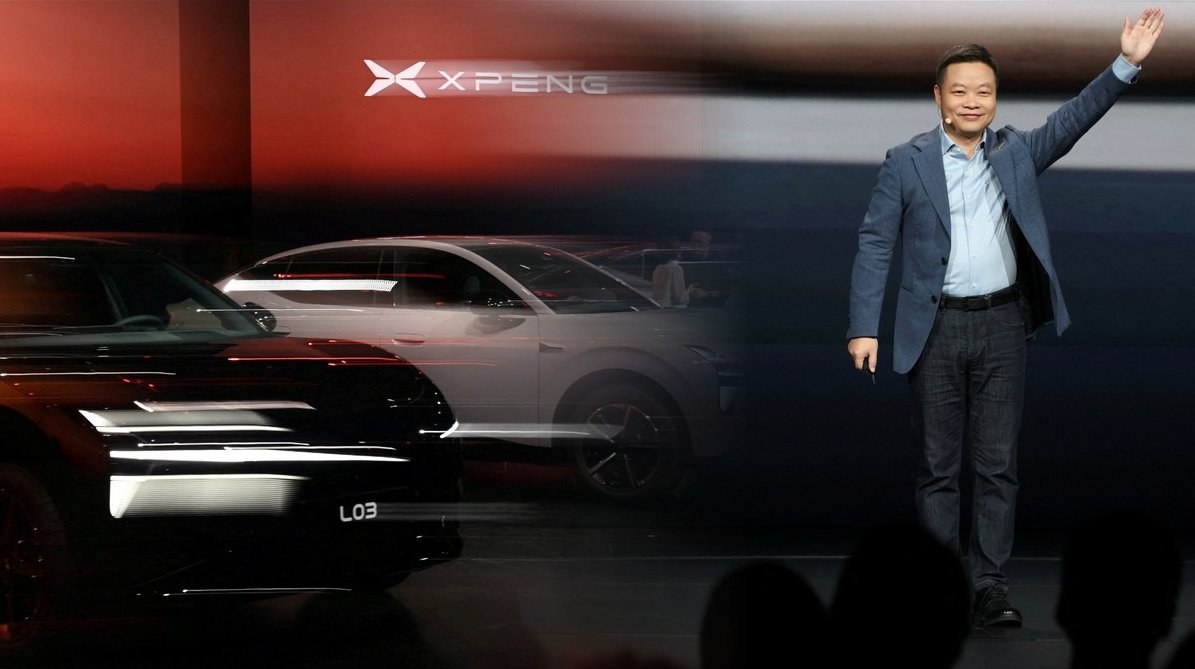
Xpeng, the Chinese automotive giant, has chosen Munich, the heart of Germany’s automotive industry, for the global launch of its latest SUV. The company is also considering utilizing Volkswagen’s production capabilities, which are currently being reduced. He Xiaopeng, Xpeng’s CEO, stated that European executives should critically assess why many manufacturers have previously exited the Chinese market.
The competition in the automotive sector is shifting focus from solely batteries and production costs, according to one of the key figures in the Chinese automotive industry.
Xpeng’s debut outside China showcased its MONA L03 model, a compact SUV set to enter 65 markets. In Germany, the base electric version is priced at €35,600. During the launch, He Xiaopeng expressed admiration for European and German engineering, coinciding with Volkswagen’s painful job cuts and factory closures.
In response to inquiries, He Xiaopeng acknowledged the company’s interest in investing in Germany, dismissing concerns over rising labor costs affecting major German firms.
This would not be Xpeng’s first European venture; the company has collaborated with Magna since 2025, assembling its vehicles in Graz, Austria. Initially involving two electric models, the partnership has since expanded to include the P7+ and plans for a fourth vehicle. He emphasized their intent to deepen collaboration with their Austrian partners.
When asked about utilizing Volkswagen’s available production capacity in Germany, Xiaopeng hinted at potential interest. “We are open and eager to discuss. In recent months, we have been engaging intensively with our partners about possible options. If there are concrete advancements, we will share them,” he mentioned after the Munich launch.
He further expressed hopes for establishing multiple factories and R&D centers in Europe, emphasizing their commitment to local partnerships.
Xpeng’s Ties with Volkswagen Go Deeper
Xpeng’s relationship with Volkswagen extends beyond mere commercial collaboration. The German automaker holds nearly a 5% stake in the Chinese firm for approximately $700 million. They have initiated joint projects on electric vehicles and electronic architecture for the Chinese market and collaborative parts procurement efforts. Volkswagen anticipates that this partnership could reduce new vehicle development time by over 30%.
He noted that Volkswagen, upon joining Xpeng’s board, has imparted valuable knowledge about global supply chains and globalization culture, areas previously overlooked by Xpeng. He did not portray the Chinese automotive sector as fully learned, acknowledging that German and European cars still possess numerous advantages. “In this industry, China is more like a student. We are still learning,” he added.
He Xiaopeng assured that the company does not intend to repeat a strategy focused solely on export and aggressive volume increase. “In Europe, for Europe. We want to do it right. I am not aiming for rapid scaling. Collaboration with local partners is my priority,” he stated during the press conference in Munich.
Competition Beyond Pricing and Range
He Xiaopeng made headlines in 2024 when he predicted that most Chinese car manufacturers would not survive the next decade. When asked how many brands would remain in Europe, he avoided a definitive answer.
“That question should be directed to the CEOs of European manufacturers. However, I can provide an example from China. Twelve years ago, when I entered the automotive industry, there were about 300 car manufacturers and over 100 traditional brands, totaling more than 400. A few years ago, around 40 brands were achieving significant sales. Today, if we consider significant scale to mean over 100,000 cars annually, there are approximately 20,” he explained.
He assured that the next phase of automotive competition would not solely revolve around batteries and production costs but would increasingly focus on artificial intelligence, software, and product development speed.
“When the most critical component of a car was hardware, many larger and smaller firms could thrive, each finding its niche. However, as AI and software account for 40–50% of a vehicle’s value, design and production will require entirely different business models. This shift will take another five to ten years,” he stated.
“China is likely to transition through this phase more quickly. Europe may take a different path, so I do not want to speculate on how many European brands will ultimately remain. European company executives should analyze why so many manufacturers have previously exited the Chinese market,” he advised.
Xpeng aims to distinguish the L03 primarily through its software. The vehicle utilizes the VLA model, or Vision-Language-Action, which analyzes camera images, navigation data, and user commands, translating them into the car’s behavior.
During the Munich launch, the company demonstrated the system’s tests on German roads, with the vehicle recognizing local signs, yielding to cyclists and pedestrians, observing right-hand priority, and navigating tight parking spots. In the version intended for markets outside China, navigation and some driving support functions will employ Google Maps technology.