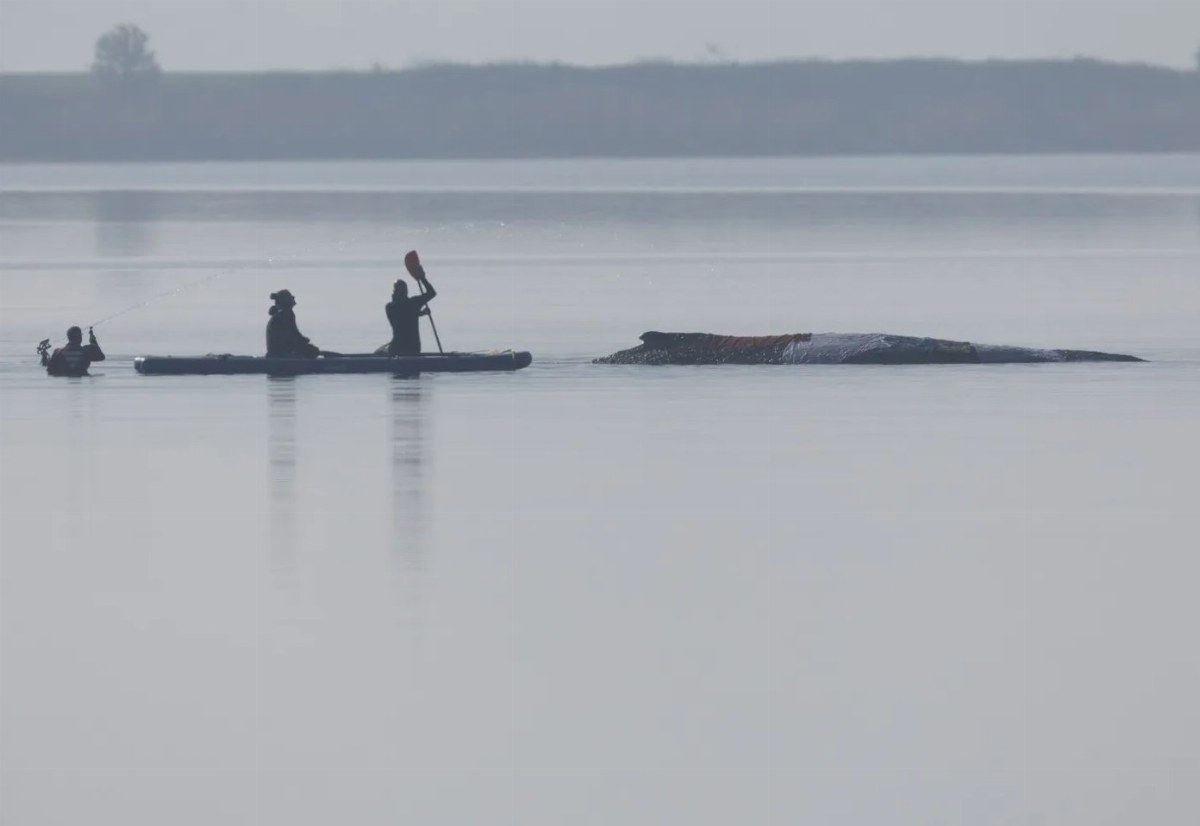
In April, a group of people in Germany undertook a bold operation to save a stranded humpback whale along the Baltic Sea coast. For a brief moment, it appeared that a nation divided by political strife and economic concerns united around a common cause.
A new satirical play inspired by this event suggests that spectators, social media influencers, politicians, and millionaires who flocked to the coast to support Timmy’s rescue sought not only to save the whale but also hoped that Timmy would rescue them in return, as noted by The Guardian.
“Timmy: Hope Dies Last,” which premiered last Saturday at the Ernst Deutsch Theater in Hamburg, reinterprets the media spectacle surrounding the whale into a play with religious undertones, where the giant marine mammal is venerated, crucified, and ultimately dismembered, with its blubber presented in a ritualistic communion.
Timmy Reveals Humanity’s Best and Worst
Transforming Timmy into a figure reminiscent of Jesus garnered criticism from Catholic theologians but was praised by the German magazine Der Spiegel. According to the publication, the play illustrates “how willing a secularized audience is to seek refuge in quasi-religious structures as a source of hope.”
The humpback whale was first spotted in German waters in March after becoming stranded near the resort town of Timmendorfer. This led to the nickname Timmy, though it was later discovered that the animal was actually female. A previous nickname, Hope, better reflected the emotional impact of the whale’s tragic fate on the German public.
Throughout the play, director Alexander Klessinger incorporates audio snippets from interviews with individuals who traveled to Timmendorfer hoping to connect with the suffering mammal. These raw and unfiltered testimonies reveal how convinced some of them were that the whale was calling out to them.
“I felt like she was waiting for me. I can’t explain it, but I felt like she wanted me there,” recounted one woman.
In one recording, another woman shares that she traveled to the Baltic Sea to help the whale using a ritual song she believes could “fill the energy gaps.”
“Timmy brought out the best in people,” the Süddeutsche Zeitung wrote after the play’s premiere. “But also the worst.”
In addition to reportedly driving a surge in book sales about whales and marine life, Timmy’s story inspired numerous songs, some sentimental, others satirical. At the end of the Hamburg premiere, the rock band Tulpe performed their hit “Sprengt den Wal!”(“Blow up the whale!”), whose chorus states: “Let it rain salami and whale chops.”
An AI-generated song, which went viral on social media during the height of the “Timmy craze,” is performed in the play by actors in a rock version, introducing a note of populist revolt against the “experts” portrayed as heartless.
“While she still breathes,” the lyrics state, “they’re already talking about what will happen next / about tests and numbers / as if she were just a lifeless body, without a heart.”
The 2 Million Euro Operation
Ultimately, a complex and risky operation to transport the whale back into the sea, aided by a barge filled with water, was financed by two millionaires and authorized by authorities, despite warnings from experts who argued that the animal was injured and unlikely to survive.
The play reconstructs a press conference during which biologists who recommended letting the whale die peacefully were accused by some involved in her rescue of wanting to “kill” the animal. One woman insisted it would be “undignified” for the whale to die in a cove rather than in the open sea.
Nearly two weeks after Timmy was released, on May 14, the whale was found dead near the small island of Anholt, in the Kattegat Strait separating Denmark from Sweden. Controversies surrounding the cost of the rescue operation, estimated at around 2 million euros, continue to this day.