When PSD and PNL do politics like in the 90s, AUR rose from under 1% in 2020 to 19% of the Parliament. And it is rated in the voting intention with almost 42%

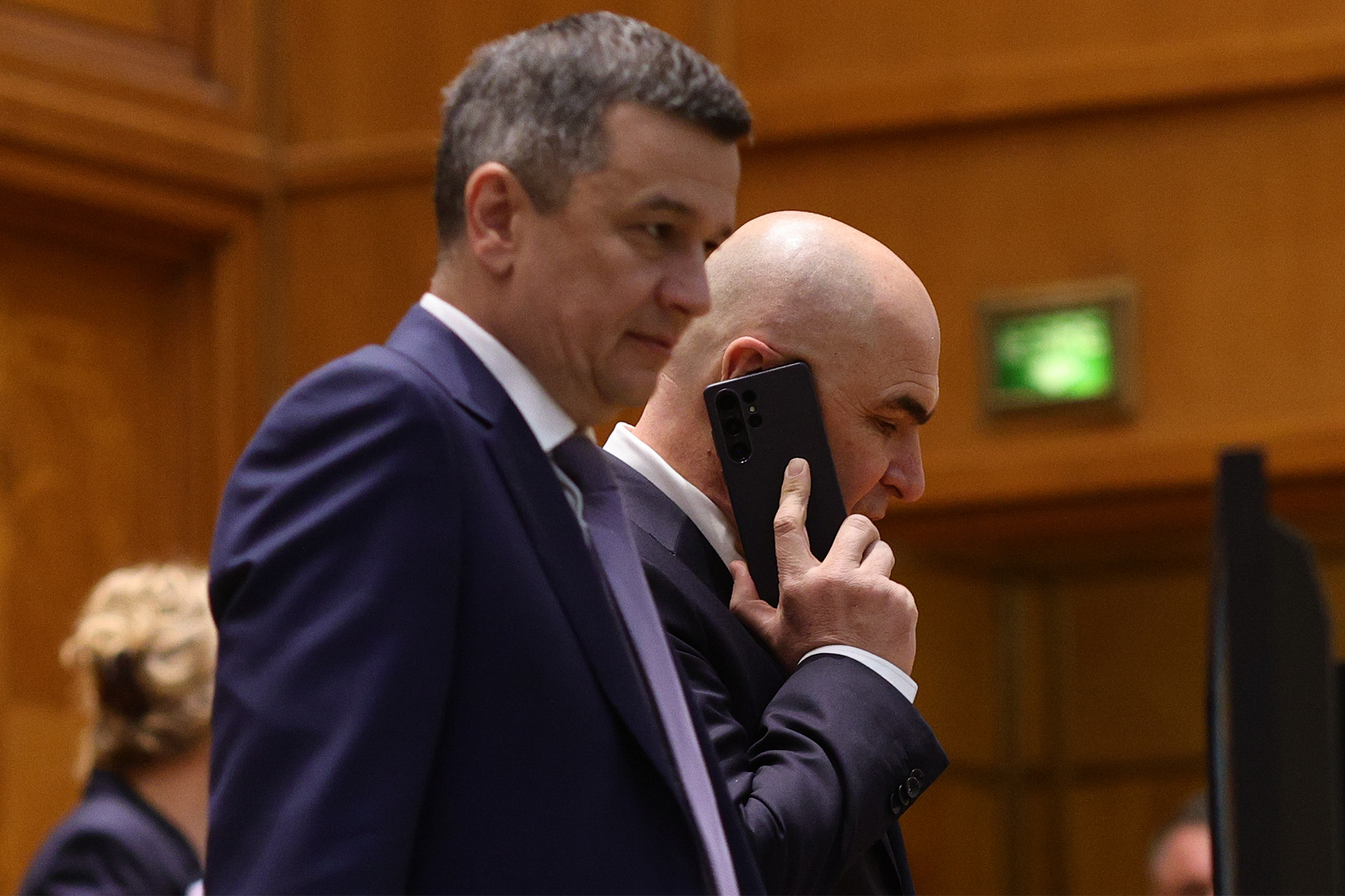
Eugen Tomac and his technical team should not have been running these days in the halls of the Parliament in search of a majority. The mandate of prime minister should have been assumed and negotiated by PSD and PNL. However, the two big parties seem at this moment to be paying tribute to a style of doing politics from the '90s. However, the year is 2026, with a policy in which an elephant is getting bigger in the room: in 6 years it has gone from 1% to 40% in the voting intention of the mobilized electorate.
There are not a few who wonder what was in Nicușor Dan's mind when he chose to nominate Eugen Tomac as a candidate for the position of prime minister of a “technical government”.
Gabriel Bejan equated the presidential decision with the cancellation of the parliamentary elections, not even two years after the cancellation of the presidential elections. Cătălin Tolontan talks about the president's dangerous game.
Others say, simply, that we are dealing with a death of democracy.
Even the candidate himself said in his first interview that he wanted to talk “about another person, another situation and a political solution”.
In principle, everyone is right. Technical/technocratic governments lack electoral legitimacy and act in the logic of political impunity. However, this is not compatible with a functional democracy, even in the case of short-term mandates of such Cabinets.
After the censure motion in which the Bolojan Government was dismissed, PSD, PNL and AUR declared their willingness to take over the mandate of prime minister. However, we arrived, after a month of negotiations, at the moment when the president chose the version of a Tomac “technical government” that no one declares himself willing to vote for, with the risk of further deepening the political crisis, doubled by an economic one. It would have been logical to offer the mandate to a candidate who has the transparent support of a parliamentary party. In the given situation, to the PSD, i.e. to the party that gathered the necessary majority to adopt the censure motion for the dismissal of the Bolojan Government.
Did Nicușor Dan deceive his voters?
Those who expected a spectacular move by Nicușor Dan, after PSD-AUR's censure motion, are disappointed. The lack of quick decisions by the president and a firm position on the part of the dismissed prime minister Ilie Bolojan were perceived as complicity with the PSD, going so far that Eugen Tomac was also considered a proxy of the social democrats.
If we look back, however, Nicușor Dan never promised that he would not give the mandate of prime minister to PSD, just as he never promised that he would, of course, give it to PNL.
What the president said since the election campaign was that he would block the AUR's access to power and support a pro-Western government that would get Romania out of its difficult economic situation. Parliamentary mathematics allows him to stick to this logic. In theory, a parliamentary majority can be made without AUR.
For a month Nicușor Dan acted in this direction. One by one, PSD and PNL showed themselves willing to take over the mandate of prime minister. The almost obsessive question was whether there was even a majority to support the proposals. And this parliamentary math shows that, in the absence of collaboration between the two parties, the only option would be the co-optation, in plain sight or through the back door, of AUR in the power game.
After several rounds of informal and formal consultations, PSD declared that it wanted to restore the Coalition with PNL, but without Ilie Bolojan. PNL, along with USR, ruled out any collaboration with PSD. What's more, PNL was asking the president to force PSD to formalize its relationship with AUR, offering the mandate of prime minister to the social democrats.
A crash fix or a scarecrow
In this context, the solution chosen by Nicușor Dan to keep the coordinates he won the mandate, but also within the constitutional limits, was the nomination of an outsider to seek a majority by satisfying the demands of all the parties qualified as pro-Western. “It has even reached the point where it seems normal that exactly the political forces against which the Romanians mobilized a year ago should be invited to be part of the governing act. I also believe that such an attitude is irrational and goes against the national interest that the Romanians defined in such large numbers in May 2025”, declared Nicușor Dan, at the time of the nomination of Eugen Tomac as a candidate for the position of prime minister of a “technical government”.
Such a breakdown solution or, ultimately, a scaremonger for the anticipated can provide time to restore, in one way or another, the lost majority. Moreover, even if it passes the Parliament, sources directly involved in the negotiations do not give any chance of survival for such a “technical government” for more than a few months, until the adoption of next year's budget.
GOLD, the elephant in the room
During the negotiations for the appointment of a new prime minister, PSD and PNL, the two major parties in the former coalition with claims to the Victoria Palace were in irreconcilable positions. PSD and PNL are tributes to a style of doing politics specific to the years 1990-2000. While the social democrats were arguing with Ilie Bolojan, and the liberals with Sorin Grindeanu, hoping for a capitalization from direct attacks, an elephant swelled in the room. And this elephant is named GOLD.
Today's world and its challenges are no longer those of the 90s-2000s. Much less the tools with which political battles are fought now.
They caused a party that obtained less than 1% of the votes in the local elections in September 2020, to have a score of almost 10% in the parliamentary elections two months later. Four years later, AUR obtained almost 19% of the votes in the general elections, and now it is rated, in the voting intention of the mobilized electorate, with almost 42%.
AUR, as I wrote recently, is a party inflated by a strong social anxiety amid the pandemic, the war in Ukraine and a perceived political class more corrupt than ever. Without being a pro-Russian party in theory, the rise of AUR coincides with the intensification of Russian propaganda in its most sophisticated form, fueled intensely by political instability.
What Russia is looking for in the minds of Romanians
Propaganda is to democracy what the club is to totalitarianism, summarizes Noam Chomsky, one of the great thinkers of our time, stating that power factors rely for control on managing information and shaping public consensus. Another author, professor of psychology and neuropsychology at Trinity College Dublin, Simon McCarthy-Jones argues, at the same time, that if until recently the fight was for freedom of expression, today it is for freedom of thought, in a world dominated by technologies designed to influence attention, emotions and decisions.
The emergence of social platforms represented a turning point in communication and propaganda. If the Internet meant another form of one-to-many message transmission, the advent of social networks made the transition from one-way communication to one-to-many-to-many participatory communication. It is what is increasingly being called cognitive warfare. In an analysis by NATO experts, the authors argue that this is a new concept largely due to the inevitable changes in the human brain with the advent of new technologies, by switching attention and multitasking at the expense of critical thinking. People thus become easier to manipulate. The thesis is also supported in other works by modern psychologists and philosophers that explain how we got to the point where the infantilization of adults/voters has become a dangerous reality of our day.
In an interview with the HotNews audience, American historian Timothy Snyder, one of the most respected contemporary thinkers, talks about Russia's intense efforts in social media and disinformation campaigns to change people's psychology and ultimately politics.
“Russia works very hard to support, above all, parties and views that treat everything as a conspiracy, that campaign for “us and them” politics, that try to make everyone feel angry and hopeless. So there's a daily assault on that,” Snyder says.
And Dragoș Stanca, digital specialist, president of BRAT and tech entrepreneur, draws attention to some campaigns that are carried out in Romania in the online environment to extract “extremely valuable data for actors hostile to Romania's interests or for some parties in the country”. “You are profiled and you are given political, anti-democratic messages or conspiracy theories,” exemplifies Stanca, in an interview for HotNews.
What we can't negotiate
This is the time and world we live in. Not only us, but also the politicians called these days to offer solutions to a crisis that they also caused. Eugen Tomac and his technical team should not have been running these days in the halls of the Parliament in search of a majority. The mandate of prime minister should have been assumed and negotiated by PSD and PNL.
As a sad refrain, however, liberals and social democrats claim that they do not negotiate principles and values. But when you reduce them to names, whether they are PSD, PNL, Grindeanu, Bolojan or Dan, then freedom, democracy, truth, justice, citizen safety become meaningless.
And that never brings anything good. And this is also seen in the polls.