Bolojan announces that we are losing money from PNRR because we did not bring the trains to the promised speed. Beyond Curtici another world begins. The area where they reach 230 km/h

Prime Minister Ilie Bolojan announced on Saturday, in Iasi, new money lost from PNRR. One of the reasons is related to railway speed. HotNews analyzed routes and speeds. Long-distance trains in Romania often run at average speeds of only 50 – 55 km/h. On the main railway corridors in Central Europe InterCity trains frequently reach 80–90 km/h.
- We compared the average speeds for 12 long-distance trains in Europe, half of which pass through Romania. The longest ones have traveled over 1,100 km and pass through several countries.
- We're not too good at maximum speeds either: in Romania and Hungary the maximum is 160 km/h.
- On certain lines, maximum speeds reach 200 km/h in Serbia and Poland and 230 km/h in Austria.
The difference in train speed is clearly felt by passengers during the journey: if in Romania a 700 km journey can take 14–15 hours, in countries such as Poland, the Czech Republic or Austria the same distance is covered in 8–9 hours, i.e. in half.
Speeds of 50-55 km/h when crossing Romania by train
Examples of speeds here and in Europe near us
Romania has among the slowest trains in Europe and this can be clearly seen when we compare the average speeds for trains with the longest journey, especially night trains.
On very long distances, Romanian trains have average speeds 25-30 km/h lower than trains from Central European countries where they chose to invest in the railway sector.
The “Dacia” Bucharest – Vienna train has an average speed of 61 km/h between Brașov and Arad and over 70 km/h from the Hungarian border to Austria. With trains such as Iași – Timișoara or Cluj – Galați, you cross the country at average speeds of 51-52 km/h.
For comparison, IC trains that cross from one side to another in countries such as Poland, the Czech Republic, Slovakia or Hungary do so at average speeds of 80-90 km/h.
An example is the international train connecting the Polish city of Gdynia (on the Baltic Sea) and the Czech capital Prague. The 827 km are traveled at an average of 90 km/h, with many sections where the speed exceeds 120 km/h, on modernized lines.
In Romania, too, modernizations are underway that should allow increasing speeds in the coming years, but until then there are many speed restrictions, especially between Brașov and Sighisoara and between Caransebeș and Arad.
Slow trains at home, but fast in the neighbors
An example that says a lot relates to the comparison between the direct train Bucharest – Vienna and the Nightjet train Vienna – Amsterdam. Although the distances are similar (over 1,100 km), the Vienna – Amsterdam train takes four hours less, although it has many stops.
The direct train Bucharest – Sofia has an average speed of 54 km/h, and Bucharest – Chisinau, only 43 km/h. In the first case, there are also frequent stops, and the route is much longer than on the road. In the second case, it is a long stop at customs, for controls and for changing bogies.
In Central Europe the speeds for long-distance trains are much higher. From Prague to the Baltic Sea the average speed is almost 100 km/h, and from Budapest to Stuttgart, 81 km/h.
In many cases, the rail route is much longer than the road route, examples being the routes Prague – Dresden or Bucharest – Sofia.
Night trains sometimes have stops of tens of minutes for shunting and for detaching or attaching groups of carriages. Even so, the Austrian Nightjet trains, which dominate this segment in Europe, manage to have average speeds of 80-90 km/h, thanks to long stretches where they run at 120-140 km/h.
International rail connections in the Balkans remain few and slow. There hasn't been a direct Bucharest-Belgrade train for over a decade, Greece hasn't had an international train for years, and there are extensive works between Belgrade and Budapest and no direct trains are running yet.
The differences relate to both infrastructure and traffic management. In many Central European states the main lines have been upgraded for speeds of at least 160 km/h, modern signaling systems exist and freight traffic has decent speeds. In Romania, speed restrictions, construction sites and aging infrastructure severely reduce commercial speed.
Where are the fastest trains near Romania
Serbia has 200 km/h sections of the railway being built between Belgrade and Budapest. There is still a long way to go before the whole project will be ready, but there is a super-fast section between Belgrade and Subotica, and 174 km are covered by IC trains produced by Stadler in 79 minutes.
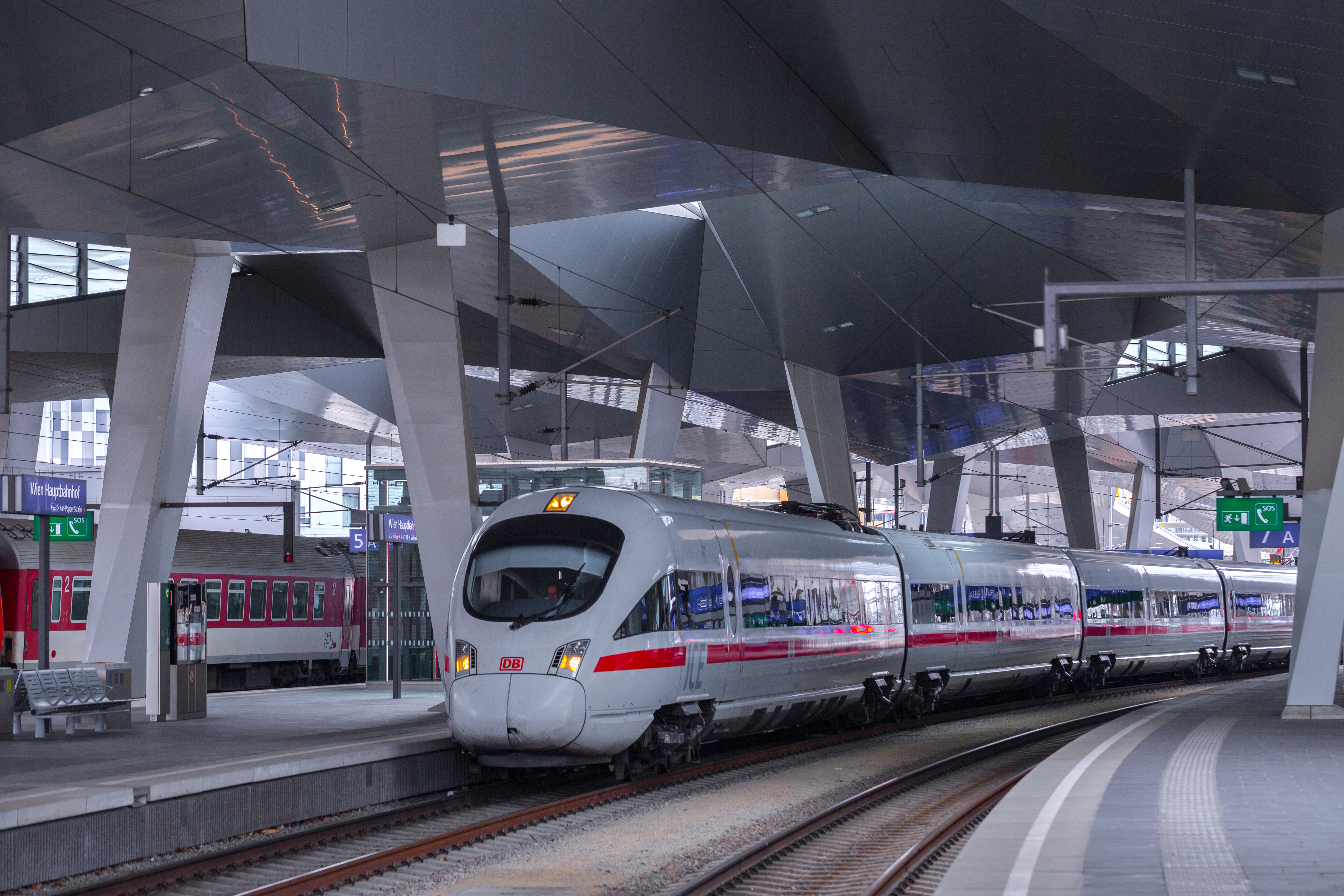
Another very fast area is in Austria, between Vienna and Linz, where 187 km are covered in 75 minutes by ICE trains that reach 230 km/h.

Turkey has an ever-expanding high-speed train network, and the “flagship” line is Istanbul – Ankara, 561 km, the fastest trains taking 4 hours and 11 minutes. The maximum speed reached is 250 km/h.
In Romania, the highest average long-distance speed is between Constanța and Câmpina, where the fastest trains take 3 hours and 17 minutes over 309 km, with an hourly average of 95 km/h.
Further west, trains also reach peaks of 320 km per hour
In Western Europe, high-speed trains reach 320 km/h in France, 310 km/h in Spain and 300 km/h in Italy. Thanks to trains such as TGV, AVE, Frecciarossa, Eurostar, ICE, Thalys or Italo, distances of 800-1000 km are covered in under 4-5 hours.
Here are two examples:
Paris – Nice, 974 km, 5 h 46 min
Barcelona – Seville, 1,091 km, 6 h 46 min
Average speeds for long-distance trains in Europe:
Trains connected to Romania
- Bucharest – Vienna 1124 km, 18 h 30 min, 60 km/h
- Bucharest – Sofia, 537 km 10 h, 54 km/h
- Bucharest – Chisinau, 590 km, 13 h 30 min, 43 km/h
- Iasi – Timișoara 16 h 815 km, 51 km/h
- Brașov – Budapest, 803 km, 15 hours and 20 minutes, 52 km/h
- Cluj – Galati, 13 h 30 min 714 km, 53 km/h
International long-distance trains from Central Europe:
- Prague – Gdynia, 827 km, 9 h, 91 km/h
- Vienna – Venice, 631 km 7 h 10 min, 88 km/h
- Budapest – Warsaw, 806 km 11 h 40 min, 69 km/h
- Prague – Zurich, 1,103 km 13 h 30 min, 82 km/h
- Budapest – Stuttgart, 974 km, 12 h, 81 km/h
- Vienna – Amsterdam 1,167 km 14 h, 84 km/h