INTERVIEW. The Romanian behind Bulgaria's Eurovision win, who has been working with DARA since he was 16, says why “we should use folklore more”

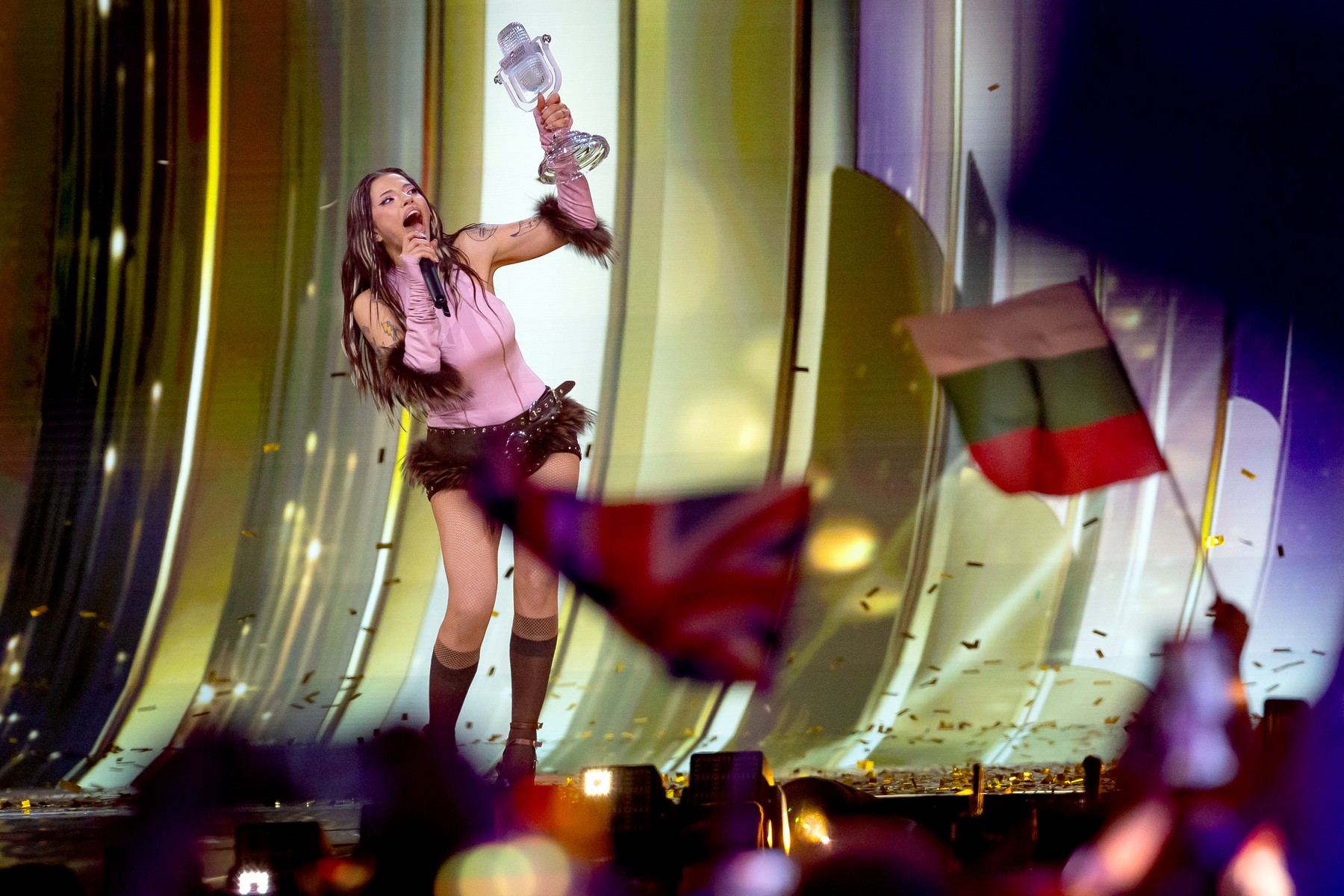
Bulgaria won Eurovision for the first time, with DARA. Her name immediately appeared on the home page of The New York Times. How could the song with which Romania could win Eurovision look like? “We have a lot of folklore and a lot of influences, and I think it would be better to use them more, more than we do now,” says Cristian Tarcea, 33, from Constanta, who worked on the rhythmic structure and sound of the song Bangaranga, together with the Norwegian composer Anne Judith Wik.
- The career of Tarcea (known in the music world as Monoir) is a pilgrimage of artistic daring across different continents and cultures. Tracks produced by Monoir have garnered billions of views and are charting in Turkey, Greece, Russia, South Korea and India.
- He has been working with DARA since the artist was 16 years old, he explains, in an interview for HotNews. What is it like to work with an artist of “special energy”, so young.
- The man who unofficially put a Eurovision on his record talks about how the world listens to music today “in an age of speed”.
Cristian Tarcea from Constanta is a music producer, composer and DJ, but also the brain behind the label Thrace Music, which released artists such as: Kate Linn, Brianna, Sandra N., Dharia, Iarina and many others.
Tarcea is known as Monoir in the artistic world. He is also the producer behind some hit songs. Among them: “Lost In Istanbul” (140 million views on Youtube), “Sugar & Brownies” (27 million views), “Your Love” (96 million views), “The Violin Song” (80 million views), “Chameleon” (48 million views), “Perfect” (11 million views).
The tracks have garnered billions of views and have dominated the charts in Turkey, Greece, Russia, South Korea and India for years.
The collaboration with DARA started long before this hit, since the artist was 16 years old. In fact, Monoir and DARA even have a featured track dating back to 2018, “My Time”, released on Cat Music (a Romanian record label launched in 1991) and which has garnered 7.4 million views.
Tarcea was also involved in the election of Alexandra Căpitănescu
Tarcea was part of the expert jury chosen by Romanian Television for the Eurovision Romania 2026 National Selection, following which Alexandra Căpitănescu was chosen to represent Romania this year.
From this position, Tarcea evaluated and scored the Romanian songs entered in the competition, while the song he produced for Bulgaria ended up being selected to represent the neighboring country. About how this should feel like a double success for Romania, but also about what it takes to win a contest like Eurovision, about how to make a hit and the music industry, in the interview below, given exclusively by Monoir to HotNews.
“We wanted to have fun, that's how we started Bangaranga”
– When you started working on “Bangaranga”, did you feel that it could become a winning song at Eurovision or did the success surprise even you?
– Cristian Tarcea: The truth is that in 2023, when we gathered in the studio, we were not going to do anything specifically for Eurovision. We wanted to have fun and do something fun, without barriers, without limits. That's how “Bangaranga” was born, with me, DARA and Anne-Judith in the studio.
– What exactly was your contribution? to the play? How much of the identity of “Bangaranga” comes from the rhythmic structure and minimalistic sound you've built in the studio?
– Her first version is produced by me, so probably 80% of her current character was given by me. Dimitris Kontopoulos came in as a co-producer to adjust the track to the time and arrangement for Eurovision. That's because there are stricter requirements regarding the timing of the piece and the arrangement. Having experience of Eurovision from many other editions, his contribution can be heard in the official version of Eurovision released on the platforms.
“In 2026, people are in a lot more of a hurry”
– “Bangaranga” seems the opposite of the classic Eurovision songs, very loaded. Do you think the public is tired of the artificial spectacular?
– I think that a song does not necessarily have to be “thought out” for Eurovision. As long as it has a wow factor or a catchy part, it might reach people more easily.
We are in 2026, long format has become short format, people are in a much more hurry, and music must reach people as quickly as possible with a catchy or interesting part so that you don't lose it.
Of course, there is still the Eurovision-specific music niche, much appreciated by the fans. But this year I think I proved that you don't need a piece of a certain pattern to reach the public.
“DARA has a special energy”
– What was it like to work with DARA since the artist was 16 years old. What did you see in her then and what makes her different from other pop artists in the region?
– DARA has a special energy that I can't explain in words and that you only feel when you're around her. Every time I entered the studio with her, I felt energized and inspired to make music without boundaries and without directions or “templates”.
– How much did the artistic instinct of DARA matter and how much the production formula built by the international team?
– I think the whole moment, the song plus the show, was a concept, if I may say so. From the play to what was seen on TV, it was something else. And that I think raised the moment. Also, the oriental elements and the tempo changing on the drop was kind of a surprise that I integrated from the first session in 2023, imagining how people would react when listening and how the tempo change would feel.
The Directing of Show team managed to implement everything excellently and bring out the concept through choreography and artistic timing.
– Bulgaria won Eurovision for the first time in history with a song performed by a Romanian. Is there a bitter taste that the trophy did not come for Romania?
– I think that both Bulgaria and Romania made a show and a beautiful figure. For Romania, I consider this to be a double success. You have nothing to do with us, we Romanians are everywhere.
– At the same time, you were also a member of the jury of the Romanian National Selection. How did you experience this double position: juror for Romania and composer for Bulgaria?
– It was something unexpected and surprising for me too. While I was judging and in the hall, I received a message that Bulgaria will participate in Eurovision. I didn't know what song or artist.
I only found out when I was in the hall at our local final – where I performed “Choke Me” since the pre-selections, because I really liked it – that the Bulgarians will participate with DARA and the song “Bangaranga”, produced by me. They chose the artist first, then the piece. That is why their selection took longer.
– Did you have any moment of discomfort knowing that your play competes directly with Romania?
– Not. For me, 'Choke Me' is kind of Yin and 'Bangaranga' is Yang. It's two different songs, two different moments, and somehow that was a wonderful thing. People saw two fabulous and different shows at the same time. I was happy throughout the contest for both countries.
About Alexandra Căpitănescu: “She is a complete artist”
– Alexandra Căpitănescu got a lot of votes from the public and finished in 3rd place. From your perspective, what did she lack to win Eurovision?
– I think Alexandra didn't miss anything at all. He is a complete artist and the song and timing was very good. It was simply a matter of preference here. Just like in music, it's hard to please everyone.
– Romania seems to have impressed rather with voice and show, while “Bangaranga” relied on atmosphere and sound identity. Do you think Romania still misunderstands Eurovision?
– I wouldn't say that. This year's National Selection made me understand that Romania has gained courage and has a good direction regarding Eurovision. Little by little we realize that Eurovision is about music in general and not about a specific niche, the “Eurovision niche”. We realize that it's about a concept, something new, something that can excite people watching and listening on TV to what's happening.
“We live in an age of speed”
– Why do you think a minimalistic, almost hypnotic piece worked better than the big, dramatic productions in the finale?
– I would say that because they are easier to digest and remember. We live in an age of speed, social media and trends. Simpler, repetitive words, a good hook. And I think, more than anything, the energy you have when you're doing the piece is also important. And DARA I think managed to express the madness I had in the studio when I conceived the song.
– In your opinion, what would the perfect song sound like for Romania to win Eurovision?
– There is no such thing as a perfect piece, but I think that Romania has a lot to say from a musical point of view. We have a lot of folklore, we have a lot of influences, and I think it would be better if we used more of it, in one form or another, maybe more than we do now.
– After this victory, do you see yourself working for Romania on a song that will actually win Eurovision? Or is it easier to build success for other countries than for the Romanian market?
– I have never limited myself to working only with foreign or local artists, only that, over time, I liked making music in English, and the weight with which you can enter the Romanian music market probably pushes me to make more music for “export”, for the international market.
But I am always open to do something like that for Romania. Provided I'm not on the jury. Then it would be a conflict of interest and it would not be OK.