
Anthropic created Claude for Small Business, a suite of tools that is intended to help small businesses organize and handle everyday business tasks. To further encourage their owners to look into the future of business they are creating, he has even prepared a short free course (quite sensible, by the way) for people starting their adventure with more advanced use of artificial intelligence.
The company claims that the new device can help with invoices, payments, marketing campaigns, customer contacts and preparing reports, among others. In other words, Anthropic wants Claude to become a “dark job” agent — the part of running a business that small business owners tend to dislike the most and that often spills over beyond actual business hours.
It sounds very attractive, that's why we decided to take a closer look at how one of the most valuable start-ups in the world wants to fight for the hearts (and wallets) of small companies and what this means for business management and accounting applications.
Read also: A new wave of entrepreneurs in the USA. They are motivated by artificial intelligence and fear
How Claude for Small Business works
How does it work? Claude for Small Business is another plug-in for Claude Cowork, the Anthropic environment for working with AI agents, whose updates in recent months have regularly resulted in stock market sell-offs of shares of software-related companies. To use it, you need to install the Claude Desktop application and pay for one of the Anthropic service subscriptions. So it is not a separate application for running a business or a new AI modelbut a suite of processes designed with specific applications and audiences in mind.
Claude for Small Business is a plug-in for the Claude Cowork platform, used from the Claude application.
|
Mieszko Krzykowski / Onet
Such a package consists of two main parts: connectors and skills (skills). Connectors are integrations with external services and applications. They determine from what sources Claude can download data and in what tools he can prepare actions. At the time of writing Claude for Small Business's list of connectors includes 12 items and it follows that Currently, companies conducting their accounting in the QuickBooks application will benefit fully from this packagemaking payments using PayPal or the Stripe platform and having an online store launched using Squarespace.
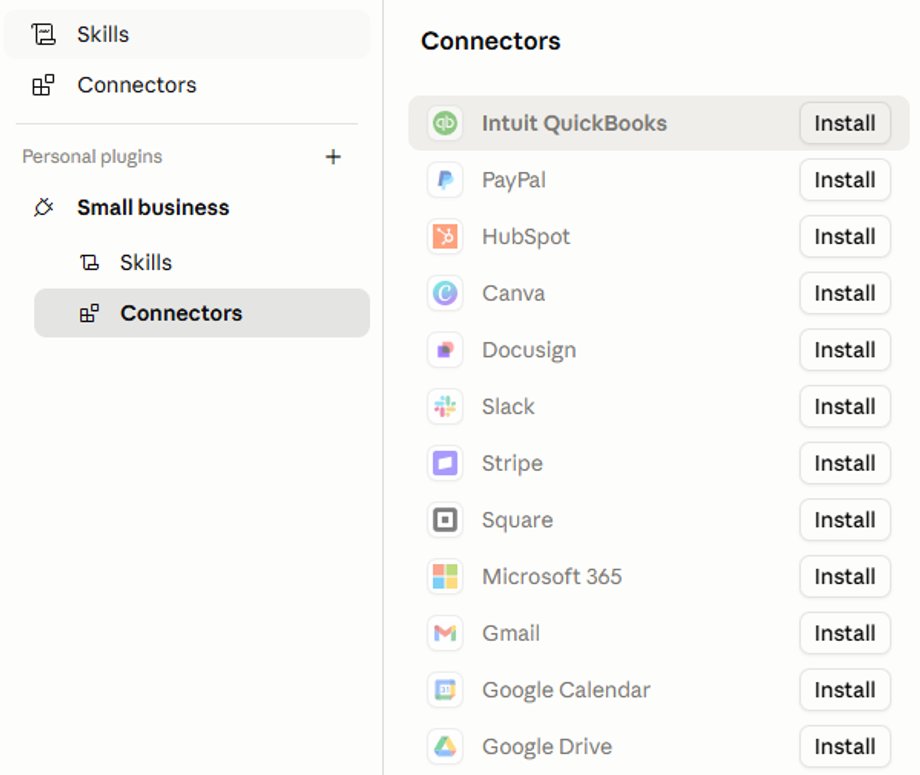
Using the new Anthropic tool makes the most sense when your business is run within a specific software ecosystem.
|
Mieszko Krzykowski / Onet
Skills, in turn, are prepared instructions for the agent invoked by commands starting with a slash or simply as part of a regular “conversation” with artificial intelligence. You can think of them as a very complex query to the chatbot. Each of them is responsible for a specific type of task: preparing a summary of receipts and expenses, collecting outstanding invoices, checking margins, planning payments, organizing CRM or preparing campaign materials. They can also run in the background and automatically launch at a specific time or be triggered by an event. A classic application here would be the automatic preparation of monthly summaries or a payroll list.
As of this writing, the Claude for Small Business skills list in the Claude Desktop app has 31 items. Some are very universal and independent of the applications used, others assume the use of the programs and services mentioned a few paragraphs ago, but after carefully checking their operation, one more thing is visible: some of the instructions contain guidelines written for the American tax system, valid at the time of tool release. In Poland, this would mean having to manually adapt them to local regulations.
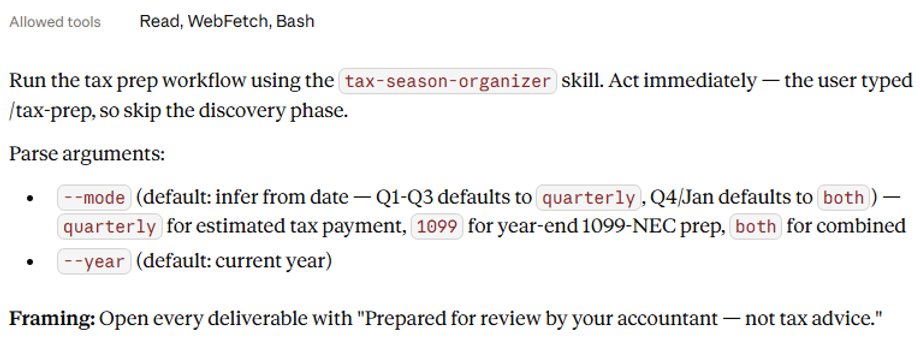
Tax-related commands are currently related to the US tax system.
|
Mieszko Krzykowski / Onet
Useful, but only in a specific ecosystem
Using Claude for Small Business makes the most sense when you already operate within a specific ecosystem or you just want to start a business that can be connected to this ecosystem. Alternatively, for people who have enough experience in working with artificial intelligence to create and modify “skills” and integrations with various services on their own.
Revolution? Not yet. Potentially useful tool? In some situations, definitely yes.
What does this say about the enterprise software market?
Even though the new product from Anthropic will not be very useful for a typical Polish entrepreneur, interesting conclusions can be drawn from how it works.
First, the new Anthropic tool reminds you that AI does not replace classic company software, but rather changes the way we interact with itbecause AI agents do not create new tools, but use existing ones. We will see how exactly this will affect the software market and how we manage our companies, but it can be assumed that building a specific ecosystem will be very important – such as the one whose seeds can be seen around the Anthropic news.
Secondly, tools like this do not remove accountants from the company's workflow. Leaving aside the issues of hallucinations and the fact that any artificial intelligence system is non-deterministic, so you never know what will appear in its output, the “skills” of AI agents are most effective and safe in the hands of people who understand what they are doing. This means you still need someone who can verify everything and is up to date with all changes, although the role of accountants in the future may be very different from what it looks like now. There is probably a version of the future in which the state provides all the most important tax information in a form readable to AI agents, to which a language model can be attached and be sure that everything will be settled correctly, but we are still far from it.
Read also: The government has decided. There will be penalties for misusing AI