
How has Russia's war against Ukraine changed? Could it even end this fall? DW spoke to military and experts about the likelihood of a new truce.
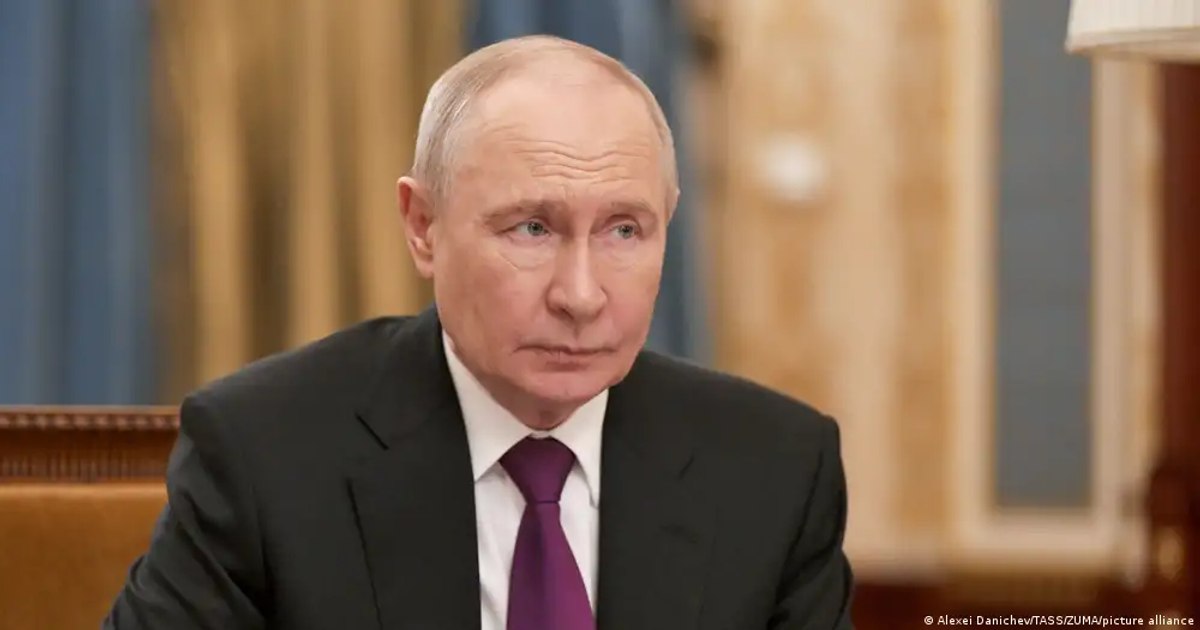
The President of Russia, Vladimir Putin
The US and Israel's war against Iran continues to distract from Russia's war against Ukraine. Kiev fears it will receive fewer US weapons as it prepares to hold out for years to come. Meanwhile, Moscow is taking advantage of the global rise in oil and gas prices. Here, then, is one of the faces of reality in the spring of 2026.
Another is the de facto deadlock at the front, with neither belligerent currently able to make significant territorial gains. Ukraine, however, attacks more and more often, deep inside Russia, installations of the oil transport infrastructure, for example in Tuapse, on the Black Sea. The Kremlin is forced to temporarily cut off mobile internet in Russia, and President Vladimir Putin's popularity continues to slide.
What does all this mean? Where is the war going in the fifth year since the start of the full-scale invasion? Western experts and military people DW spoke to in late April on the sidelines of the Kiev Security Forum believe we are close to an end to the war, especially thanks to the midterm elections in the US.
Will Putin order a new mobilization?
Given the situation on the front in Ukraine, international experts have been speculating for weeks that Putin could announce a new mobilization, just as he did in the fall of 2022. The Ukrainian military does not rule out this possibility either.
Evelyn Farkas of Arizona State University's McCain Institute, however, does not believe in a general mobilization in Russia. Farkas, who held a senior position in the Pentagon under Barack Obama, sees rather the problems of the Russian economy, which she believes will prevent the Kremlin leader from making such a decision.
Is Ukraine becoming more independent of Western weapons?
Despite the tensions in the Persian Gulf, Kurt Volker believes that Ukraine has an advantage. The former US special envoy for Ukraine appreciates that its position is stronger today than before. In his opinion, Kiev has significantly reduced its dependence on Western weapons and covers its needs “to the extent of 60 to 70 percent” through its own production. Ukraine can therefore continue the fight even if the United States stops its arms deliveries through the Europeans.
Less than a year ago, Volodymyr Zelensky, during a visit to the US, feared that Ukraine might lose the war if American support stopped. According to Volker, this scenario is no longer valid. At the same time, he notes that Washington can no longer guarantee the delivery of the same volume of important missiles for the Patriot air defense system by the end of the year. The former US permanent representative to NATO attributes this to Trump's “priorities”, namely the war against Iran.
Farkas: Zelenskiy will resist Trump's pressure
Recently, the Ukrainian president has been saying that he expects to be under increasing pressure from the Trump administration by the fall. Trump would like Ukraine to accept Russia's terms for a ceasefire, particularly the withdrawal of Ukrainian troops from the Kiev-controlled part of Donbas. Evelyn Farkas is convinced that Ukraine could successfully withstand this pressure.
The director of the McCain Institute expects the current Iranian crisis to be resolved by the summer, the Strait of Hormuz to be free again, and the US, as Trump has announced, to then pursue “regime change” in Cuba. Even in this scenario, however, she does not expect increased pressure on Kiev. Instead, this development could further weaken Russia, as a historical ally of Havana, she points out.
Real negotiations only after the US midterm elections
Both Farkas and Volker are confident that November's midterm elections for the US Congress could become a turning point if the position of Trump and the Republican Party is weakened. “This will be enough to put pressure on the US government to continue its support for Ukraine and NATO,” says Farkas.
War is “difficult” to end on the battlefield, says Admiral Giuseppe Cavo Dragone. According to the chairman of NATO's Military Committee, Russia's military remains “strong” despite mounting losses. However, the economic situation could be one of the reasons that could lead Moscow to accept a peace agreement.
“I don't think that Russia will ever agree to a peace treaty with Ukraine. But I do think that at some point Moscow might accept a truce, and I would say that that moment is close,” says Kurt Volker, Trump's former special envoy for Ukraine. He says the negotiations to end the war have so far been a “farce”. But changes in Russia and war losses could force the Kremlin to end hostilities. “What matters is the reality. The situation in Russia has deteriorated considerably and continues to deteriorate,” Kurt Volker believes. Time is playing against Putin, he says.
Experts have divergent views on when a tipping point might occur. Volker does not rule out this happening this year. He estimates the probability at “over 50 percent.” Farkas, on the other hand, believes that 2027 will be the year in which “the Ukrainians will emerge victorious.”
Roman Goncharenko – DW


