Hungarian voters want domestic recovery measures first, are divided on Ukraine and are not very keen on giving up Russian energy, it shows a survey of the European Council on Foreign Relations, a Brussels-based think-tank.
Péter Magyar and his party, Tisza, won Hungary's April 12 election by a landslide and will begin their term of government on Saturday after 16 years with Viktor Orbán.
Expectations are high for a country with a stagnant economy, much EU funding blocked and corruption problems after a decade and a half in which Fidesz, the former prime minister's party, built a system that controlled the state.
European partners also expect Magyar's Hungary to adopt a more constructive attitude towards Brussels and Ukraine, to be more cautious about Russia, China and Donald Trump's America, and to stop being the main obstacle to EU policies.
But a poll by the European Council on Foreign Relations (ECFR) in Hungary, which looks in detail at the opinion of both declared Tisza and Fidesz voters, shows that the mandate of the new prime minister will be a complicated one, under the pressure of different expectations of Hungarians.
Hungarians, on the whole, are rather cautious about supporting Ukraine, are not ready to give up energy from Russia, and obviously want Magyar to deal with domestic issues first.
Hungarians voted primarily against Orbán
The survey shows that Hungarians who voted for Tisza mostly did so because they wanted a “change” rather than for the party itself, a point also emphasized by Hungarian commentators in discussions with HotNews before the election.
In the survey, most Hungarians explained their vote for the party by citing a desire for change or systemic reform (37%), anti-Fidesz sentiment (30%) and exasperation with corruption and mismanagement of the country (17%).
Only 15% of Hungarian voters overall believe that Tisza's vision or the qualities of his leader were the main factor in the election victory.
And Tisza voters pointed to dissatisfaction with Fidesz and a desire for change as the main reasons for the party's electoral success.
The second most frequently cited reason by Tisza voters was corruption within the Fidesz party and poor management of the country.
And only 21% of Tisza's declared voters believe that Tisza's party program was the main factor in the election victory.
Magyar's mandate may be more fragile than it appears
The responses, ECFR analysis shows, suggest Magyar's party's mandate may be more fragile than the upbeat images from election night might suggest.
The real challenge for Magyar now begins: to define his own vision for Hungary and convince his voters to support him
Hungarians look in their own house
When it comes to priorities, Magyar has a strong mandate to focus on domestic matters.
In the ECFR survey, when asked to list up to two of the most important problems facing Hungary, Hungarians focused on domestic issues such as the cost of living (37%), the state of public services (33%), corruption and governance (26%), economic growth and jobs (24%).
At the same time, “relations with the EU” are mentioned as one of the most important issues facing Hungary by only 15% of respondents and 21% of Tisza party voters.
A large majority of Hungarians, 75%, believe that fixing the economy will be a difficult or very difficult task, and 55% think the same about fixing the judiciary.
Theoretically, the responses suggest that Magyar might have room to maneuver, but ECFR's analysis recalls that the popularity of Polish Prime Minister Donald Tusk dropped quite quickly after the election, which rather shows that time is of the essence.
Hungarians are clearly pro-EU
Even though relatively few Hungarians consider relations with the EU a priority for their country, they still expect the new government to restore Hungary's ties with Brussels.
Nationally, almost 80% of respondents expect Hungary to improve its relations within the EU under the new government.
Almost as many expect Hungary to gain access to PNRR funds, even though most do not believe this will be easy.
If Magyar succeeds in unlocking EU funds, it would be his government's first major achievement. He has already met Commission President Ursula von der Leyen in Brussels to talk about it.
The resumption of good relations with Brussels also seems to respect the clear pro-Europeanism of Hungarian citizens.
According to the survey, three-quarters of Hungarians (73%) support their country's EU membership, with the figures for each party being different: 90% of Tisza voters and 52% of Fidesz voters.
And there is even a national majority that wants Hungary to join the Eurozone.
Support for Ukraine is limited
Hungarians have been waiting for Budapest to approve EU financial support for Ukraine (this has already happened) and to improve relations with Kiev.
But Magyar does not have the mandate for stronger support for Kiev.
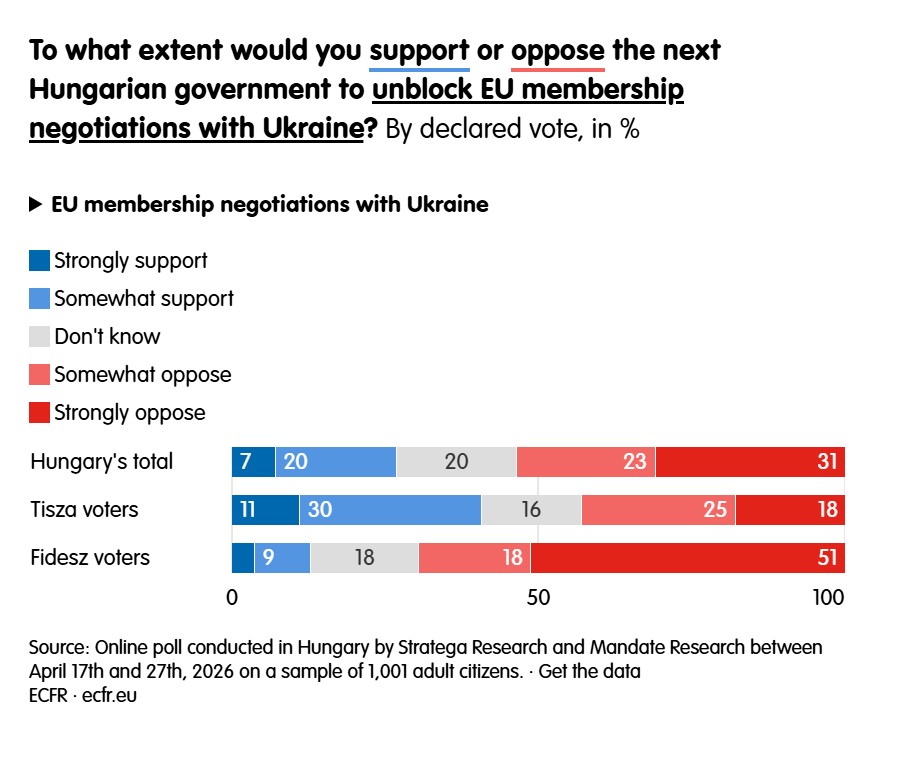
A majority of voters (54%) do not want the government to unblock EU accession negotiations with Ukraine, and even voters in Tisza are divided on this: 41% would be in favor of the unblocking, while 43% would oppose it.
Majorities – both nationally and among Tisza voters – do not agree with the new government supporting Ukraine financially, and an even larger number are against military support.
There are two policies related to Ukraine where Magyar could have dilemmas – because Tisza voters are at odds with the national majority.
Asked whether the government in Budapest should allow military aid to Ukraine to transit through Hungary, the country as a whole opposes it, but Tisza voters are largely in favor of it.
Similarly, more than half of Hungarians reject the idea of Ukraine eventually becoming a member of the EU, while Tisza voters are largely in favor of it.
Most Hungarians want Budapest to continue importing energy from Russia
Hungary's relations with Russia, on which Budapest remains heavily dependent for energy imports, also present dilemmas.
One of the big differences between Tisza and Fidesz voters is how they view “energy security”.
The former rarely rank “energy security” as one of the two most important issues facing Hungary, while it is consistently the “most important” issue for Fidesz voters.
But even if “energy security” is not at the top of Tisza voters' concerns, its importance seems to be emerging.
Before the election, two-thirds of Tisza supporters were in favor of ending the purchase of hydrocarbons from Russia, and only a quarter were against it. This clear political orientation no longer exists.
Now, just under 50% of Tisza voters support giving up Russian energy, while 38% oppose it.
Nationally, the majority of Hungarians (52%) oppose ending energy imports from Russia.
Continued energy imports from Russia – a policy Magyar has already suggested – could raise tensions with Brussels and other European capitals, ECFR notes.
European partners may conclude that the new government is not doing enough to end its dependency and that it is undermining the EU's hard-won unity on this issue.
Orban challenged in court the REPowerEU regulation banning Russian gas until September 2027. It is not clear whether Magyar will support this action or not.
A progressive agenda
The ECFR poll also shows the complexity of Tisza voters. Most embrace key elements of the progressive agenda (eg climate and LGBTQ+ rights).
However, this does not prevent them from also supporting traditional family policies.
An overwhelming majority of Tisza voters, as well as the Hungarian public, want the new government to have an ambitious climate policy.
Then, Tisza voters clearly want (71%) the new government to protect the rights of the LGBTQ+ community, a view that is also found among public opinion nationally (49%), even though Fidesz voters are largely opposed to this.
However, Tisza voters also support traditional family policies (such as incentives to marry and have children).
The ECFR survey was conducted online in Hungary, by Stratega Research and Mandate Research, between April 17-27, 2026, on a sample of 1,001 adult citizens.