The US Navy has flight tested the first drone that will operate from aboard aircraft carriers. The Stingray will have a precise purpose in hunting operations

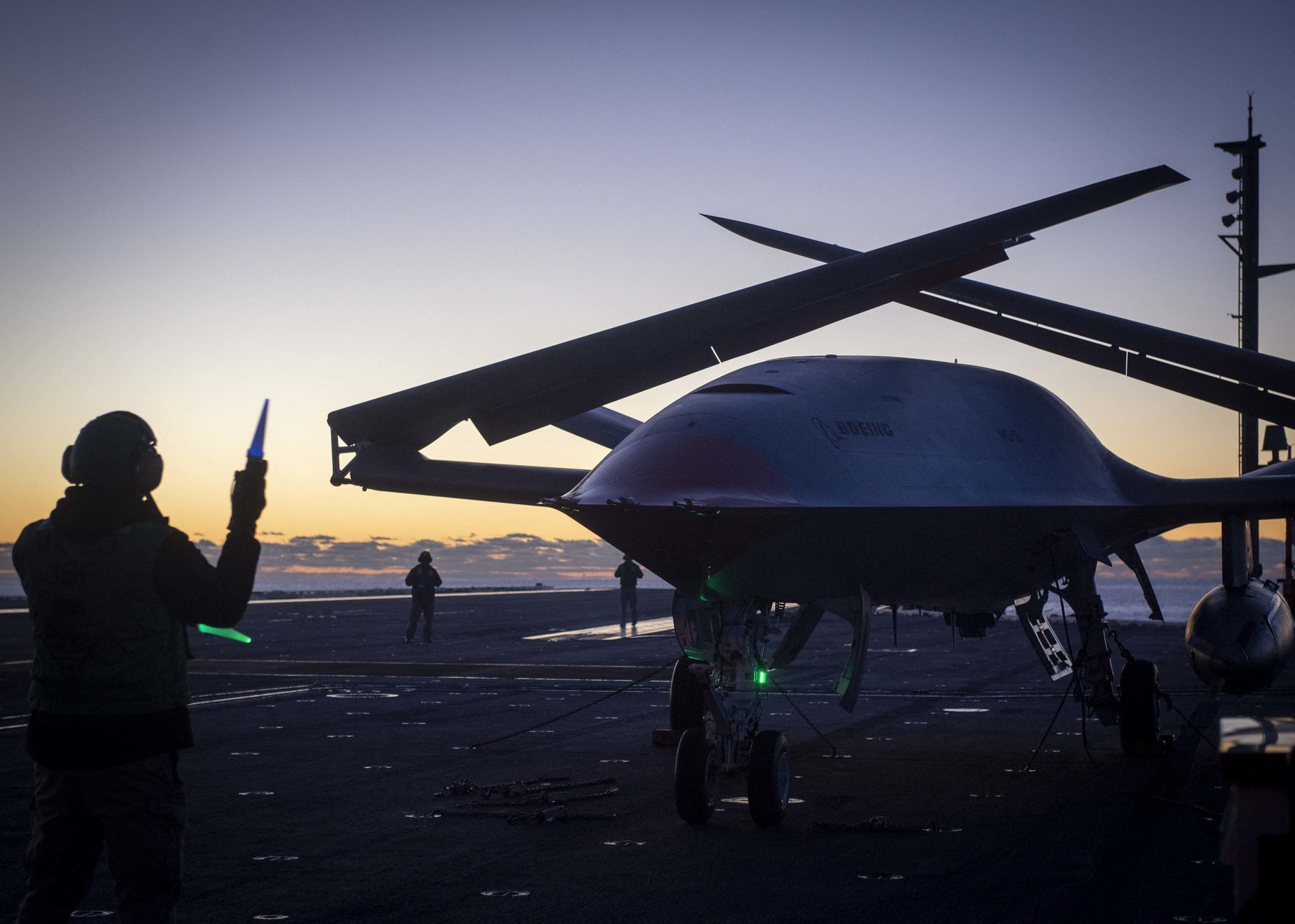
The United States Navy and the American company Boeing have completed a critical stage in the testing of the MQ-25A Stingray drone, which will be the first drone designed to operate exclusively from aboard aircraft carriers. The Stingray will have a specific purpose: it won't replace fighter jets, but it will help double the range of current fighter jets.
The MQ-25A Stingray drone recently underwent rigorous ground and flight testing, Naval Technology writes. Engineers focused on control systems integration and platform stability under operational conditions, maneuvers that are part of final preparation for deployment on aircraft carriers.
The MQ-25A Stingray drones are intended as aerial refueling drones, and with them the US Navy wants to extend the range of the F/A-18 Super Hornet and F-35C aircraft. Basically, the drone will take over the dangerous task of aerial refueling from the much more expensive and valuable aerial tankers.
A step for the future of American aircraft carriers
The test flight lasted two hours and took place at Boeing's base at MidAmerica Airport, located in Mascoutah, Illinois. In it, Boeing and Navy Air Vehicle Pilots (AVPs) commanded the aircraft remotely via the MD-5 Unmanned Aerial Mission Control System, which incorporates Lockheed Martin's MDCX technology.
During the test, AVP pilots performed a series of evaluations to confirm the aircraft's basic flight controls, engine performance and handling. They programmed flight paths and established waypoints before the autonomous system on board the aircraft took over propulsion, guidance and flight operations.
The MQ-25A is set to become the US Navy's first operational carrier-based unmanned aerial system (UAS) whose primary role is in-flight refueling.
Naval Command points out that the Stingray is not just a flying tank. This is the first unmanned aircraft to operate directly from the deck of an aircraft carrier alongside human crews.
Also, in other preliminary flight tests, versions of the MQ-25 Stingray drone were seen with AGM-158C LRASM anti-ship missiles mounted under the wing.
Performance and technical specifications – MQ-25 Stingray
The drone developed by Boeing relies on its transport capacity and high autonomy.
- Length: 15.5 m
- Spread wingspan: 22.9 m
- Height: 3 m
- Propulsion: A single Rolls-Royce AE 3007N turbofan engine providing over 44kN thrust
- Transfer capacity: It can deliver over 7,200 kg of fuel during a single mission.
- Range: It covers a distance of over 920 kilometers (500 nautical miles).
- Design: It has an optimized shape to reduce the radar footprint, although its primary role is not one of stealth attack.
- Aircraft carrier compatibility: It uses the standard Catapult Launch and Cable Recovery (CATOBAR) systems on aircraft carriers.
The strategic impact
The refueling capability extends the “long arm” of the US Navy, writes Naval Technology. Practically, in the context of tensions in the Pacific or even in the Indian Ocean and the Middle East, distances become a critical factor for security. MQ-25 drones can allow aircraft carriers to remain a safe distance from enemy shores, out of range of cruise missiles.
At the same time, such autonomous tankers can keep manned air tankers out of harm's way. Incidentally, during the current conflict in Iran, one of the US military aircraft that crashed during missions was a KC-135 air tanker: all six crew members died.
At the same time, the use of such drones alongside fighter jets in attack missions may practically allow the US Navy to more reliably strike targets much further away than at present. This asymmetry provides a huge tactical advantage over any adversary, and military experts believe the Stingray is just the beginning of a revolution.
In addition, beyond the possible armaments hung under the wings, in the future, the platform may receive new modules for electronic surveillance and reconnaissance.