Women are disappearing from technical universities. This is a problem for the labor market and the tech industry

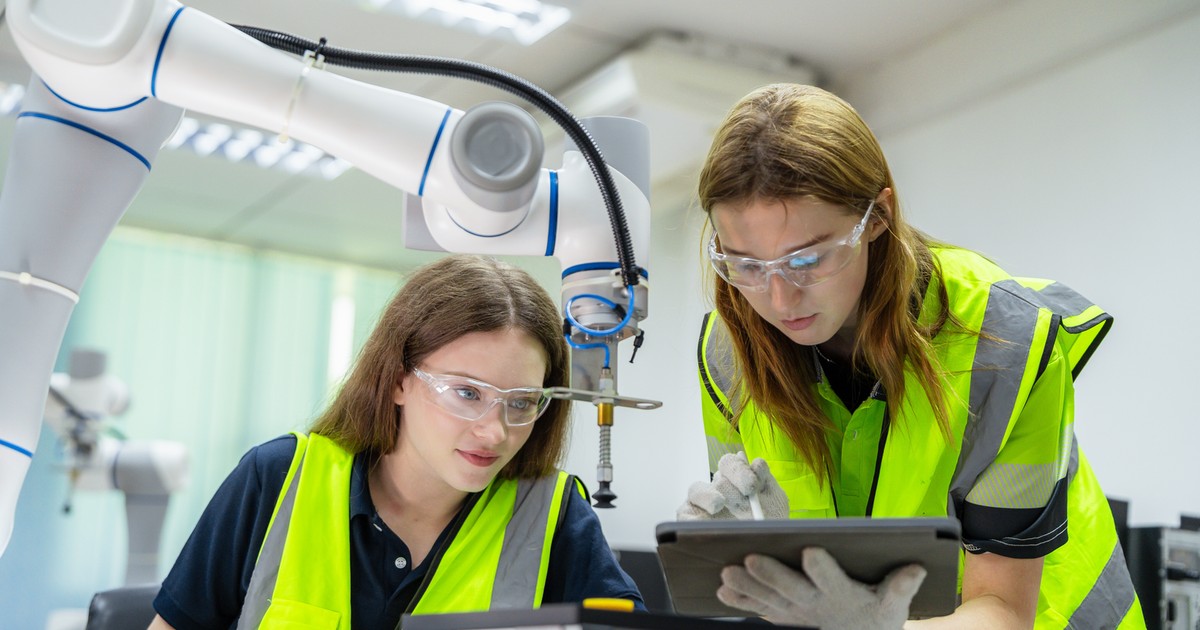
The report “Women at technical universities 2026”, prepared by the Perspektywy Educational Foundation and the Information Processing Center – National Research Institute, shows that since 2019 the number of female students at technical universities decreased by over 15%.. Although the decline concerns all students (approx. 12%), it is particularly important in the case of women – because they are the least represented in the fields of study today.
– We are one step further than when we started almost 20 years ago, but we still need to strengthen women in STEM – says Dr. Bianka Siwińska, president of the Perspektywy Educational Foundation, originator of the Girls at Politechnics! campaign! / Girls to Strict!
Men still dominate STEM
Although women often constitute the majority in social sciences and some sciences, engineering fields that are key to industry and technology remain highly masculinized.
The most difficult situation concerns the areas of new technologies – automation, robotics, data analysis and AI. Even though the number of women choosing these studies is growing, their percentage remains practically unchanged – because the number of men is growing even faster. In the academic year 2024/2025, women constituted on average 18.2 percent. students, and at technical universities only about 15-16 percent.
Read also: Experts warn: without these competences, AI will not change the Polish economy
Computer science attracts women, but there are still few of them
Computer science is relatively the best. Between 2019/2020 and 2024/2025, the number of women studying IT increased by over 40%, while the number of men – by 22.3%. Thus, the share of women increased by 1.9 percentage points. and amounted to 17.5 percent. However, this is still not much for one of the fastest growing segments of the labor market.
“Engineering, analytical and technological competences are becoming a pillar not only of innovation, but also of the safety of entire societies. In this context, the presence of women in the STEM field is not only a matter of equality – it is a strategic necessity and a condition for building resilient, diverse teams able to meet the challenges of the modern world,” the authors emphasize in the report.
Read also: IT in Poland is changing the rules of the game. This is the new salary leader
Directions with almost no women and an island of balance
The report shows large differences between majors. In some technical studies, women do not study at all, and in others they constitute only a few percent. Motor vehicles are an extreme example – 96.6 percent. students are men.
However, there are “islands of balance”. The most feminized technological field remains biomedical engineering, where women constitute approximately 60%. students. A relatively balanced gender share (40-60%) is also present, among others, on:
- business analytics,
- bioinformatics,
- nanotechnology,
- data analytics in business,
- social informatics and cognitive technologies.
An interesting regularity is also the higher share of women at technical universities with a vocational profile – 39.1%. compared to 32.3 percent at academic universities.
Inequalities in technical studies will affect the labor market
Experts emphasize that the gender imbalance established during studies is later transferred to the labor market – to technology companies, industry 4.0 and the modern business services sector. In a situation of chronic shortage of technical staff, any barrier discouraging women from such career paths means a competence deficit.
Read also: These skills decide about working in IT. “Expectations were not met”
Data also show that women choose full-time studies much more often. At public universities, the difference between full-time and part-time mode exceeds 8 percentage points. This may be important for reskilling programs and after-hours education offers.
The “Girls to Universities of Technology!” campaign has been operating on the market for 19 years and has significantly influenced the increase in women's participation in technical education. Its effects include: the establishment of the Association of Polish Rectors or the development of mentoring programs for women in STEM. Experts emphasize, however, that without systemic support – already at the primary and secondary school stage – the trend may continue to reverse.