Diesel and petrol pump prices in Central and Eastern Europe have risen by around 10-25% compared to the “quiet” periods of 2023-2024. In Romania, in one month the increase was almost 15% for a liter of diesel. And compared to April 2025, Romanians pay 23% more per liter of gasoline and 31% more for diesel.
The data shows a consistent pattern across Eastern Europe: diesel has become more expensive than gasoline.
Map of diesel and petrol prices in Central and Eastern Europe. Where is Romania located?
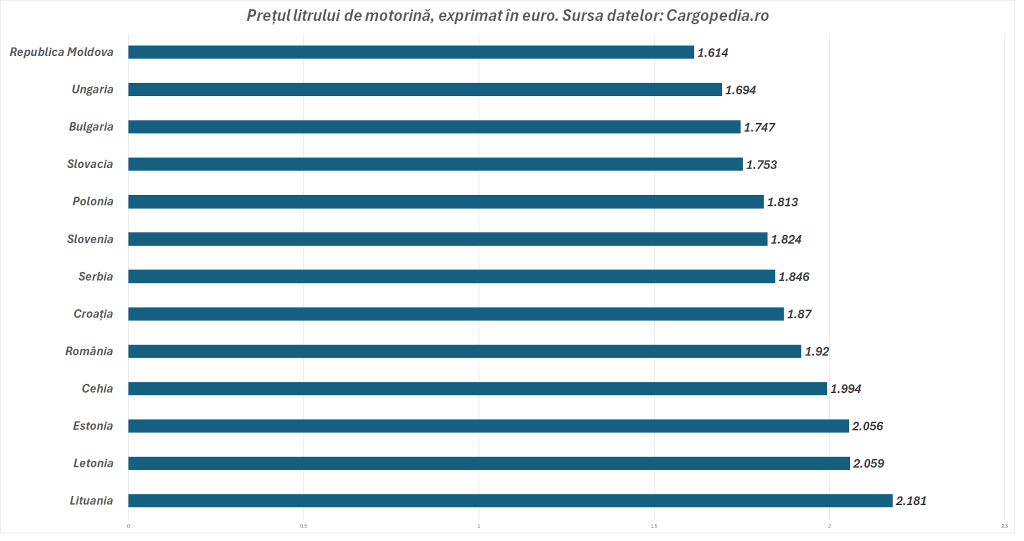
At the pumps in Bucharest, Cluj or Timișoara, the price of a liter of gasoline exceeded 1.75 euros. Diesel fuel – the fuel for trucks, buses and half of the European car fleet – has exceeded 1.92 euros/litre. These figures translate into higher bills at the supermarket or more expensive transport.
The trigger is known: the Israeli-American attack on Iran and the blockade of the Strait of Hormuz, through which about 20% of the world's crude oil and liquefied gas flows. In a perfectly interconnected global energy market, a closed tap in the Persian Gulf is felt within hours at European refineries and within days at pumps in Warsaw, Bucharest or Vilnius.
On Wednesday morning, the National Institute of Statistics published inflation data, showing that the “fuels” group rose in price by 6.4%. After a few hours, the INS came with clarifications. The details were much clearer than in the first communique. In March 2026, compared to February 2026, the price of gasoline increased by 11.11%. Diesel: +14.98%, in a single month. And for the “fuels” group as a whole – which also includes LPG, wood and coal -, the increase was 6.4% monthly.
Compared to April 2025, Romanians pay 23% more per liter of gasoline and 31% more for diesel. These are increases that can no longer be explained only by domestic fiscal policy or general inflation.
Incomes have not increased with inflation
In a discussion with HotNews, economist Laurian Lungu, co-founder of the think tank CPAG, explains: “If you look at the price of oil in real terms, that is, if you subtract inflation, oil is cheaper today than it was in 2012. In real terms, I repeat! That's what matters. And then, why is the world worried if the price in real terms is lower?”.
Basically, if in 2012 gasoline cost, let's say, 6 lei/liter, and since then the cumulative inflation was 50%, then the equivalent of that price in today's money would be 9 lei. If now gasoline costs 8.5 lei. Even though “nominally” it looks more expensive than in 2012, in real terms (purchasing power) it is actually cheaper.
Why did diesel become more expensive?
The explanation for the fact that diesel has become more expensive than gasoline throughout Eastern Europe lies in the structure of European imports. Europe depends on diesel imports from the Middle East and is directly exposed to bottlenecks in the Strait of Hormuz. Gasoline is easier to produce from alternative sources, and diesel, more difficult.
The practical consequence is that diesel inflation spreads further and deeper into the economy than gasoline inflation. Trucks run on diesel. The tractors run on diesel. Backup generators run on diesel. When diesel becomes more expensive by 31-47%, all logistics, all agriculture, all trade pay more.
Bruegel and Euronews analysis shows that the Iran/Middle East war has added a “war premium” of about $10 per barrel to crude oil, which translates to about €0.10–0.30/litre more for petrol and diesel at the consumer level than usual levels in 2023–2024.
For Eastern Europe, current pump prices (around €1.55–1.80/l for petrol and €1.70–2.00/l for diesel in many countries) are around 10–25% higher than the “normal” thresholds (€1.40–1.60/l for petrol and €1.50–1.70/l for diesel) in periods without major shocks.
In many countries, including Central-Eastern Europe, diesel has crossed the threshold of 1.90–2.00 euros/liter, while standard gasoline (95) is usually in the range of 1.55–1.80 euros/liter, which reflects a diesel premium at the pump.