Quantum computers are approaching the breakthrough and their “moment of chatgpt”. What does this mean for business and investors

Google chip from Google reduced the number of physical cubits needed for one logical cubic, which, in combination with experimental error correction, allowed to solve the task impossible in a classic supercompter in five minutes. For clarification: Kubit is a bit like a coin that rotates in the air – before it falls, he is both an eagle and a rest, thanks to which The quantum computer can take into account both results at once.
Microsoft went even further, demonstrating Majorana 1 – the first processor from the so -called A topological core in which the cubs are protected at the level of matter. The concern claims that You can pack a million such cubits on a payment card size.
In parallel, AWS and Caltech showed the Ocelot-a prototype based on a slightly different class of Kubit, which reduces the cost of error correction by up to 90 %, and Fujitsu with the Riken Institute launched a 256-cubite superconducting computer, confirming that Japan wants to become a hub for cloud services of this kind.
All this means one thing: quantum computers quickly become much more powerful and more practical, which can revolutionize technology in the coming years.
Check also: Everyone wants a practical quantum computer to be created. But why?
From “quantum advantage” to “economic advantage”
Media messages tempt with the promise of quantum advantage – solving problems completely beyond the reach of classic machines. MIT researchers, however, offer a more mundane criterion: Quantum Economic Advantage, i.e. the moment when the time multiplied by the cost of using a quantum computer becomes lower than the classic with the same quality of the result. They claim that companies should translate the process of processes into the simulation categories – providing – and estimate the potential of “MIT grille”.
Special offer
The aforementioned grille is a two -dimensional mesh proposed by researchers from the myth – on its horizontal axis the size or complexity of the problem, on the vertical axis, accumulates the percentage algorithmic advantage offered by the quantum algorithm over the best classic. A simple diagonal sets a point where a cost -comparable quantum and classic computer finish the calculations at the same timeand the fields above the line show areas where today (or with a slight decrease in equipment prices) it pays to use quantums, while below – where a traditional computer remains faster or cheaper.
If we notice that there is an economic advantage in the context of the use of quantum computersit is worth making appropriate changes in the strategy now.
Going further, McKinsey estimates that by 2030 there will be 2-5 thousand in the world. operating quantum systems, but the hardware and software that supports the most complex tasks will appear rather after 2035. At the same time, market forecasts are growing faster than a year ago. Fortune Business Insights raised the value of the quantum computers market from $ 928 million. in 2023 to over $ 12.6 billion in 2032, which is given by CAGR (Compound Annual Growth Rate – cumulative annual growth rate) of 34.8 percent. This suggests that the “quantum” segment awaits rapid and lasting growth.
Read also: Ovhcloud wants to shape the future of technology and digital sovereignty [WYWIAD]
Mature use scenarios
Where specific quantum computers work best? There are at least a few applications. Here are the most important ones:
Chemical and material simulation. Pfizer already uses quantum techniques for modeling crystalline structures, which reduces the time of analysis from months to weeks and increases the accuracy of the selection of drug candidates. Daimler, BASF and Honda run similar programs, counting on faster battery and catalyst design.
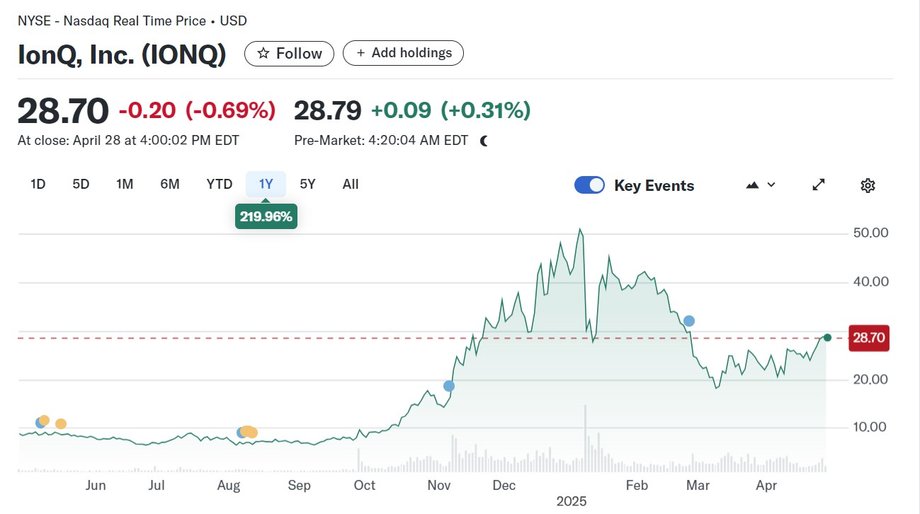
Ionq. During the year, the company's shares ensured a profit of 219 percent.
|
Yahoo finance
Optimization in logistics. Volkswagen already in 2019 confirmed that the quantum annealing D-Wave allows you to optimize dynamic bus schedules in a few seconds, and the algorithm is scaled to any city. DHL and Nippon Steel are working on similar implementations.
Finance and risk. JPMorgan Chase publishes open studies showing how line algorithms on Quantinum or IONQ equipment shorten the calculation of the portfolio for a row in size while maintaining the quality of the result. At the same time, the bank develops Certified Randomness techniques (so -called certified randomness) to the emission of cryptographic keys, ensuring an adequate level of data security.
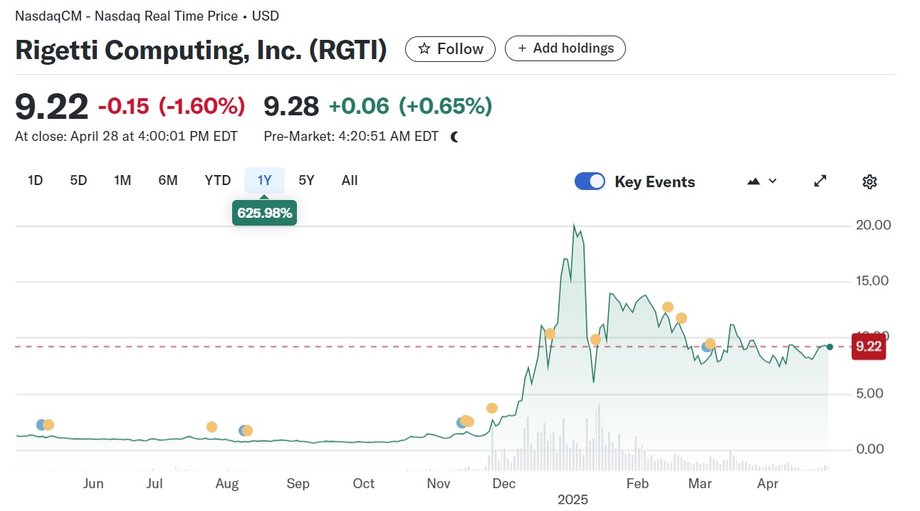
Rigetti computing per year provided a profit of shares of as much as 625 percent.
|
Yahoo finance
AI + quantum computers. Ionq demonstrates hybrid neural networks in which some of the scales are trained quantum – the company also built a system for the USAF research laboratory, operating at room temperature.
Impressive Big Techu marketing also arouses great skepticism. Physicists remind you that the road to the scalable, “quiet” cubic is still measured in the years, and the bubble analogous to the dot-com can be inflated on the market. Therefore, it is worth separating laboratory messages from those that really go to customers, e.g. in a cloud model.
See also: Quantum computers like cryptocurrencies. Profits on shares of 200 percent
Investment chance – but with a risk filter
On January 15, 2025, Microsoft announced 2025 “The year of being Quantum-Ready”, inviting corporations to partnerships and training. Domino: Rigetti Computing (symbol: RGTI) and D-Wave Quantum (QBTS) increased by approx. 20 percent, IONQ (IONQ) by 35 percent, and quantum computing inc. by as much as 40 percent in no time.
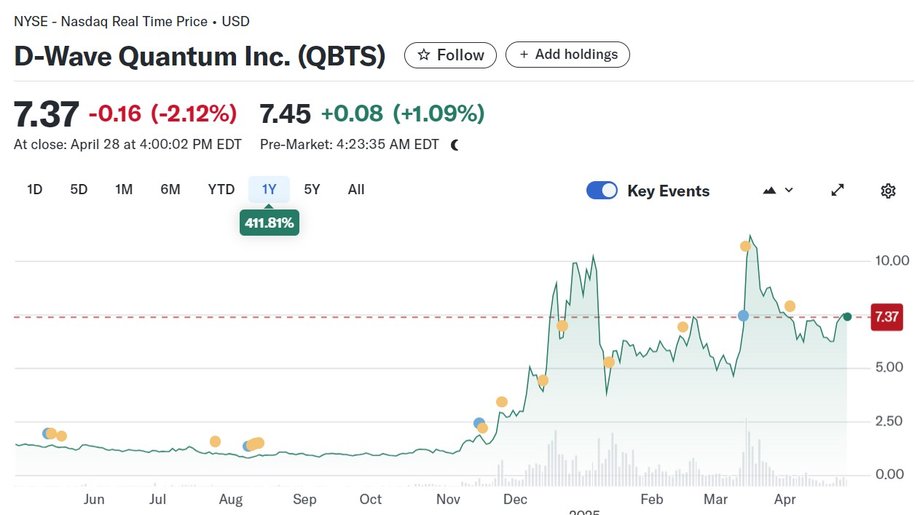
D-Wave Quantum is another company whose course has launched. The last 12 months is a profit of 411 percent
|
Yahoo finance
This is a replay from the breakthrough of chatgpt, but The scale of investments in liquid helium or vacuum lasers raises the entry threshold and risk.
How to get involved? Investors interested in quantum companies can decide on shares of companies such as: IONQ (ion traps), D-Wave (quantum annealing) and Rigetti (superconductors). They offer the highest exposure to individual technologiesbut also the greatest variability. It is enough to assess how quickly the courses of these companies are growing and falling, and you can easily compare them to some cryptocurrencies. In other words: it is early and the risk is high.
Investors interested in less risk may consider the actions of technological giants. Alphabet, Microsoft, IBM, Amazon and Fujitsu finance the development of quantums from income cloud lines – In their case, however, participation in quantum computers is only one of the bikes of growth.
In addition, we have at our disposal a company with a broadly understood supply chain. Oxford Instruments (Cooling), NVIDIA (GPU-QC controllers), Globalfoundries (photonic production)-this is less spectacular, but A more stable plant for investors for “shovels and jeans” of the upcoming era of golden quantum fever.
With investment decisions, it is also worth remembering that McKinsey predicts a chronic talent deficit – In 2025, more than half of the quantum jobs remains unhappy. From the perspective of companies, this means the rising costs of R&D and the pressure for acquisitions-today Honeywell (owner of 54 percent Quantinum) and IBM invest in start-up ecosystem to secure the staff. Therefore, the quantum sector is better to treat with a limit. The exposure to shares of such companies should be treated as a start-up segment in the Series phase: great potential, high projects mortality and extreme variability of share prices.
Quantum computers are inevitable
The quantum moment resembles the first months of generative AI, when a narrow group of companies showed that conceptual evidence turns into a market, and each hardware advertisement causes an unexpected investors' reaction.
If the pace of progress persists, in the middle of a decade – at the turn of 2025 and 2026 – business will get the first services that They will realistically shorten the time of calculations in chemistry, finance and logistics. Then what is a niche speculative investment today may turn out to be participation in the next large technological jump. But exactly as in the case of ChatgPT – those who understood the new technology before it became fashionable.
Author: Grzegorz Kubera, Business Insider Polska journalist